Issue #32
Weekly Banking Intelligence: September 04 to September 10, 2026
THIS WEEK’S SIGNAL
Twenty-one global banks, including Citi, Goldman Sachs, and UBS, announced plans to form a stablecoin consortium and launch a USD token in the first half of 2027. That happened the same week Moody’s put out a formal warning about AI technology dependency at banks, and KeyBank reported measurable, operational AI results in consumer banking. Read those three things together and a clear pattern emerges: the infrastructure layer of banking is being rebuilt in real time, on multiple fronts simultaneously, and the institutions that are managing it well are the ones that treated modernization as a connected program, not a set of parallel projects. If you are still running AI, payments, and core transformation as separate workstreams with separate sponsors, this week is a good week to revisit that structure.
DEEP DIVE
From “AI That Knows” to “AI That Acts”: What Axis Bank and J.P. Morgan Are Telling Us
At the Global Fintech Forum 2026, Axis Bank and J.P. Morgan both described a shift in how they are thinking about AI in banking. The framing that caught my attention came from both institutions independently: the move from AI that knows customers to AI that acts on their behalf. Axis Bank is deploying AI for personalized banking and customer engagement. J.P. Morgan is using it for trade analysis, customer service, and fraud detection. Neither of these is experimental anymore. These are production systems making operational decisions at scale.
Why it matters: When AI moves from insight to action, the governance stakes change entirely. An AI that surfaces a recommendation is one thing. An AI that executes a transaction, routes a payment, or denies a fraud claim without a human in the loop is something different. The question is not whether your institution is ready to deploy agentic AI. The question is whether your risk framework, your audit trail, and your operating model are built for a world where the AI is the actor, not the advisor. Most banks are not there yet, and the gap between deployment speed and governance readiness is where the real risk lives.
Why it matters for your operating model: This shift also has direct consequences for how banks staff and structure their operations. If the AI is executing the decision, who owns the outcome? Who reviews the exception? Who trains the model when it gets it wrong? These are not technology questions. They are organizational design questions, and they need answers before the system goes live, not after the first incident. The banks I find most credible on this topic are the ones that have already assigned clear ownership, not just to the model, but to the process the model sits inside.
KeyBank’s results this week added some useful texture here. As reported this week by CIJ.World, KeyBank has begun reporting measurable value from AI in consumer banking, specifically in operational efficiency, customer intelligence, and faster decision-making. That is not a press release claim. That is a bank saying the math is working. The interesting thing about KeyBank is that it is not one of the largest institutions in the country, which suggests that AI-driven operational improvement is not exclusively a Tier 1 story anymore. Mid-size banks with the right architecture and operating model discipline are starting to close the gap.
What I would be asking if I were in the room: Do we know exactly where our AI systems are making decisions without human review? Do we have a clear owner for each of those decisions? And if one of those systems produces a bad outcome tomorrow, can we reconstruct what happened, explain it to a regulator, and fix it before it happens again? If the answer to any of those is uncertain, that is where the work is.
MARKET MOVES
TabaPay Raises $155 Million and Moves Toward Banking
TabaPay, a U.S.-based payments infrastructure company that processes card funding and disbursements for fintechs and neobanks, secured $155 million in strategic growth financing from FTV Capital this week, with plans to acquire Transact Bank and move into banking directly. This is a payments infrastructure company deciding that the fastest path to a full product offering runs through a bank charter, not around one.
Why it matters: We have watched fintechs build around banks for years. The ones with enough scale and the right investor backing are now deciding it is more efficient to become a bank. TabaPay’s move is worth watching because it is not a consumer-facing neobank chasing deposits. It is an infrastructure company that already has the client relationships and the transaction volume. The charter is the missing piece. If the acquisition closes, it will be one of the cleaner examples of a fintech-to-bank conversion we have seen, and it will raise questions for community and mid-size banks about which parts of their payments infrastructure are now competing with their fintech partners.
Mastercard Acquires BVNK
As reported this week by Fintech News Switzerland, Mastercard completed its acquisition of BVNK, a UK-based company providing infrastructure that supports both fiat and on-chain payments, in August 2026. The deal positions Mastercard to help financial institutions, fintechs, and enterprises move between traditional and blockchain-based payment rails from a single platform.
Why it matters: Mastercard is not making a bet on crypto. It is making a bet on the infrastructure layer that sits between fiat and on-chain, which is where the real complexity lives for banks trying to serve clients who want both. For banks evaluating their payments strategy, this acquisition narrows the number of neutral infrastructure providers in that space. It also signals that the major networks are not waiting for regulatory clarity on stablecoins before positioning themselves to own the rails.
VENDOR SIGNALS
Chainlink and Bottomline Partner on Cross-Chain Payments for 600-Plus Banks
Chainlink, a decentralized oracle network that connects blockchain systems to real-world data and external networks, announced a partnership with Bottomline Technologies, a payments and financial technology company serving financial institutions globally, to enable cross-chain payment capabilities for more than 600 banks in Bottomline’s network. The integration is designed to allow banks to move value across different blockchain networks without building the connectivity themselves.
This matters because most banks in Bottomline’s network are not in a position to evaluate and build cross-chain infrastructure independently. Partnerships like this one effectively make a technology decision on behalf of those institutions by embedding it in the platform they already use. If you are one of those 600-plus banks, it is worth understanding exactly what you are inheriting and what governance and risk
obligations come with it, because the underlying technology is not trivial and the regulatory treatment of cross-chain transactions is still evolving.
FIS Launches Embedded Banking Platform for U.S. Banks
FIS, one of the largest financial technology companies in the world, launched an embedded banking platform this week that allows U.S. banks to offer accounts, cards, and payments through third-party business software. The product is designed to let banks distribute their products through the software environments their commercial clients already use, rather than requiring those clients to come to the bank’s own interface.
For community and regional banks, this is a meaningful distribution question. Embedded banking has largely been a fintech story, with neobanks and BaaS providers capturing the software-native customer. FIS bringing this capability to its bank client base changes the competitive dynamic somewhat. The more important question is whether the banks that adopt it have the operational model to support it: the servicing, the compliance monitoring, the exception handling. Embedding the product is the easy part. Running it well is where most of the work lives.
Deutsche Bank Selects Thought Machine for German Private Bank Operations
Deutsche Bank’s Private Bank has selected Vault Core, the cloud-native core banking platform built by Thought Machine, for its operations in Germany. Thought Machine, a London-based core banking technology company, has built its platform on a smart contract model designed to give banks full configurability of their product logic without custom code.
Deutsche Bank is not a small institution making a cautious technology bet. This is one of Europe’s largest banks making a deliberate architectural choice for a specific business unit, and the choice of Thought Machine signals a preference for configurability and cloud-native design over the stability of an incumbent provider. For banks watching the European core modernization market, this is a data point worth tracking. The question it raises internally: if Deutsche Bank’s Private Bank is rebuilding on a cloud-native core, what is the right architectural standard for your institution’s next product or market expansion?
Kyndryl and Krungsri Renew Five-Year Core Banking Partnership
Kyndryl, the IT infrastructure services company spun out of IBM in 2021, and Krungsri, one of Thailand’s five largest banks, renewed a five-year partnership this week to advance Krungsri’s core banking transformation using automation, AI, and managed services. The agreement extends a relationship that has been in place through Krungsri’s ongoing modernization program.
Long-term managed services agreements in core banking are worth noting because they represent a specific operating model choice: the bank is deciding that ongoing transformation capability is better sourced externally than built internally, at least for the infrastructure layer. That is not a wrong answer, but it creates a dependency that needs active management. The governance structure around a five-year managed services agreement, specifically who owns the roadmap, who controls the pace of change, and what happens when the bank’s needs diverge from the vendor’s priorities, is as important as the technology itself.
Sagehaven Bank Selects Nymbus for De Novo Digital Banking
Sagehaven Bancorp, a bank currently in formation, selected Nymbus, a modern core banking platform serving U.S. banks and credit unions, as the technology foundation for its proposed digital-centric operation. The selection is notable because it reflects the continued preference among de novo institutions for cloud-native platforms over traditional core providers.
De novo bank selections carry a specific kind of signal: these institutions have no legacy to protect and no migration risk, so their technology choices reflect a clean view of what a modern banking stack looks like.
Nymbus continues to build its reference base in this segment, which strengthens its position in conversations with established institutions considering a parallel or replacement core strategy.
REGULATORY PULSE
Moody’s Warns Banks on AI Technology Dependency
As reported this week by QA Financial, Moody’s issued a formal warning to banks about the risks of AI technology dependency, specifically the exposure that comes from relying on external vendors for AI models, infrastructure, and software updates while remaining legally responsible for the reliability of AI-enabled services. The warning is consistent with the direction supervisory guidance has been moving in the U.S. and Europe, but Moody’s putting it in writing carries its own weight.
The Moody’s warning is not a compliance notice, but it is a signal of where credit and risk assessments are heading. If Moody’s is flagging AI vendor dependency as a risk factor, it is reasonable to expect that examiners and rating analysts will begin asking more pointed questions about vendor concentration, model governance, and contingency planning. Banks that have not mapped their AI vendor dependencies with the same rigor they apply to their core banking and payments vendors are likely to find that gap uncomfortable in the next examination cycle.
AI Regulatory Pressure Builds on Both Sides of the Atlantic
Better Markets, a Washington-based financial reform advocacy organization, published a detailed analysis this week arguing that disclosure-based AI regulation in financial markets is insufficient and that affirmative regulatory standards, enhanced enforcement, and significantly more regulatory resources are needed to keep pace with private sector AI development. Separately, as reported this week by Finance Derivative, the EU AI Act’s compliance deadline for high-risk AI applications has been pushed back, but the practical window for preparation is shorter than it appears given the complexity of what compliance actually requires.
U.S. regulators are already incorporating AI into supervisory examinations, which means this is not a future concern for most banks. It is a present one. The combination of a U.S. examination environment that is already asking AI questions and a European regulatory framework that is moving toward hard compliance requirements creates a dual-track obligation for any bank with cross-border operations. The institutions that built their AI governance frameworks as standalone compliance exercises are likely to find them insufficient. The ones that embedded governance into how the AI is actually built and operated are in a better position.
TALENT SIGNALS
AI Execution Roles Move to the Front of the Hiring Queue
KeyBank is actively hiring for AI product and engineering roles tied directly to its consumer banking AI deployment, consistent with the operational results it reported this week. J.P. Morgan continues to expand its AI engineering and MLOps headcount across its consumer, commercial, and markets businesses. Both hiring patterns reflect the same dynamic: banks that have moved AI into production need people who can run, monitor, and improve live systems, not just build pilots.
The shift from AI experimentation to AI operations has a specific talent consequence. The skills that matter most right now are not research-oriented. They are operational: model monitoring, production reliability, workflow integration, and the ability to connect AI systems to the people and processes that own the decisions those systems support. Banks that are still hiring primarily for AI strategy and exploration roles are likely a cycle behind.
BMO Harris Bank is hiring for a cluster of roles in AI governance, risk, and model validation, which is a different signal from the engineering-heavy patterns at JPMorgan and KeyBank. The governance hiring suggests BMO Harris is responding to regulatory pressure and internal risk management requirements rather than net-new capability deployment. That is not a criticism; it is a sequencing choice. But it does suggest the institution is still working through the governance layer while others are already in production.
Across the broader market, traditional middle-office processing roles and routine analyst functions continue to contract at institutions that have deployed AI in those workflows. The headcount reduction is not dramatic in any single quarter, but the trend is consistent and directional. Banks adding AI capacity in operations are not backfilling the roles that AI is replacing.
CB RADAR UPDATE
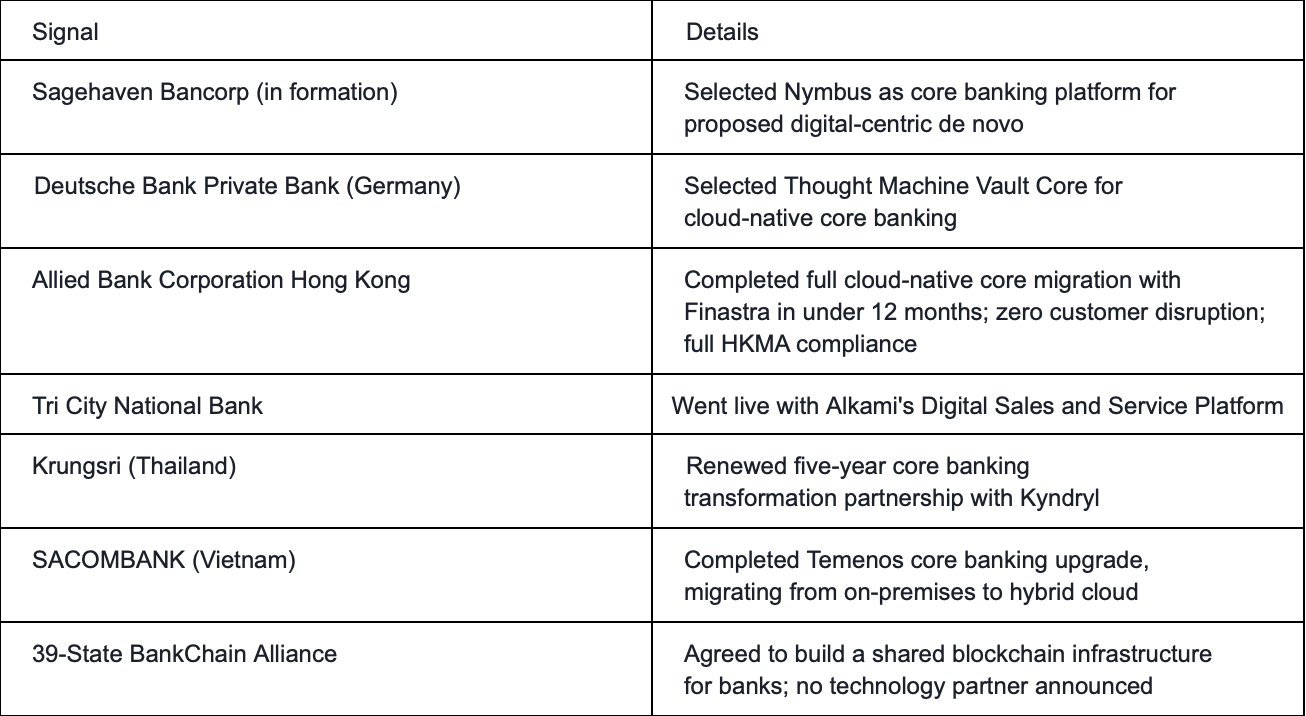
States in BankChain Alliance. Source (verbatim from this brief): 39-State BankChain Alliance | Agreed to build a shared blockchain infrastructure for banks; no technology partner announced
The pattern in our proprietary CB Radar database this week is geographic breadth. Core selections and go-lives are not concentrated in the U.S. or Western Europe. Thailand, Vietnam, and Hong Kong all appear this week with material modernization activity. The 39-state BankChain Alliance is the most structurally interesting entry: a multi-state public infrastructure commitment with no named technology partner yet. That partner selection, when it comes, will be one of the more consequential vendor decisions in the community banking space in recent memory.
RICK’S STRATEGIC TAKE
➜ The 21-bank stablecoin consortium is the story I would bring to a board meeting this month. Not because it changes anything immediately, but because it tells you where the largest institutions in the world think settlement infrastructure is going. When Citi, Goldman, and UBS are building toward a shared USD token with a 2027 launch target, the question for every other bank is not whether to watch. It is what your payments and treasury architecture needs to look like when that infrastructure exists. The banks that will be ready are the ones having that conversation now, not in 2026.
➜ Moody’s warning on AI vendor dependency deserves more attention than it is getting. Banks have spent years managing third-party risk frameworks for their core systems and payment processors. Most of those frameworks were not built with AI vendor relationships in mind, specifically the model update cycles, the infrastructure dependencies, and the question of who is actually responsible when an AI-enabled service fails. If your third-party risk program has not been updated to address AI vendors explicitly, that is a gap worth closing before your next examination.
➜ What I keep coming back to this week is the operating model question underneath all of these technology announcements. Deutsche Bank choosing Thought Machine, Krungsri renewing with Kyndryl, Sagehaven selecting Nymbus: these are all technology decisions, but the harder work in every one of them is the operating model redesign that has to happen alongside the platform change. The technology is often the easier part to get right. The governance, the staffing model, the process redesign, the change management: that is where most transformations actually succeed or fall short. I have seen institutions make the right technology choice and still struggle because they underestimated what had to change around it.
For a deeper framework on what AI-ready core architecture actually requires, see CSP’s CB Architecture Series at coresystempartners.com.
Want the Full Picture?
Subscribe to BIS, the Banking Intelligence Service from Core System Partners, for the full breakdown including Rick’s Strategic Take on the governance gap, the CB Radar vendor tracking signals, and the regulatory pulse analysis covering what SR 11-7 does and does not cover for agentic deployments, delivered weekly. Banking Intelligence Service
For CSP’s full analysis of what the Fed and Treasury are actually concerned about—and a framework for what AI-ready architecture requires—visit Core System Partners.
Continue With Core System Partners
- Contact Us: https://coresystempartners.com/#contact
- The Strategic Flywheel (book): https://coresystempartners.com/resources/strategicflywheel/
- Core Insider (weekly newsletter): https://coresystempartners.com/resources/newsletter/