Issue #33
Weekly Banking Intelligence: September 11 to September 17, 2026
THIS WEEK’S SIGNAL
Core consolidation is no longer a strategy deck conversation. It is a live operational program at some of the largest banks in the world, and this week the evidence got harder to ignore. As we reported in Issue #31, Deutsche Bank has been executing a significant architectural overhaul. This week, Deutsche Bank confirmed it is collapsing 15 core systems down to two, selecting Thought Machine’s cloud-native Vault Core platform as the engine for its Personal Banking and Wealth Management products in Germany. At the same time, FIS acquired an AI-native core modernization startup, and a repackaged community bank core entered the market under a new name. Three separate signals, same underlying pressure: the core banking market is consolidating, and the institutions and vendors still deferring that conversation are running out of runway.
DEEP DIVE
Deutsche Bank’s 15-to-two consolidation: what the execution actually requires
As we reported in Issue #31, Deutsche Bank has been working through a significant architectural overhaul tied to its broader AI and modernization agenda. This week, the details got more specific. Deutsche Bank is reducing 15 legacy core systems to two, with Thought Machine’s Vault Core selected as the platform for Personal Banking and Wealth Management in Germany. That is not a pilot. That is a committed architectural decision with real governance, real migration risk, and real dependency on delivery execution over multiple years.
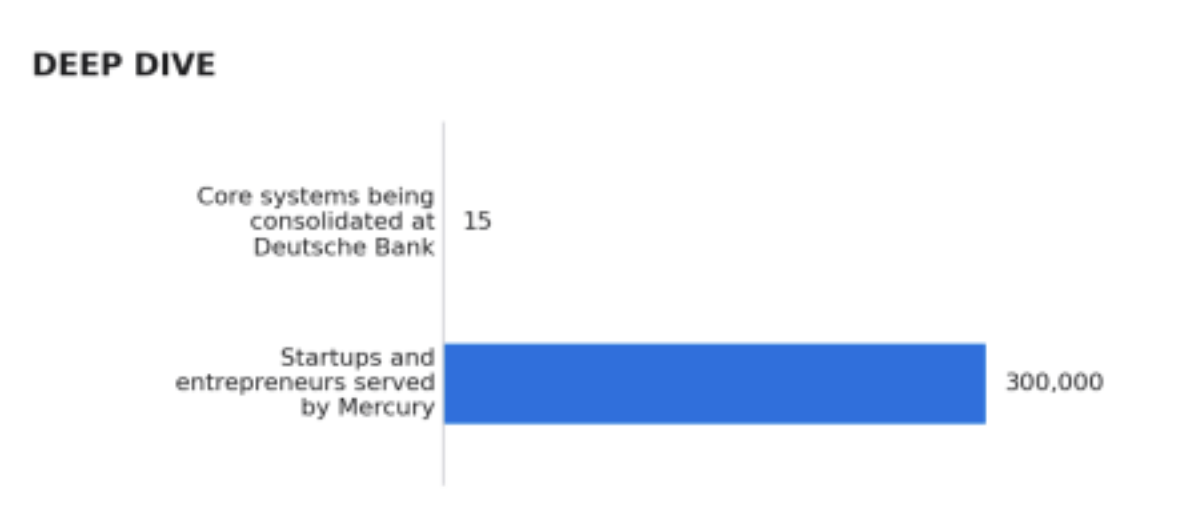
Legacy core systems being consolidated. Source (verbatim from this brief): Deutsche Bank is reducing 15 legacy core systems to two, with Thought Machine’s Vault Core selected as the platform for Personal Banking and Wealth Management in Germany.
What caught my attention is the framing coming out of this week’s discussions at the TCF 2026 conference, as reported by The Asian Banker. The strongest thread across institutions is that core modernization is no longer only about replacing the core itself. It is about the operating architecture around the core: data, cloud,
integration, cybersecurity, process design, workforce capability, and governance. You have to keep live banking operations running while the transformation is in progress. That is the part that rarely makes the press release.
Why it matters: For any bank watching Deutsche Bank’s move, the question is not whether to consolidate. It is whether your organization has the governance structure, delivery capability, and change management discipline to execute at that scale without disrupting the customer. Deutsche Bank is a Tier 1 institution with
deep resources. Most banks attempting something similar will face the same structural challenges with considerably less margin for error.
Why it matters for operating model and architecture: The TCF 2026 discussions reinforced something I have seen repeatedly in practice. The longer-term challenge for large banks may no longer be the decision to replace the core. It is sustaining the governance and delivery capability required to see it through. Vendor selection is the easy part. The hard part is the three to five years of disciplined execution that follows.
On the community bank side, CORA Group, which acquired the Phoenix core system from Finastra, officially launched PhoenixWorx this week, repackaging the platform for U.S. community financial institutions. The launch bundles Phoenix with MalauzAI digital banking, AnalyzerIQ analytics, and ECM content management under one offering. It is an interesting bet: rather than building from scratch, CORA Group is assembling a suite around an established core with an existing installed base.
Why it matters: Community banks evaluating core options now have another entrant making a credibility argument based on continuity rather than disruption. I want to be balanced here. Choosing the right core and vendor partner matters enormously over the long term. In the short term, a bank can absorb a difficult conversion if the operating model and change management are strong. But over five to ten years, the platform decision shapes what is possible. Community banks should evaluate PhoenixWorx not just on what it offers today, but on CORA Group’s roadmap, financial stability, and support model. Those are the questions worth pressing.
MARKET MOVES
Capital One and Brex: a signal worth watching
In January, Capital One agreed to acquire Brex, a financial technology company that combines corporate credit cards with expense management software, payments, and AI-powered financial tools, for approximately $5.15 billion. As reported this week by The Motley Fool and Yahoo Finance, the argument being made in the market is that this acquisition may look less like an outlier and more like the beginning of a broader consolidation pattern, where large banks acquire fintech capability rather than waiting to build it.
Why it matters: The logic is straightforward. Organic development of fintech-grade AI, payments, and expense management capability takes years. Acquisition compresses that timeline, but it also imports integration risk, cultural complexity, and the challenge of running a fintech operating model inside a regulated bank. The question I would be asking is not whether the deal makes strategic sense on paper. It is whether the acquiring institution has the operating model and integration discipline to absorb it without losing what made the fintech valuable in the first place.
VENDOR SIGNALS
FIS acquires OpenCoreOS
FIS, one of the largest financial technology providers in the world, acquired OpenCoreOS this week, an AI-native core modernization platform that was introduced in October 2025 and described by its founders as the next chapter in their work on banking technology. According to FIS, general availability was planned for the first quarter of 2026, as reported by The Fintech Times. That timeline, as FIS has characterized it, has not been independently confirmed.
This acquisition tells you something about where FIS sees the competitive pressure coming from. AI-native core architecture is no longer a theoretical threat to incumbent platform providers. It is close enough to production that FIS chose to acquire rather than build. For bank buyers, the relevant question is how OpenCoreOS capabilities get integrated into the broader FIS product roadmap and on what timeline.
Fiserv’s Project Elevate and agentOS
Fiserv, another major core and payments technology provider, is publicly discussing Project Elevate as its turnaround vehicle, alongside Clover growth and an AI offering called agentOS. As described by Fiserv’s leadership, agentOS is designed to help banks automate processes while retaining human oversight, and is positioned as both an AI solution and an orchestration layer linking bank functions to core systems. Monetization is expected through platform economics and value-based pricing for automation.
The framing around human oversight is worth noting. It is not accidental. Regulators and bank risk teams are paying close attention to where accountability sits when an AI agent takes an action. Fiserv is signaling that it understands that concern, but the real test is whether agentOS delivers measurable automation outcomes at the operating model level, not just at the demo level.
Temenos on AI and core economics
Temenos, a global core banking software company, surfaced this week in discussions at The Asian Banker’s TCF 2026 conference with a specific claim: that AI agents can meaningfully reduce the cost and complexity of core installation, upgrades, and integration management. The company has identified those three areas as priorities in its 2026 AI product strategy.
If that holds up in production, it changes the economics of core modernization in a meaningful way. Installation and upgrade costs are a significant friction point for banks evaluating platform changes. The question is whether Temenos can demonstrate this at scale with real clients, not just in controlled environments.
AI voice agents and core compatibility
A market assessment published this week examined AI voice agent solutions for banks and credit unions, covering vendors including Nuance, Talkdesk, and Eltropy. The analysis noted that banking-specific solutions integrating with FIS, Fiserv, and Jack Henry cores are achieving containment rates of 70 percent or higher on routine service calls, including balance inquiries, payment confirmations, and account status.
Seventy percent containment on routine call types is a real operational number, not a pilot metric. For banks still running high-volume contact center operations, that figure deserves a direct conversation with whoever owns your contact center cost line.
REGULATORY PULSE
State examiners get an AI inspection playbook
The Conference of State Bank Supervisors (CSBS) released a supervisory framework this week giving state bank examiners structured guidance for inspecting AI deployments at financial institutions. As reported by American Banker, the framework is notable because it explicitly covers generative and agentic AI, the same
technologies that the Federal Reserve, OCC, and FDIC placed outside the scope of their revised model risk guidance in April. State examiners now have a playbook that reaches further than the federal framework.
For banks operating under state charters, or with significant state regulatory relationships, this is not an abstract development. Examiners who previously had limited structured guidance on AI are now equipped to ask specific questions about generative and agentic AI governance. If your AI governance documentation has not been updated to address agentic systems specifically, that gap is now more visible.
Bank-fintech risk guidance shifts to material harm
Federal regulators revised the bank-fintech third-party risk framework this week, moving away from treating every vendor relationship as inherently high risk. As described by Law360, the revised approach asks institutions to document why specific arrangements warrant deeper diligence, monitoring, and contingency planning, based on the potential for material harm rather than vendor category alone. A parallel statement addressed core providers specifically, acknowledging that market concentration among core vendors can limit community banks’ access to information and contract flexibility.
That acknowledgment about core provider market power is worth reading carefully. Regulators are signaling awareness that community banks often have limited negotiating leverage with their core vendors, and that this structural imbalance has compliance and resilience implications. For community banks, this is an opening to document those constraints formally, which may prove useful in future examinations.
TALENT SIGNALS
AI surveillance investment without the operational depth to match
A report published this week by Shield, a compliance technology firm specializing in communications surveillance, found that banks are increasing investment in AI-driven compliance surveillance while still falling short on broad operational change. The pattern is consistent with what we have been tracking: capital is flowing into AI tooling faster than the organizational capability to govern and operationalize it is being built.
The talent implication is direct. Banks are hiring AI engineers, machine learning engineers, and AI governance leads because AI adoption demands those roles. At the same time, middle-office processing roles and routine compliance headcount are declining as automation absorbs the work those positions used to do. The gap this report identifies is not a technology problem. It is an operating model and talent architecture problem, and it tends to surface first in compliance functions where accountability is clearest.
FIS and de novo bank activity
FIS disclosed this week that it signed five de novo bank charters in the first half of 2026, including Mercury, a fintech serving more than 300,000 startups and entrepreneurs that is among the applicants for a new bank charter. De novo institutions are hiring from scratch, which means their talent profiles are instructive. They are building AI-native operating models from day one, with no legacy headcount to manage down. Established banks competing for the same talent pool are doing so while simultaneously managing workforce transitions that de novo entrants do not face.
CB RADAR UPDATE
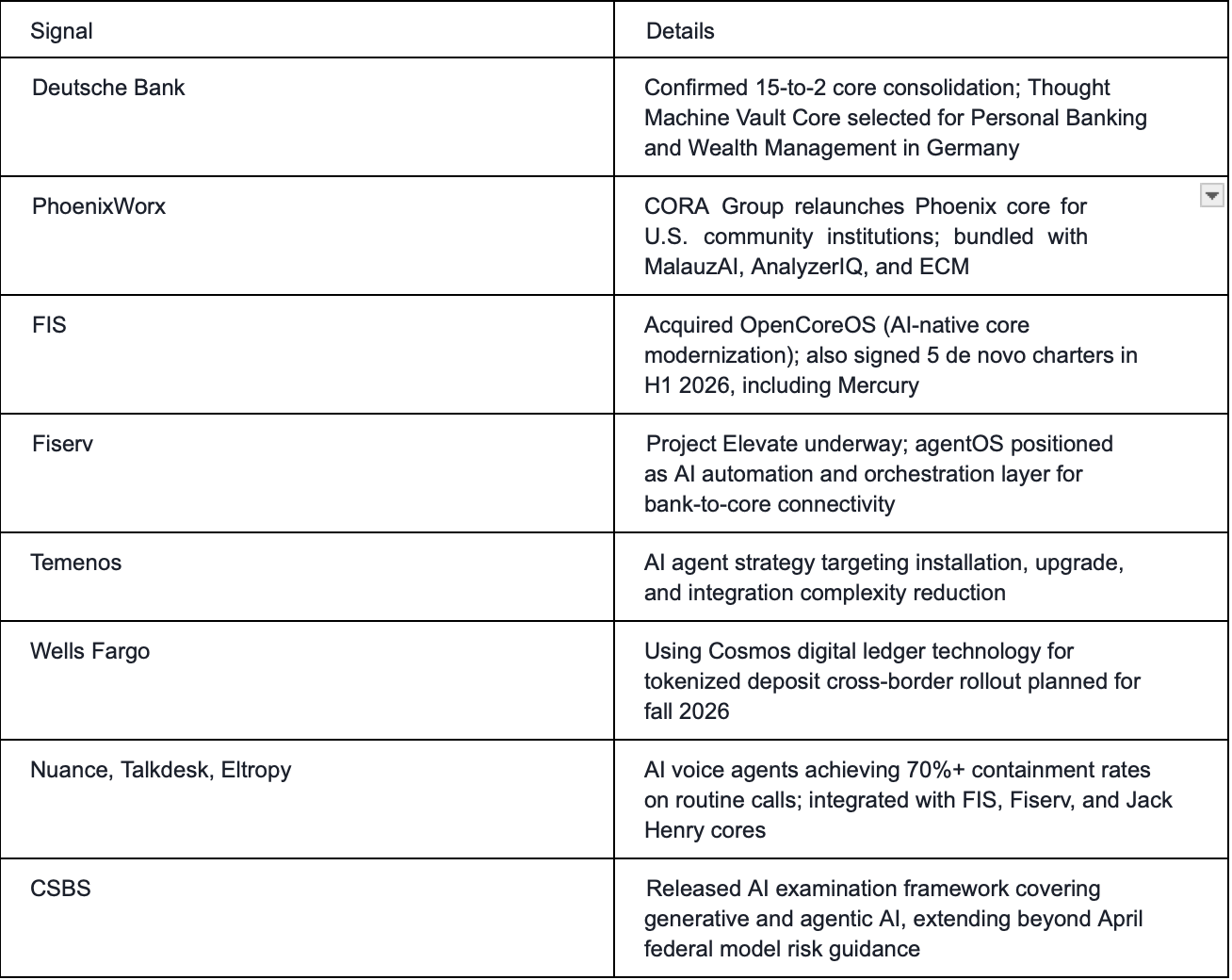
The CB Radar picture this week reflects a market in active motion. Established platform vendors are acquiring AI-native capabilities rather than building them, new entrants are being absorbed or repackaged, and the examination environment is tightening around agentic AI specifically. Banks in vendor evaluation or contract renewal discussions should treat this week’s signals as live inputs, not background noise.
RICK’S STRATEGIC TAKE
➜ Deutsche Bank collapsing 15 cores to two is the kind of decision that looks obvious in hindsight and genuinely difficult in execution. What I keep coming back to is the governance question, not the vendor question. Thought Machine was the right call for their architecture. But the harder work is sustaining delivery discipline across a multi-year program while keeping the bank running. I have seen programs with the right vendor selection still struggle because the internal governance structure could not hold the weight of the transformation. The vendor is not the risk. The execution model is.
➜ The CSBS AI examination framework closing the gap on agentic AI is a signal banks should not underestimate. Federal guidance left generative and agentic AI out of scope in April. State examiners now have a playbook that covers exactly those systems. If your AI governance documentation was written for traditional model risk management and has not been updated to address agents specifically, you have a visible gap that examiners are now equipped to find. This is not a compliance exercise. It is a governance readiness question.
➜ I want to be direct about something I have been watching across the last several issues. We have reported real, measurable AI results: KeyBank’s consumer banking numbers in Issue #32, BNY Mellon’s workforce math in Issue #30, and this week’s surveillance containment rates from Shield. AI is delivering real outcomes in specific, well-scoped deployments. What I am also seeing, and what the Shield report reinforces, is that investment in AI tooling is outpacing the organizational change required to operationalize it broadly. Those two things are not contradictory. Point solutions can deliver real savings. Broad operational transformation requires something more: a connected program, clear ownership, and an operating model that has actually been redesigned, not just patched. The banks getting both right are the ones treating AI not as a technology initiative but as an operating model change that happens to be enabled by technology.
For a deeper framework on what AI-ready core architecture actually requires, see CSP’s CB Architecture Series at coresystempartners.com.
Want the Full Picture?
Subscribe to BIS, the Banking Intelligence Service from Core System Partners, for the full breakdown including Rick’s Strategic Take on the governance gap, the CB Radar vendor tracking signals, and the regulatory pulse analysis covering what SR 11-7 does and does not cover for agentic deployments, delivered weekly. Banking Intelligence Service
For CSP’s full analysis of what the Fed and Treasury are actually concerned about—and a framework for what AI-ready architecture requires—visit Core System Partners.
Continue With Core System Partners
- Contact Us: https://coresystempartners.com/#contact
- The Strategic Flywheel (book): https://coresystempartners.com/resources/strategicflywheel/
- Core Insider (weekly newsletter): https://coresystempartners.com/resources/newsletter/