
Issue #42
Weekly Banking Intelligence: November 13 to November 19, 2026
THIS WEEK’S SIGNAL
BCG’s 2026 AI governance benchmark of 26 banks found that institutions in the top third for actually operationalizing AI governance are 2.5 times more likely to be advanced AI adopters. Read that again. The banks doing governance well are not slowing down; they are moving faster. That finding flips the narrative that most banks have been telling themselves, which is that rigorous governance is a brake on AI deployment. The institutions that figured out governance early appear to have turned it into a competitive advantage, and that gap is widening.

DEEP DIVE
Governance as accelerant: what the BCG benchmark actually tells us
BCG’s 2026 AI Safety and Governance in Banking benchmark, covering 26 global banks, found that institutions in the top third for operationalizing AI governance are 2.5 times as likely to be advanced AI adopters. This is not a correlation between good intentions and good outcomes. It is a correlation between having the actual infrastructure in place: the policies, the model risk management processes, the accountability structures, the audit trails, and the ability to move AI from pilot to production at scale. Banks that built governance as an afterthought are finding it is now a bottleneck. Banks that built it into the foundation are finding it is a runway.
Why it matters: Most governance conversations inside banks still happen in the risk function, not the business lines. What the BCG data suggests is that the banks pulling ahead have moved governance out of the compliance lane and into the operating model. That is a different organizational design problem, and it is not solved by hiring a Chief AI Officer and calling it done.
Why it matters: The OCC’s AI examiner framework, which this publication covered in Issue #40, is now being reinforced at the state level. As reported this week by PYMNTS, state financial regulators are moving AI oversight into routine supervision. Banks that have been treating AI governance as a federal compliance exercise are about to discover that state examiners have their own expectations, and those expectations are becoming concrete. The BCG data and the regulatory trajectory are pointing in the same direction: governance is not optional infrastructure, and the time to build it was before the examiners arrived.
Backbase, the Amsterdam-based digital banking platform provider, published its Banking Predictions 2027 report this week, arguing that banks will need to rebuild their operating models around governed AI agents rather than simply layering agents on top of existing structures. That framing matters. An AI agent that operates inside a well-governed operating model is a controlled, auditable, explainable tool. An AI agent that operates on top of a legacy operating model with unclear ownership and fragmented data is a liability. The distinction is not primarily a technology question. It is an organizational design question, and most banks have not had that conversation seriously yet.
A piece published this week in Forbes noted that AI agents moving money autonomously require a fundamentally different control framework than AI tools that assist human decisions. The risk profile is not the same. When AI recommends a credit decision and a human approves it, the accountability chain is reasonably clear. When AI executes a payment, adjusts a portfolio, or closes a position without a human in the loop, that chain needs to be designed deliberately. Banks that are piloting agentic AI without first answering the ownership and accountability questions are building exposure they may not fully see yet.
MARKET MOVES
SME Bank expands into the Netherlands on SaaScada’s core
SME Bank, a neobank focused on small and medium-sized enterprise lending that originated in the Baltics, has gone live on SaaScada’s cloud-native core banking platform as it targets expansion into the Dutch market, as reported this week by Fintech Global. SaaScada, a UK-based cloud-native core banking provider, built its platform specifically for financial institutions that need to scale across jurisdictions without replicating infrastructure.
Why it matters: This is not a headline deal, but it is a useful signal. A growth-stage neobank choosing a cloud-native core as the foundation for geographic expansion rather than adapting a legacy system is exactly the operating model flexibility that established regional banks find difficult to replicate. The Dutch market is competitive and well-banked. SME Bank is betting that architectural agility will let it move faster than incumbents. Whether that bet pays off is worth watching.
VENDOR SIGNALS
OpenAI brings financial workflows directly into ChatGPT
OpenAI’s applied AI team ran a hands-on workshop this week demonstrating how financial services firms can build custom workflows inside ChatGPT using built-in market data, filings, and earnings transcripts from partners including LSEG, PitchBook, and Daloopa. The demonstration walked through a wealth advisor’s workflow from identifying a portfolio change to preparing the client presentation, using Codex to build custom skills and connect internal data sources.
This is worth paying attention to for a specific reason. OpenAI is not just selling API access to developers anymore. It is building a financial services workflow layer that sits inside the tool wealth advisors and analysts already have open on their desktops. The integration of LSEG and PitchBook data directly into that environment lowers the barrier to adoption considerably. The question banks should be asking is not whether their people will use these tools; many already are.
The question is whether the bank has an visibility into what data is flowing in and out, and whether the governance structures built for enterprise AI deployments actually cover the tools employees are picking up on their own.
PSD3 approved; composable core banking gains momentum in Europe
The European Commission formally accepted the Council’s position on the revised Payment Services Directive (PSD3) on November 3, 2026, according to Lovguiden’s regulatory tracker. The same reporting noted that composable core banking architectures are moving from early-adopter territory toward mainstream consideration among European banks preparing for the open banking obligations PSD3 will impose.
For banks operating in Europe or watching European regulatory patterns for signals about where U.S. open banking requirements may eventually land, the PSD3 approval starts a compliance clock. Composable architecture is not a prerequisite for PSD3 compliance, but banks with tightly coupled legacy cores are going to find the required API exposure and data-sharing obligations significantly harder to implement cleanly. The institutions that have already moved toward modular, API-first architectures are in a better position to absorb those requirements without a major re-platforming effort.
REGULATORY PULSE
State regulators move AI oversight into routine examination
As reported this week by PYMNTS, state financial regulators are incorporating AI oversight into routine supervision, giving banks and nonbank financial institutions more concrete expectations around AI risk management. This follows the OCC’s Bulletin 2026-54, covered in Issue #40, which introduced a four-tier risk classification framework for AI use in lending, payments, and autonomous agent applications. The state-level movement suggests that AI examination is no longer a federal-only concern.
The practical reality is that banks with multistate charters or significant nonbank subsidiaries may now face AI examination from multiple directions simultaneously, with frameworks that are not yet fully harmonized. Institutions that built their AI governance programs around a single regulatory reference point should be pressure-testing those programs against state-level expectations now, before the examiner arrives with a different set of questions.
TALENT SIGNALS
AI reshapes banking headcount, but the revenue link stays murky
As reported this week by CNBC, Barclays is planning 5,000 job cuts in 2026 as it expands AI across operations, customer service, and compliance. Santander’s Chief Financial Officer José García Cantera stated that AI initiatives generated 194 million euros in business value in the first nine months of 2026, describing AI as now embedded in “all the processes that we are conducting at the bank.” Recruiters and analysts cited in the same report noted that demand is shifting toward AI engineering, software development, and AI governance roles as routine processing and middle-office functions contract.
The Santander number is notable, but the CNBC headline is equally honest: the ability of AI to drive profits at scale remains unclear. What is clear is that the job mix is changing. Banks are adding AI engineers, machine learning specialists, and AI governance leads because AI adoption requires them. Tellers, routine analysts, and middle-office processing roles are declining as a direct consequence of that same automation. The headcount math is not complicated. The harder question is whether the revenue gains will eventually justify the investment at the scale banks are now committing to, and Santander’s 194 million euro figure, while meaningful, is one data point against a much larger spend.
CB RADAR UPDATE
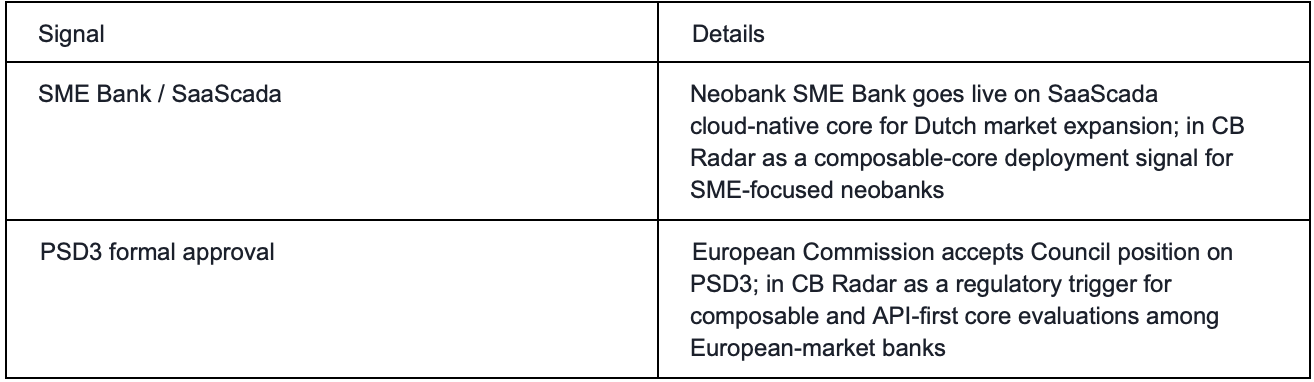
Both CB Radar entries this week point to the same underlying pattern: institutions facing new market or regulatory pressure are increasingly choosing architectures designed for flexibility from the start rather than trying to adapt existing systems. That preference is showing up in vendor selection conversations, and it is worth tracking as a leading indicator of where core banking procurement is heading in 2027.
RICK’S STRATEGIC TAKE
➜ The BCG finding that governance-mature banks are 2.5 times more likely to be advanced AI adopters should end the internal debate at most institutions about whether to invest in governance infrastructure. It is not a compliance cost. It is an operating capability, and the banks that treated it that way are now visibly ahead. If your governance program still lives primarily in the risk function and has not been embedded into how your business lines actually deploy AI, that is the gap worth closing first.
➜ The OpenAI financial workflow demonstration this week is a quiet signal with significant implications. When sophisticated AI tools with embedded market data become available directly inside the applications your people already use, your enterprise AI governance program needs to account for adoption that happens outside the formal deployment process. I have seen this dynamic before in other technology cycles: the tool that bypasses the procurement process often ends up with more users than the one that went through it. That is a data governance and liability question, not just a technology question.
➜ State regulators moving AI oversight into routine examination, combined with the OCC’s four-tier framework from Issue #40, means the examination environment for AI is becoming multidimensional faster than most banks anticipated. The institutions I would be most concerned about are the ones that built their AI governance programs reactively, in response to a single regulator’s expectations, without thinking about how those programs hold up under scrutiny from multiple directions. If I were running the bank, I would want to know right now whether our AI governance documentation and our actual practices are consistent, and whether they are consistent across every jurisdiction we operate in.
For a deeper framework on what AI-ready core architecture actually requires, see CSP’s CB Architecture Series at coresystempartners.com.
Want the Full Picture?
Subscribe to BIS, the Banking Intelligence Service from Core System Partners, for the full breakdown including Rick’s Strategic Take on the governance gap, the CB Radar vendor tracking signals, and the regulatory pulse analysis covering what SR 11-7 does and does not cover for agentic deployments, delivered weekly. Banking Intelligence Service
For CSP’s full analysis of what the Fed and Treasury are actually concerned about—and a framework for what AI-ready architecture requires—visit Core System Partners.
Continue With Core System Partners
- Contact Us: https://coresystempartners.com/#contact
- The Strategic Flywheel (book): https://coresystempartners.com/resources/strategicflywheel/
- Core Insider (weekly newsletter): https://coresystempartners.com/resources/newsletter/