
The leapfroggers are proving you don’t need legacy to modernize—just a clean slate, cloud-native core, and the speed to build what’s next.
Not every bank is burdened by history.
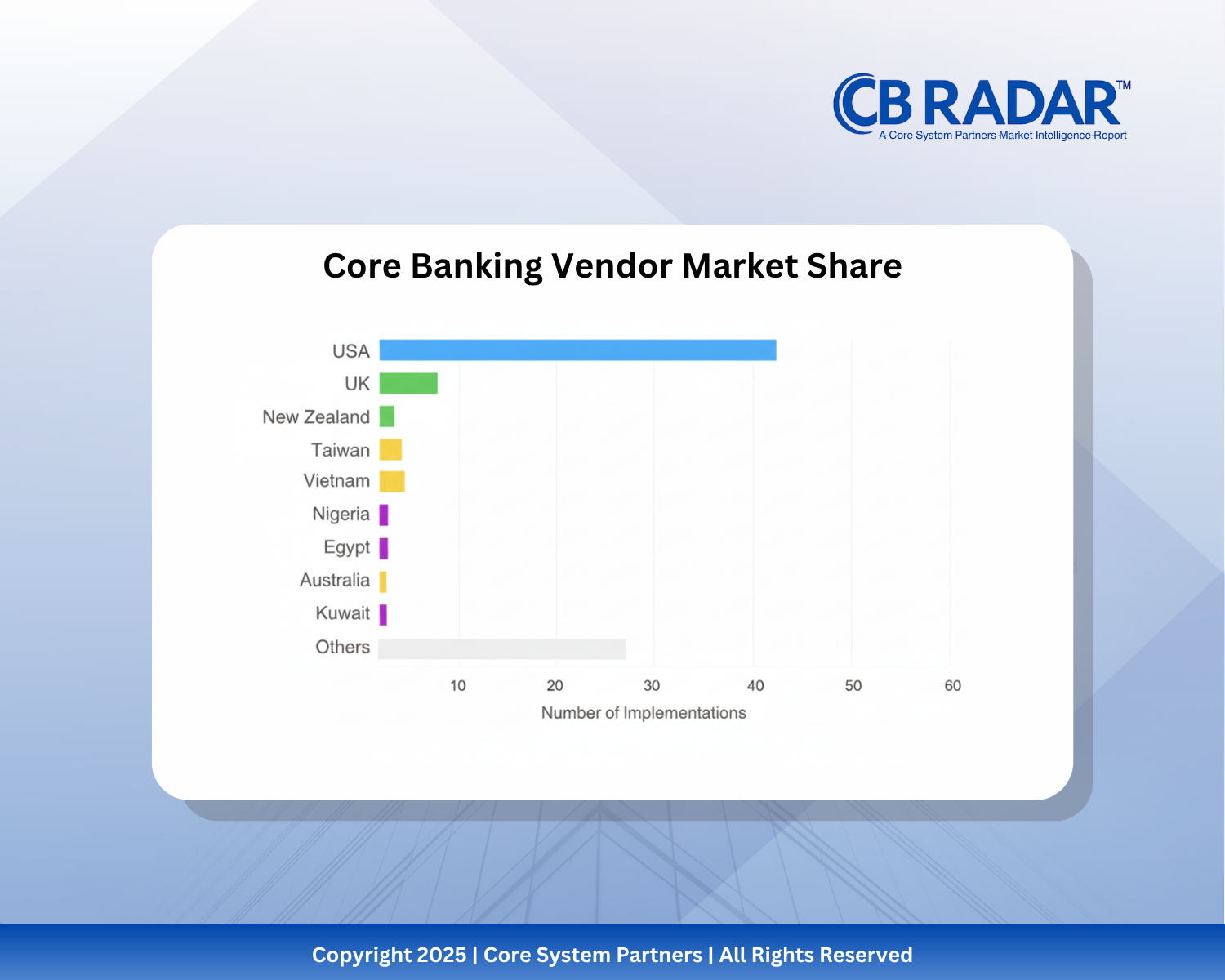
In CB RADAR™ 2025, a clear pattern emerged among smaller, fast-growing institutions — especially in markets like Vietnam, Nigeria, and Kuwait — where modernization isn’t about replacing the past. It’s about starting fresh.
These are the leapfroggers — banks that are skipping legacy technology and moving straight to cloud-native cores, unencumbered by decades of infrastructure debt.
“When you don’t have legacy, speed becomes your biggest advantage.”
The Clean-Slate Advantage
For banks in developing or emerging economies, modernization looks very different.
Instead of migrating thousands of interdependent systems, they’re building greenfield platforms — cloud-based, modular, and API-first from day one.
That gives them agility traditional banks can’t easily match:
- Faster time-to-market for digital products.
- Lower integration cost.
- Built-in scalability without physical infrastructure.
“Emerging markets aren’t catching up — they’re starting from a different line.”
Why It’s Happening Now
Several forces have aligned to make leapfrogging possible:
- Cloud maturity: Vendors now offer out-of-the-box banking platforms ready for rapid deployment.
- Mobile-first societies: In many regions, consumers skipped desktop banking entirely.
- Regulatory flexibility: Fewer legacy compliance structures allow faster innovation
- Global capital: Fintech investment is reaching new geographies that were once too small to target.
In short, technology and timing have finally converged for smaller markets to move fast — and move well.
Lessons for Established Markets
While large banks wrestle with layered complexity, smaller players are proving that transformation doesn’t have to take years or billions.
Their secret is focus: they modernize what matters and ignore what doesn’t.
The best of these leapfroggers are treating technology not as a “core replacement project,” but as a business model redesign.
“True modernization isn’t about catching up to others — it’s about building what’s next.”
The Emerging Blueprint
CB RADAR™ data shows that emerging markets share a few common threads that others can learn from:
- Single-platform commitment: No hybrid distractions — one integrated system.
- Rapid prototyping: Test, launch, adapt — not plan for perfection.
- Talent partnerships: Local teams trained in agile delivery from day one.
These principles are exportable. The difference is mindset, not market size.
The Global Implication
As leapfroggers mature, they’ll start influencing vendor roadmaps, global delivery standards, and even customer expectations.
What starts in Lagos or Hanoi today could shape the way mid-tier U.S. banks modernize tomorrow.
“Innovation doesn’t flow one way anymore — it’s global, and it’s circular.”
What CB RADAR™ Reveals
CB RADAR™ 2025 challenges the assumption that transformation leadership belongs only to big banks or developed markets.
The leapfroggers show that the absence of legacy can be a competitive advantage and that agility, not history, defines the next generation of banking.
Read the full CB RADAR™ 2025 report to explore how emerging markets are redefining transformation speed, strategy, and scale.
And if you want to benchmark your own institution’s readiness against the market, you can also try our Core Banking Transformation Readiness Scorecard, which helps you see how your bank stacks up against the themes revealed in CB RADAR™.
CB RADAR™ is not a vendor pitch. It’s a reality check. And in a market where every decision carries long-term consequences, clarity is your strongest advantage.
#CoreBankingTransformation #CoreBankingBenchmarks