
AI governance doesn’t fail from lack of documentation, it fails from lack of architecture.
In core banking architecture, what starts as pragmatic quickly becomes permanent.
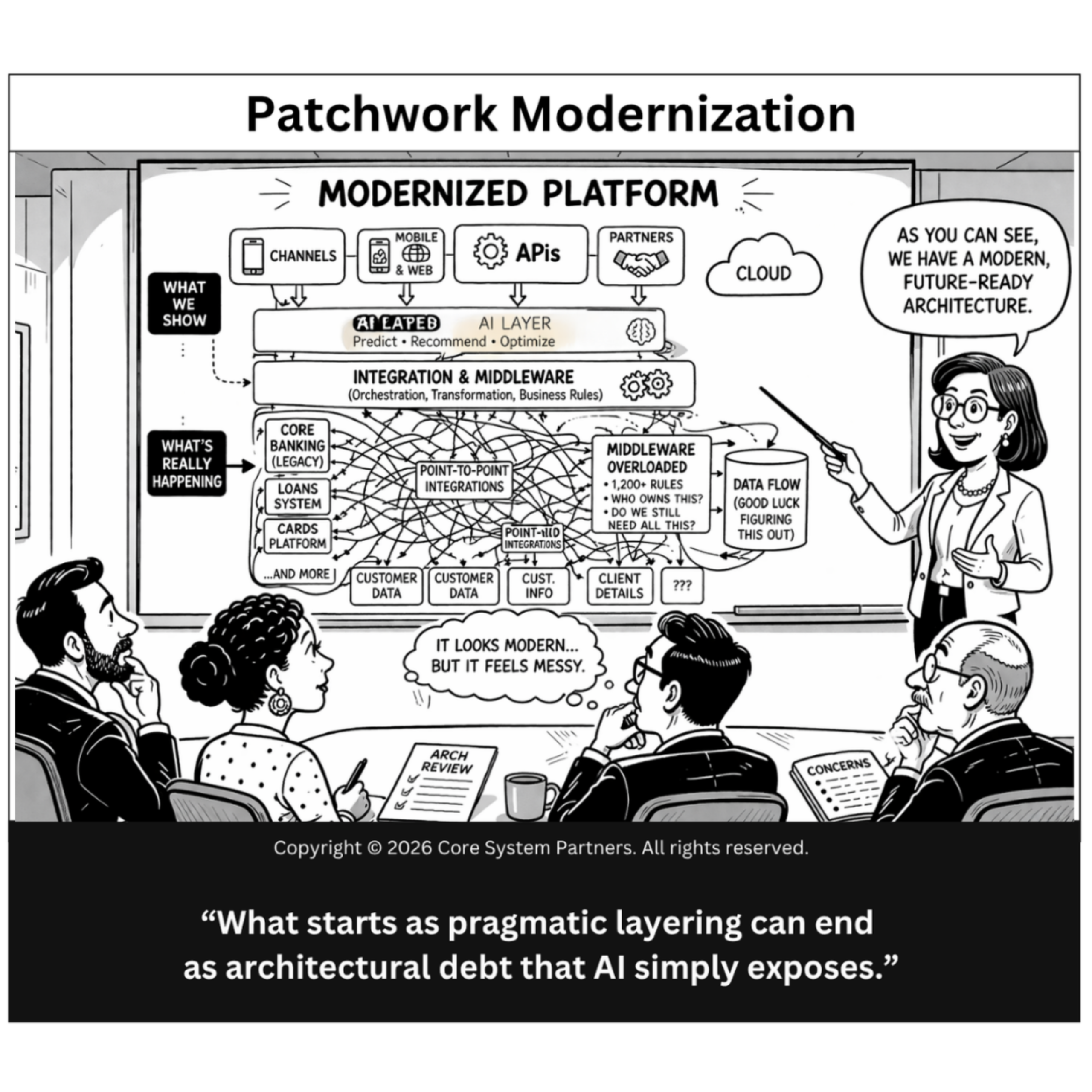
This cartoon captures a pattern most institutions recognize but rarely confront directly. Over time, banks layered new capabilities onto legacy foundations—APIs here, middleware there, cloud for select workloads. Each move made sense in isolation. Each solved a real problem.
But collectively, they created something else entirely.
Look closer at the scene:
- The integration layer has multiplied into dozens of point-to-point connections, each with its own logic and dependencies.
- The middleware layer has become a decision engine, quietly hosting business rules and data transformations it was never meant to own.
- The data flows move through paths no single team can fully trace, making lineage a reconstruction exercise rather than a capability.
- The AI engine sits on top, technically connected—but starved of clean, consistent, real-time context.
From a distance, it looks like modernization. Up close, it behaves like accumulation.
If your institution is ready to move from awareness to action, visit coresystempartners.com/contact to start the conversation.
Return to: Why AI makes modern core banking architecture non-negotiable
#CoreBankingTransformation #CoreBankingArchitecture