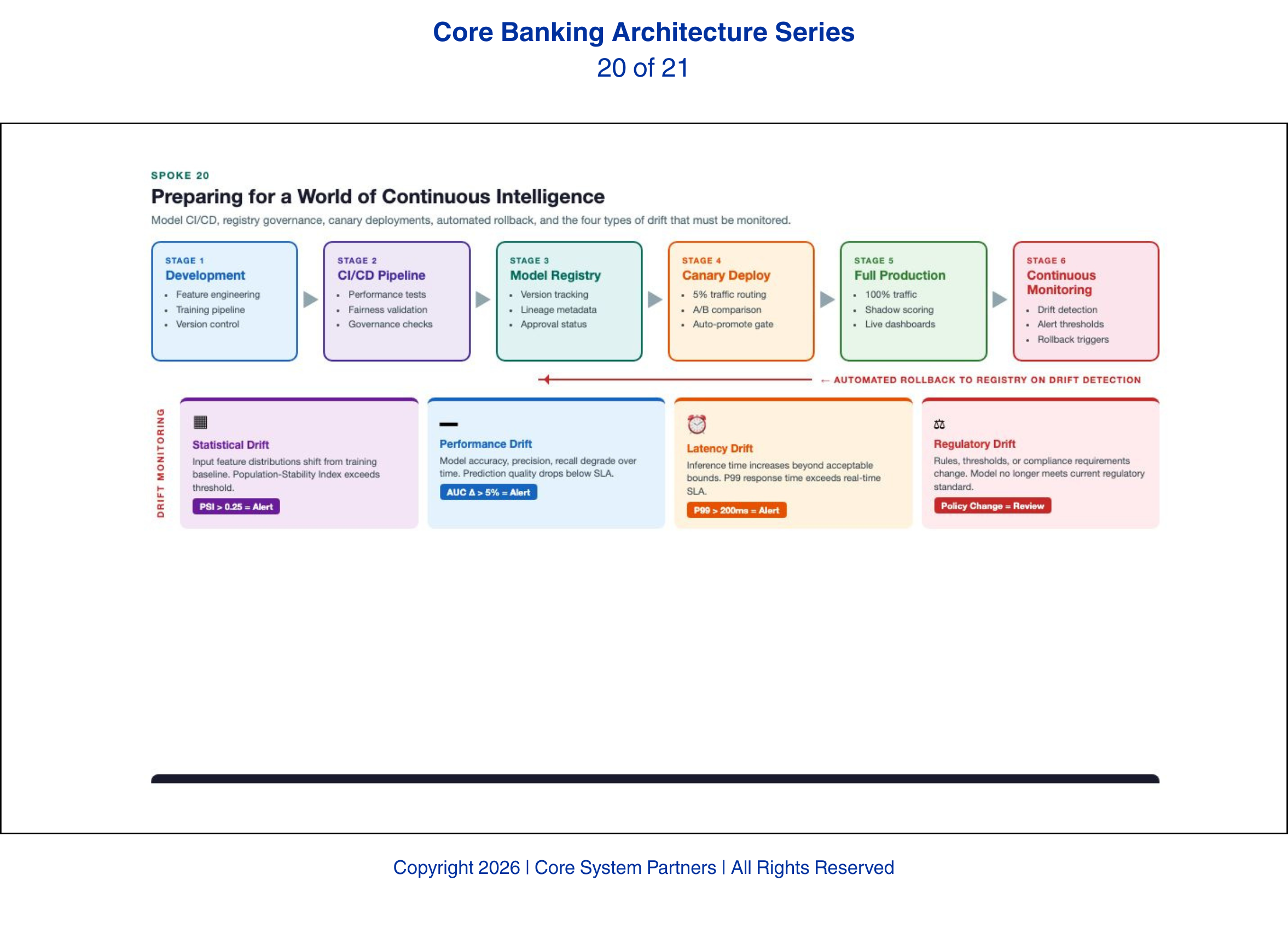
Continuous intelligence requires disciplined model lifecycle management, from CI/CD to monitoring and automated rollback.
AI is not a project with a delivery date. It is a continuous capability that requires continuous evolution. The architecture must support that evolution without operational disruption and the organizing principle is one that banks already understand: the same delivery discipline you apply to software must now apply to AI models.
Models improve. They degrade. They get replaced by better versions. They get constrained by new regulations. This happens on timescales of weeks or months, not the annual release cycles that banks are accustomed to managing. Banks that treat model deployment as a one-time project will find themselves perpetually behind, running models that were state-of-the-art when deployed and outdated by the time they settle into production.
The infrastructure that makes continuous intelligence possible, model CI/CD, registries, canary deployments, automated rollback, and drift monitoring, is not optional. Every component is an architectural requirement.
CI/CD for Models
Most banks deploy models manually. A data scientist trains a model, hands it to an operations team, and the operations team deploys it through a process that is part automation and part institutional knowledge. There is no standard pipeline. There is no automated testing gate. There is no consistent deployment process across different models.
A model CI/CD pipeline automates the path from model development to production. When a data scientist produces a new model version, the pipeline automatically runs validation tests: does the model perform at or above the baseline on the standard test dataset? Does it produce biased outcomes on the fairness test suite? Does it comply with the governance requirements, explainability, lineage tracking, audit trail compatibility? Only models that pass every gate reach production. Models that fail are returned to development with specific diagnostic information.
The discipline is identical to what banks already apply to software: version control, automated testing, staged deployment. The artifact is different, a model instead of an application, but the engineering rigor is the same.
The Model Registry
A model registry is the system of record for every model the bank has ever deployed. It tracks versions, performance metrics, deployment history, training data references, configuration parameters, and governance status. When someone asks which version of the fraud detection model is running in production, the registry answers instantly. When someone asks how that version’s performance compares to the previous version, the registry provides the comparison.
The registry is not a documentation tool. It is an operational system that the CI/CD pipeline writes to and the monitoring system reads from. When a new model version is deployed, the registry records it. When the monitoring system detects drift, it queries the registry to determine which version is affected and what the previous version’s performance baseline was. When a rollback is triggered, the registry identifies the target version to revert to.
Banks without a model registry are managing model inventory by memory and spreadsheet. That approach fails at scale and it fails under examination.
Canary Deployments and Automated Rollback
Deploying a new model version directly to all production traffic is the equivalent of deploying untested software to every user simultaneously. It works when the model is better. It creates immediate, widespread impact when the model is worse. Canary deployment solves this by routing a small percentage of production traffic to the new model version while the majority continues to be served by the current version.
The canary is monitored continuously. If the new version performs at or above the current version, the traffic percentage is gradually increased until the new version handles all traffic. If the new version underperforms, the canary is automatically rolled back and all traffic returns to the current version. Banks that skip staged deployment for model updates will eventually deploy a degraded model to full production traffic and their first warning will be customer complaints or an examiner finding.
Automated rollback extends beyond canary failures. When production monitoring detects drift in a model that has been running for weeks or months, the system must be able to roll back to the previous stable version within minutes. This requires the model registry to maintain deployable artifacts for previous versions, not just records that a version existed, but the actual model binary, configuration, and dependency specifications needed to redeploy it.
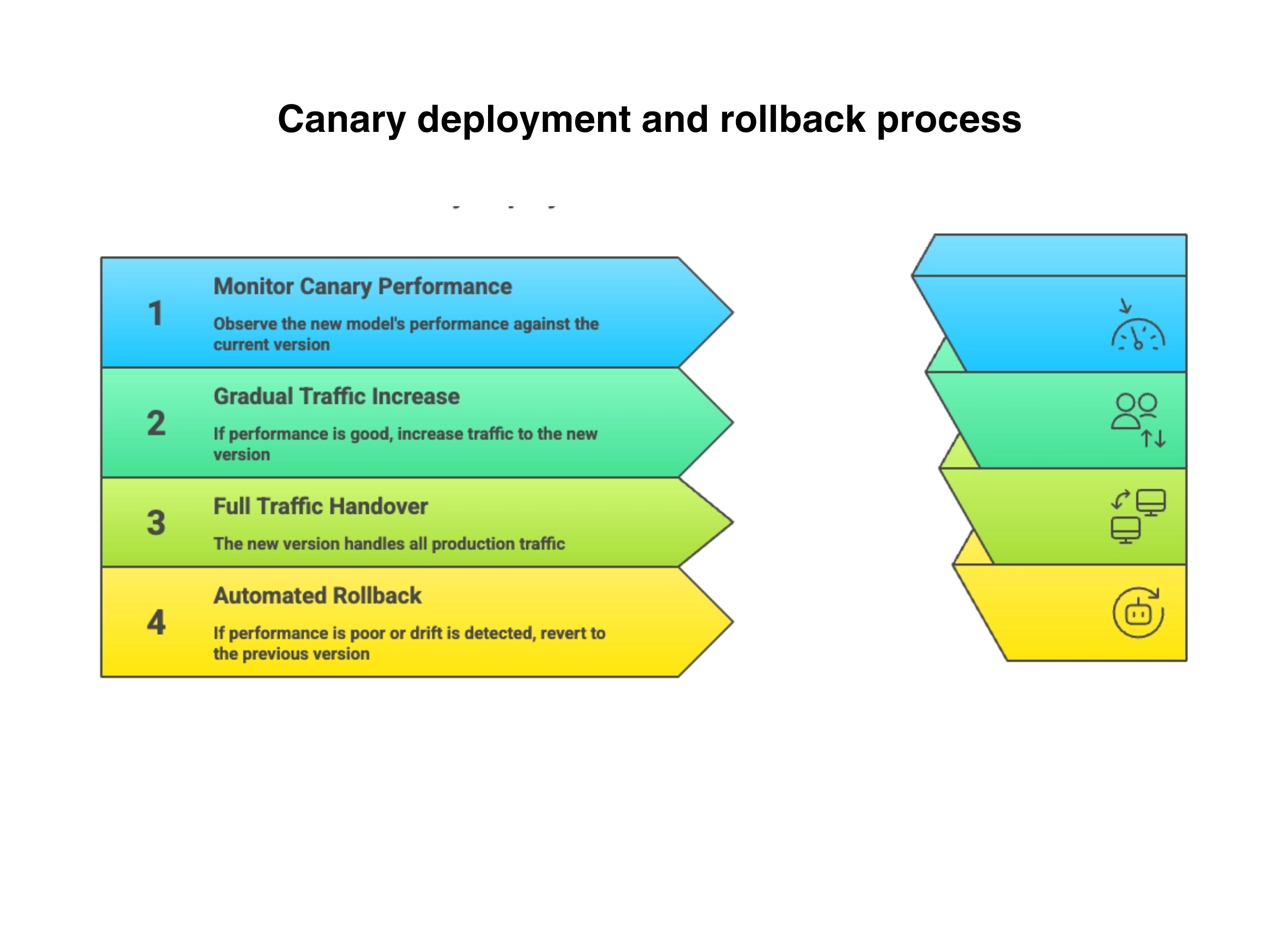
Canary deployment enables safe AI model releases with gradual rollout and automated rollback on performance issues.
Monitoring That Detects Drift Before Impact
In the context of continuous intelligence, drift monitoring is not just a safety measure, it is the feedback loop that drives the continuous improvement cycle. When monitoring detects that a model’s performance is declining, it triggers the development team to investigate, retrain, and push a new version through the CI/CD pipeline.
Effective monitoring tracks multiple dimensions simultaneously. Statistical drift in input distributions, the data the model receives is changing in ways that may affect its accuracy. Performance drift in output quality, the model’s decisions are becoming less accurate as measured against known outcomes. Latency drift, the model is taking longer to produce decisions, potentially affecting real-time workflows. And regulatory drift, new regulations or guidance that may affect whether the model’s behavior remains compliant.
Banks that monitor all four dimensions can detect problems before they become customer-facing incidents. Banks that monitor only infrastructure metrics, is the model running? will learn about problems from their customers, their examiners, or their loss reports.
Banks that monitor only infrastructure metrics — is the model running? — will learn about problems from their customers, their examiners, or their loss reports.
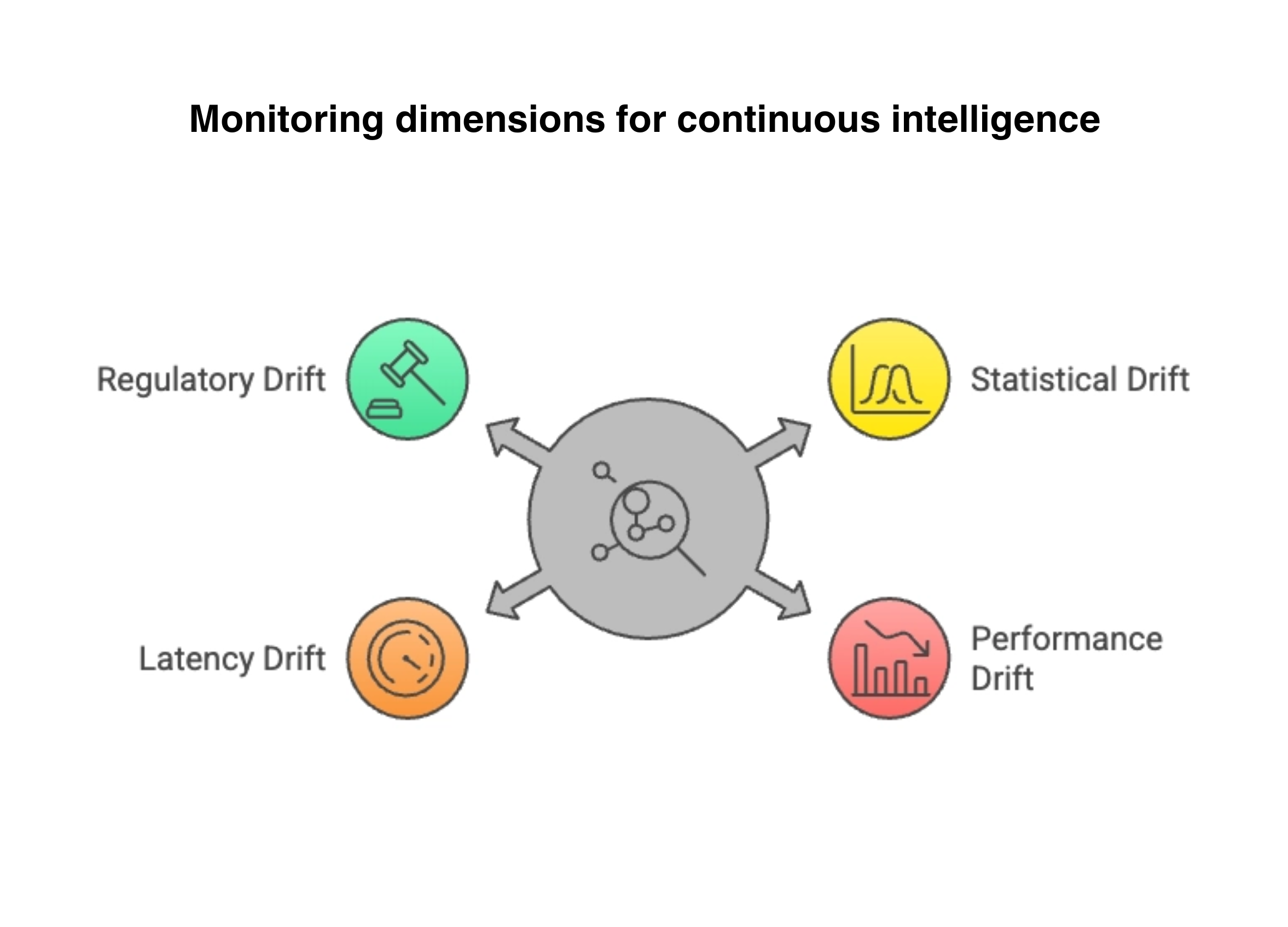
Effective AI monitoring requires tracking statistical, performance, latency, and regulatory drift in real time.
The Compounding Advantage
Banks that apply this delivery discipline to AI models will be able to iterate at the speed AI development demands. A new fraud detection approach can be developed, validated, canary-tested, and fully deployed in days rather than months. A regulatory change that requires model adjustment can be implemented and deployed within the compliance window rather than requiring an emergency project.
Banks that deploy models as one-time projects, manually tested, manually deployed, manually monitored, will find that each model update requires the same effort as the original deployment. The cost never decreases. The speed never improves. The bank is permanently behind the pace of AI evolution.
What Comes Next
This series has covered architecture, data, integration, governance, vendors, operating models, talent, agents, and continuous operations. The final article brings it all together into a coherent picture of what the AI-ready bank looks like, not science fiction, but a grounded projection from what the architectural leaders are already building today.
Where to Start
If your bank is deploying AI models and the deployment process is still manual, no pipeline, no registry, no staged rollout, no automated rollback, every model update carries risk that scales with the number of models in production. The question is not whether to build this infrastructure but how quickly.
The CSP Transformation Readiness Scorecard evaluates your model operationalization maturity against the continuous intelligence requirements outlined in this article: CI/CD pipeline existence, registry completeness, canary deployment capability, rollback readiness, and four-dimension drift monitoring. Leadership teams get a structured view of where model operations are mature and where manual processes are creating risk, in under an hour, with clear prioritization of where to invest first.
If your institution deploys a new model the same way it deploys a new core banking release — with a dedicated project, a cutover date, and a six-month runway — the continuous intelligence architecture described here is the gap between your roadmap and your competitors’.
If your institution is ready to move from awareness to action, visit coresystempartners.com/contact to start the conversation.
Next article in the series: The Bank of 2030 Will Look Like This
Return to: Why AI makes modern core banking architecture non-negotiable
#CoreBankingTransformation #CoreBankingArchitecture