Issue #26
Weekly Banking Intelligence: July 24 to July 30, 2026
THIS WEEK’S SIGNAL
The biggest deal in fintech history almost happened this week, and the fact that it didn’t may be just as revealing as if it had. Stripe, Block, and Advent International approached PayPal about a $53 billion takeover, a consortium play that signals something important: the race to own diversified payments infrastructure is intensifying, and scale alone is no longer sufficient protection. The one-product players are increasingly vulnerable.
Why it matters: If you run a bank with a payments strategy built around a single vendor relationship or a narrow capability set, this week is a good time to pressure-test that assumption.
DEEP DIVE
Bank of America’s AI Scale Announcement: What 200,000 Users Actually Means Brian
Moynihan’s Q2 earnings disclosure was straightforward: more than 200,000 Bank of America employees are actively using AI-enabled tools. That includes productivity applications, developer coding assistants, and, notably, agentic AI capabilities. This is not a headline number manufactured for investor relations. It is a deployment figure, and it deserves careful attention.
Here is what I think people are missing. Getting 200,000 employees onto AI tools is not primarily a technology achievement. It is an operating model achievement. Somebody had to decide which workflows to target first. Somebody had to train people, manage change, define governance guardrails, and figure out what “good” looks like when an AI agent is completing tasks on behalf of a banker. That organizational infrastructure is as hard to build as the technology itself, and most institutions have not started building it.
The agentic piece is where things get particularly interesting. Agentic AI does not just assist a human. It takes action. It initiates processes, makes decisions within defined parameters, and completes multi-step tasks without constant human intervention. When that capability is deployed at scale inside a regulated financial institution, the questions of accountability, audit trail, and model governance become very real, very fast. Who owns the output when the agent makes a mistake? How does that get documented for examiners? What happens when an agentic workflow crosses a compliance boundary?
Why it matters: Bank of America is not just ahead on technology. It is ahead on the organizational capability to absorb technology at scale. That gap compounds. Every quarter that a mid-tier bank runs a pilot while BofA runs at 200,000 users, the distance grows. Catching up later is not impossible, but it requires more than buying better software.
Why it matters for your operating model: The institutions that will struggle most with agentic AI are not the ones with the worst technology. They are the ones with the most fragmented data environments and the least defined process ownership. If your teams cannot clearly articulate who owns a workflow today, you are not ready to hand that workflow to an agent. That is not an indictment of your technology team. It is a readiness question for your entire leadership structure.
MARKET MOVES
CSI Acquires Qolo
CSI (Computer Services, Inc.), a provider of end-to-end financial technology for community and regional banks, acquired Qolo, a Florida-based treasury and payments infrastructure company. Financial terms were not disclosed. CSI says the acquisition strengthens its commercial banking capabilities, particularly around treasury and payments infrastructure.
Why it matters: CSI serves a large community bank client base, and this acquisition signals that core banking vendors are no longer content to be back-office platforms. They are moving aggressively into payments and treasury, which are historically higher-margin, stickier product relationships. If you are a community bank currently evaluating your payments and treasury technology stack, your core vendor may already be building the answer, and that changes the competitive dynamics of any RFP you run.
Northrim Bank Selects Narmi
Northrim Bank, a $3.4 billion Alaska-based institution, selected Narmi (a provider of digital banking solutions purpose-built for community and regional banks) to modernize its digital banking platform. This is a full-scale engagement, not a single-channel deployment.
Why it matters: Northrim is not a large bank. That is the point. A $3.4 billion institution making a full-scale digital banking commitment signals that the modernization imperative has moved well below the top-tier regional bank segment. Community banks that are still treating digital banking as a feature upgrade rather than a platform decision are falling further behind with each passing quarter.
Bank of Luxemburg Goes Live on CSI NuPoint
Bank of Luxemburg (Wisconsin) completed its core conversion to CSI’s NuPoint platform. CSI described the conversion as seamless.
Why it matters: Live conversions matter more than signed contracts. Every successful go-live reduces the perceived risk for the next institution considering a similar move, and it adds a reference site to CSI’s pipeline. In our proprietary CB Radar database, completed conversions consistently accelerate adjacent deal activity in the same peer group.
Bank of Maldives Selects Finastra Essence
Bank of Maldives, the country’s largest bank by assets, selected Finastra’s Essence core banking platform as part of a broader infrastructure modernization program.
Why it matters: This is a meaningful international reference win for Finastra in a market where core banking decisions carry long replacement cycles. It also reinforces that Finastra’s Essence platform continues to compete effectively in markets where implementation complexity and local regulatory alignment are significant selection criteria.
ICSFS Goes Live at African Bank of Oman
ICSFS (ICS Financial Systems, a Jordan-based core banking software provider) went live with its ICS BANKS platform at African Bank of Oman, marking the vendor’s entry into the Angolan market.
Why it matters: For North American and European bank executives, this may feel distant. It should not. Global core banking platform competition is intensifying, and vendors winning in emerging markets are building the scale, reference base, and implementation capability that eventually shows up in competitive bids elsewhere.
VENDOR SIGNALS
Temenos Named to CNBC’s World’s Top Fintech Companies 2026
Temenos, the Geneva-based core banking software company, was named to CNBC’s World’s Top Fintech Companies 2026 list. The CNBC and Statista ranking reflects scale, innovation trajectory, and market presence across the global fintech landscape.
Why it matters: Recognition lists are not strategy, but they do influence shortlists. Procurement committees and boards pay attention to rankings, particularly when evaluating vendors for long-cycle core banking decisions. Temenos appearing on this list reinforces its positioning at a moment when several large institutions are in active platform evaluation. If Temenos is on your shortlist, or your competitor’s, this signal is worth tracking.
Fintech Funding Concentrates at the Top
H1 2026 fintech funding data released this week shows aggregate funding up 23% year over year, but deal count down 26%, with 556 fewer transactions than H1 2025. Average deal size jumped from roughly $10.8 million to $17.8 million. In Q1 2026 alone, U.S. fintechs raised $11.1 billion across 466 deals, a 16% funding increase with a 33% rise in deal count versus Q1 2025.
Why it matters: Capital is concentrating. Larger rounds going to fewer companies means the fintech vendor landscape is consolidating faster than most bank procurement teams realize. The vendor you evaluated two years ago may be significantly better capitalized today, or it may have quietly run out of runway. Either way, vendor financial health deserves more diligence in your next RFP cycle than it typically receives.
AI in Risk Management: Quiet but Real
A Global Banking and Finance review published this week examined how AI is reshaping credit risk assessment, specifically through dynamic dataset analysis that goes well beyond traditional credit scoring inputs. The shift is gradual, but the direction is consistent.
Why it matters: Credit risk is one of the most regulated and scrutinized functions in banking. AI-assisted underwriting is not a future concept; it is happening in production at a growing number of institutions. The question for your leadership team is not whether AI will change credit risk management. It already is. The question is whether your data infrastructure, model governance framework, and examiner relationships are ready for the conversation.
U.S. Banking Infrastructure and Digital Assets
A detailed analysis published this week noted that stablecoins now hold more than $300 billion in outstanding value, citing a June 2026 BCG and Anchorage Digital report. Full regulatory implementation of the U.S. digital asset framework is expected in 2027 per Morgan Lewis, but the market has already moved.
Why it matters: $300 billion in stablecoin value is not a niche experiment. Banks that have not yet developed a clear internal position on digital asset infrastructure, including custody, settlement, and client-facing capabilities, are making a decision by not making one. The regulatory runway is shorter than it appears.
REGULATORY PULSE
EU AI Act Transparency Guidelines in Preparation
The European Commission confirmed this week that guidelines on transparent AI systems under the EU Artificial Intelligence Act are currently under preparation and will be published in the second quarter of 2026. These guidelines will clarify scope, legal definitions, transparency obligations, and exceptions for covered AI applications.
Why it matters: If you operate in Europe or serve European customers, your AI governance framework needs to be built with these guidelines in mind, not retrofitted after publication. Banks that wait for final text before beginning internal alignment will be behind. The institutions that are already mapping their AI use cases to the Act’s risk tiers are in a materially better position when examiners start asking questions.
BIS: AI Is Making Central Banking Harder
The Bank for International Settlements published analysis this week arguing that AI adoption is disrupting the macroeconomic rules of thumb that central bankers have relied on for decades. The investment boom in AI infrastructure, particularly data center buildout and semiconductor demand, is creating demand dynamics that traditional monetary policy models were not designed to interpret.
Why it matters: This matters for bank executives in two ways. First, the monetary policy environment is becoming less predictable, not more, which affects how you model interest rate risk and credit cycle timing. Second, if central banks are struggling to interpret AI’s macroeconomic effects, regulatory guidance on AI in banking will likely continue to evolve in ways that are difficult to anticipate. Build your AI governance posture to be adaptable, not just compliant.
TALENT SIGNALS
The AI Talent Build Continues
The pattern this week is consistent with what we have been tracking for the past several months. Tier 1 and large regional banks are actively building AI engineering, machine learning operations, and AI governance capacity. These roles are growing because AI adoption is accelerating, and the institutions that are serious about deploying AI in production need the human infrastructure to support it.
BMO Harris Bank is hiring for AI governance and model risk roles, a signal that the institution is moving beyond pilot programs and into the compliance and oversight infrastructure required for production AI. JPMorgan Chase and Wells Fargo continue to carry significant open headcount in AI engineering and data platform roles.
At the same time, traditional middle-office processing roles, routine compliance analyst positions, and branch operations headcount are flat to declining across the same institutions. This is not a coincidence. Automation is absorbing the work that those roles historically performed.
Why it matters: The talent composition of a bank’s technology and operations workforce is one of the clearest leading indicators of where that institution is in its transformation journey. If your AI governance and engineering headcount is not growing, your AI ambitions are probably still in the pilot stage, regardless of what the press releases say.
CB RADAR UPDATE
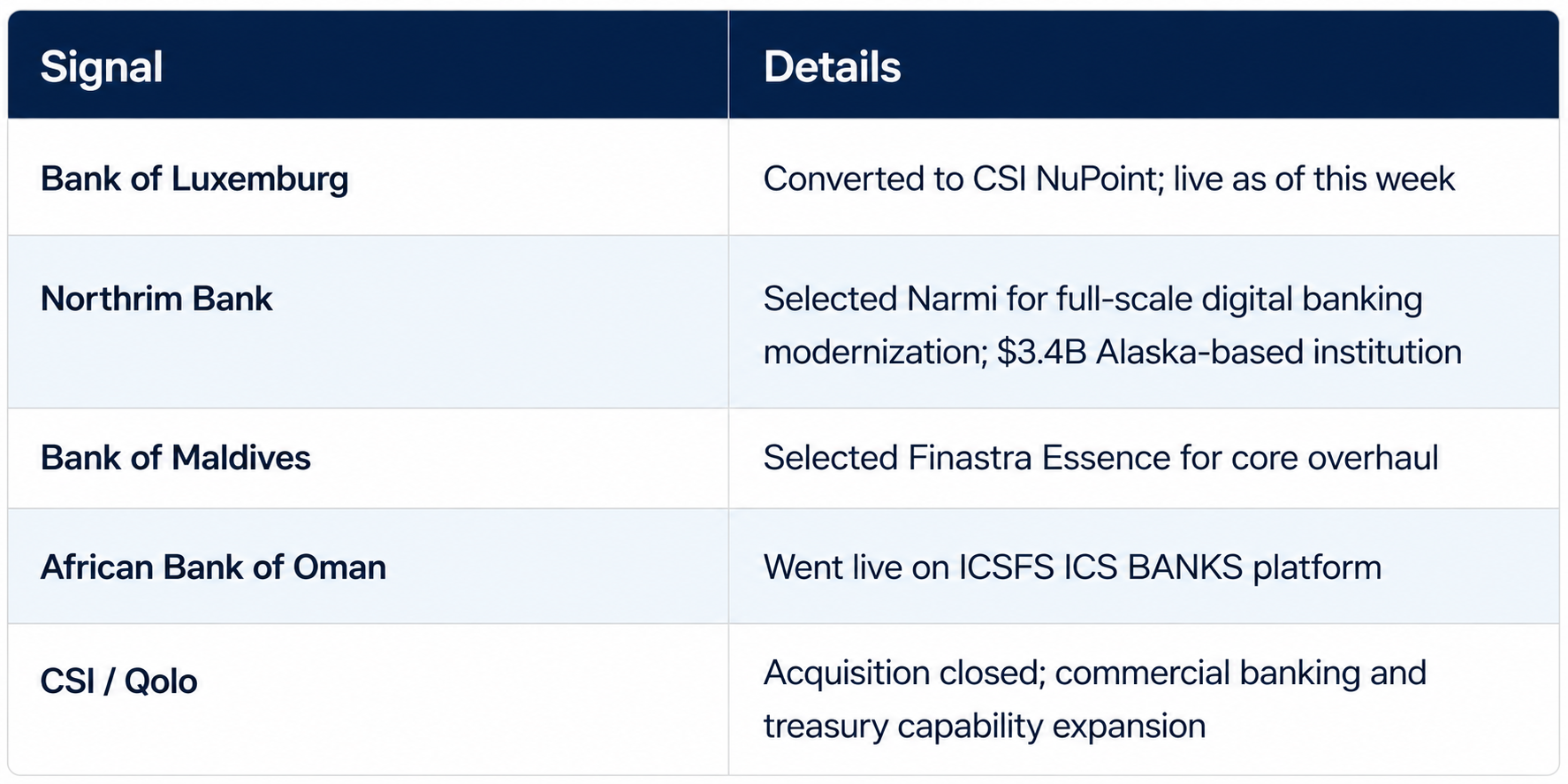
Why it matters: Five core banking and digital platform decisions in a single week is above the normal weekly run rate we track in CB Radar. The geographic spread (U.S. community banks, Middle East, Pacific Island markets) confirms that core modernization is not a regional trend. It is a global one. The community bank segment in particular is moving faster than the conventional wisdom suggests. If you are a vendor without an active community bank reference program, that is a gap worth addressing.
RICK’S STRATEGIC TAKE
➜ The Stripe-PayPal approach is the most important signal of the week, not because the deal happened, but because it reveals how non-bank players are thinking about the next decade. Ecosystem breadth is the new moat. Banks that have not yet developed a clear answer to the question “what is our payments strategy in a world where Stripe, Block, and PayPal are competing for the same relationships we are?” need to have that conversation at the board level, not the product team level.
➜ Five core banking decisions in one week, spanning Wisconsin, Alaska, the Maldives, and Oman, tells me something important: the window for “we’re evaluating our options” is closing. Institutions that have been in extended evaluation mode are watching their peer group go live. Every completed conversion in your peer group raises the question your board will eventually ask: why haven’t we moved yet? The answer to that question gets harder to defend every quarter.
➜ AI governance is becoming the new credit policy. Just as every institution eventually had to build a formal credit risk framework, every institution is going to need a formal AI governance framework, with documented use cases, model risk oversight, and examiner-ready documentation. The banks building that infrastructure now, the ones hiring AI governance leads and model risk officers today, will have a meaningful head start when regulatory expectations sharpen. The ones waiting for final guidance will be building under pressure.
For a deeper framework on what AI-ready core architecture actually requires, see CSP’s CB Architecture Series at coresystempartners.com.
Want the Full Picture?
Subscribe to BIS, the Banking Intelligence Service from Core System Partners, for the full breakdown including Rick’s Strategic Take on the governance gap, the CB Radar vendor tracking signals, and the regulatory pulse analysis covering what SR 11-7 does and does not cover for agentic deployments, delivered weekly. Banking Intelligence Service
For CSP’s full analysis of what the Fed and Treasury are actually concerned about—and a framework for what AI-ready architecture requires—visit Core System Partners.
Continue With Core System Partners
- Contact Us: https://coresystempartners.com/#contact
- The Strategic Flywheel (book): https://coresystempartners.com/resources/strategicflywheel/
- Core Insider (weekly newsletter): https://coresystempartners.com/resources/newsletter/