Issue #36
Weekly Banking Intelligence: September 25 to October 01, 2026
THIS WEEK’S SIGNAL
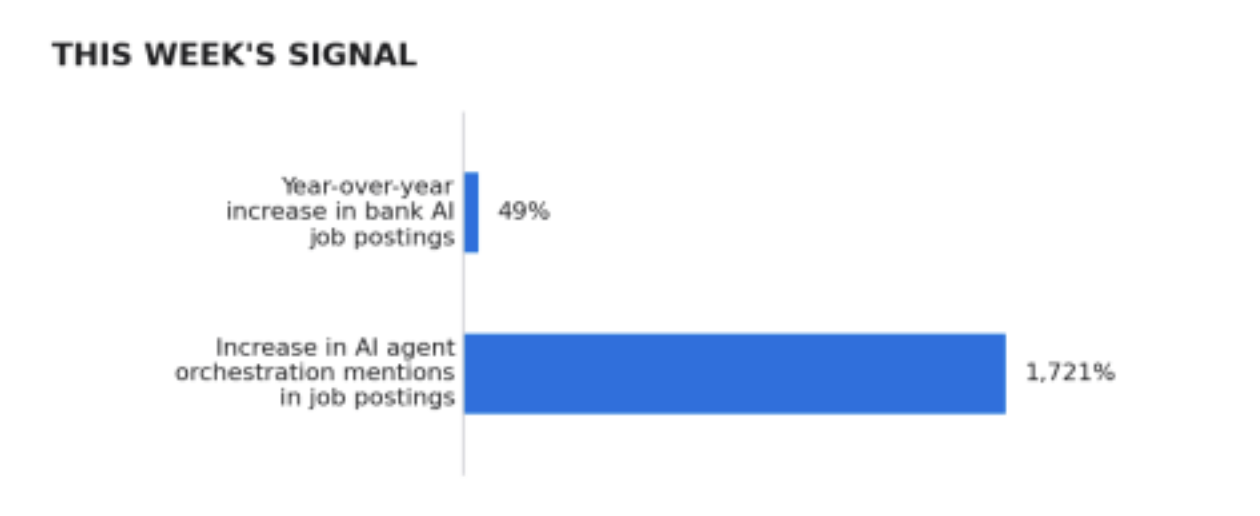
Bank AI job postings jumped 49% this year, with 139,819 open roles tracked across the industry and mentions of AI agent orchestration up 1,721%. That number is not a talent trend. It is a capability gap made visible. Banks are not hiring because AI is working well; they are hiring because they have committed to AI deployment and are now discovering they do not have the people to run it, govern it, or scale it. The institutions that get ahead of this are the ones treating AI staffing as an operating model problem, not a recruiting problem.
DEEP DIVE
Bank of America and the discipline behind AI at scale
Bank of America has been building AI capabilities for more than a decade, starting with fraud detection algorithms in the early 2010s. That history matters because it explains why the bank can now talk about AI governance with specificity rather than aspiration. Every AI project at Bank of America goes through a review covering 16 risk pillars, including privacy, bias, workforce impact, and intellectual property. That is not bureaucracy. That is what production-grade AI governance actually looks like when it has been stress-tested over time.
What caught my attention in the reporting this week was the data traceability point. As reported this week by Fortune, Bank of America and S&P Global described how high-stakes AI applications require the ability to trace an AI-generated output back to the underlying source data. In a regulated environment, that is not optional. If your model makes a credit decision, a compliance call, or a fraud flag, and you cannot explain exactly what data informed that output, you have an audit problem and potentially a regulatory problem.
Why it matters: The 16-pillar review framework and the traceability requirement are not things most banks have built. They require a data architecture that can surface provenance on demand, a governance structure with actual authority to slow down or stop a deployment, and a review process that is embedded in the project lifecycle rather than bolted on at the end. Banks that are standing up AI programs without these foundations are building on sand.
Why it matters for operating model: What Bank of America is describing is not just a technology configuration. It is an operating model. Someone owns the 16-pillar review. Someone has the authority to kill a project that fails it. Someone is responsible for data lineage across the AI stack. Most banks have not assigned those accountabilities clearly, and that gap will show up either in a failed deployment or in an examiner’s findings.
The broader industry picture reinforces this. According to Evident’s 2026 AI Index, which measures AI readiness among 50 of the world’s largest banks, average AI capabilities improved 26% over the past year, nearly three times the pace seen between 2023 and 2025. That acceleration is real. But acceleration without governance infrastructure is how you get fast failures instead of slow ones. The banks that are moving quickly and cleanly are the ones that built the foundation first.
MARKET MOVES
Pathward selects Thought Machine’s Vault Core
Pathward Financial, a South Dakota-based bank holding company that operates primarily as a banking-as-a-service and payments infrastructure provider, selected Thought Machine’s Vault Core as its core banking infrastructure. As reported this week by The Fintech Times, Thought Machine’s named U.S. and Canada clients now include M1 and General Bank of Canada, with Pathward representing a meaningful addition to the North American roster.
Why it matters: Following up on Deutsche Bank’s Vault Core selection reported in Issue #33, Thought Machine is now closing deals across a notably wide range of institution types, from a global private bank to a BaaS-focused mid-tier U.S. bank. That range matters. It suggests Vault Core is being evaluated not just as a premium option for large-scale transformation programs but as a credible choice for institutions with specific product and infrastructure requirements. For any bank currently in a core evaluation, Thought Machine’s growing reference base changes the conversation.
Suffolk County National Bank selects Fiserv Premier
Suffolk County National Bank selected Fiserv’s Premier core account processing platform along with a suite of additional Fiserv solutions including digital banking capabilities.
Why it matters: Community bank core decisions rarely move markets, but the pattern they represent does. This is another institution consolidating its technology environment around a single vendor’s stack, trading flexibility for simplicity. That is a defensible choice, especially for a bank without a large internal technology organization. The question worth asking is whether the simplification also reduces the bank’s ability to integrate best-of-breed capabilities as the AI and digital landscape continues to evolve.
Progressive core modernization: two institutions, one pattern
As reported this week by ABA Banking Journal, a major regional bank is executing a phased core modernization, having already launched a new mobile platform with commercial lending deployment planned for later this year and core deposits targeted for next year. Paul Weiss, chief transformation officer at that institution, is leading the program. Mascoma Bank in New Hampshire is following a similar staged approach.
Why it matters: The term “progressive modernization” is doing a lot of work in the industry right now. At its best, it means a disciplined, sequenced program that manages risk while delivering capability. At its worst, it means indefinite delay dressed up as strategy. What separates the two is whether there is a committed endpoint, a clear architecture target, and someone accountable for the overall program. Not every bank claiming progressive modernization has those things in place.
VENDOR SIGNALS
Backbase conversational banking goes live across 10-plus banks
Backbase, an Amsterdam-based digital banking platform company, moved its Conversational Banking product to general availability on October 8, putting AI agents capable of executing banking tasks within bank-defined controls into live service at more than 10 banks simultaneously. This is not a pilot announcement or a partnership press release. It is a production deployment across multiple institutions at once.
The significance here is the “bank-defined controls” framing. Banks deploying AI agents in customer-facing channels are taking on a new category of operational and compliance risk. The question is not whether the agent can complete a task. The question is whether the bank has defined the guardrails precisely enough, tested edge cases thoroughly enough, and established clear accountability when the agent does something unexpected. Going live at 10-plus banks in a single week compresses the feedback loop considerably.
Fiserv stablecoin platform goes live with Roughrider Coin
Fiserv launched its digital asset platform this week with Roughrider Coin as the first live deployment. Fiserv entering the stablecoin infrastructure space is notable because it positions a company that already sits at the center of thousands of community and regional bank technology stacks as a potential on-ramp for digital asset capabilities at those institutions.
Following up on Issue #32’s coverage of the 21-bank stablecoin consortium, Fiserv’s move suggests the infrastructure layer for bank-issued digital assets is being built out from multiple directions simultaneously. The consortium is building from the top down. Fiserv is building from the bottom up, through the community and regional bank channel. Both roads eventually lead to the same place: banks needing to decide what role, if any, they play in the digital asset ecosystem.
Commonwealth Bank of Australia unlocks 90% of core banking data via AWS
Commonwealth Bank of Australia (CBA) completed a migration that makes 90% of its core banking data accessible via Amazon Web Services (AWS). As reported this week by Tech Insider, Australia’s public cloud spend is tracking toward A$33.6 billion in 2026, a 17.9% increase year over year according to Gartner figures. CBA’s project is among the most significant examples of a major bank treating data accessibility as a strategic infrastructure priority rather than a technology upgrade.
The practical reality for banks watching this is straightforward: AI capability at scale requires data at scale, and data at scale requires an architecture that can actually surface it. CBA’s 90% figure is meaningful not because of the cloud migration itself but because of what it enables downstream. Banks that have not done the work to make their data accessible, clean, and traceable will find that AI ambitions run into data architecture limits faster than they expect.
BSI upgrades from Temenos R10 to R24
BSI, a Swiss private bank, completed its core banking platform migration from Temenos R10 to R24 on May 16, 2026. As reported this week by The Asian Banker, the bank is now evaluating how to convert that infrastructure investment into the next phase of digital growth.
This is a pattern worth watching. The migration itself is the table stake. The harder question, which BSI is now confronting, is what the bank actually does with a modern platform once it has one. Modernization creates optionality. It does not automatically create strategy.
REGULATORY PULSE
Regulators urge caution as AI adoption accelerates
As reported this week by The Banker, banking regulators are increasing their scrutiny of AI deployments even as banks accelerate adoption. The backdrop is the 26% average improvement in AI capability across the 50 largest banks in the past year, a pace that has outrun the development of formal supervisory frameworks at most agencies.
Following up on Issue #34’s coverage of the state-level AI examination framework, the regulatory posture this week reflects a consistent theme: examiners are watching the acceleration and are not yet satisfied that governance is keeping pace. Banks that are moving fast on AI deployment without a defensible governance structure are accumulating regulatory exposure they may not fully see yet. The 16-pillar review framework Bank of America describes in the Deep Dive this week is the kind of documented, auditable process that examiners are increasingly going to ask about.
TALENT SIGNALS
AI job postings up 49%, agent orchestration roles surge
AI-related job postings at banks reached 139,819 this year, a 49% increase. Mentions of AI agent orchestration in job postings jumped 1,721%, according to data reported this week by PYMNTS. That orchestration number reflects a specific capability gap: banks are deploying AI agents and discovering they need people who can design, manage, and govern multi-agent systems, a skill set that barely existed as a job category two years ago.
These roles are rising because AI adoption is creating demand for capabilities that banks do not have internally. That is the direct consequence of moving from AI experimentation to AI production. The harder talent problem is not finding AI engineers. It is finding people who understand both the banking domain and the AI stack well enough to make good decisions about where AI should and should not be deployed.
JPMorganChase signals shift in engineering hiring criteria
JPMorganChase is actively reshaping what it looks for in technology hires in light of AI. As reported this week by GeekWire, on the bank’s July 14 earnings call, CEO Jamie Dimon stated the bank has nearly 1,000 AI use cases in production, with approximately 50 classified as significant, spanning risk, fraud, marketing, and document processing. The bank’s Seattle technology leadership is now framing engineering hiring around AI fluency as a baseline expectation rather than a specialty.
A major Tier 1 bank is hiring for AI governance and model risk roles, signaling that the compliance and oversight side of AI deployment is drawing as much hiring attention as the engineering side. The pattern across Tier 1 institutions is consistent: AI-related roles are expanding because the work is expanding, while traditional middle-office processing and routine analytical roles continue to contract as automation absorbs that work.
CB RADAR UPDATE
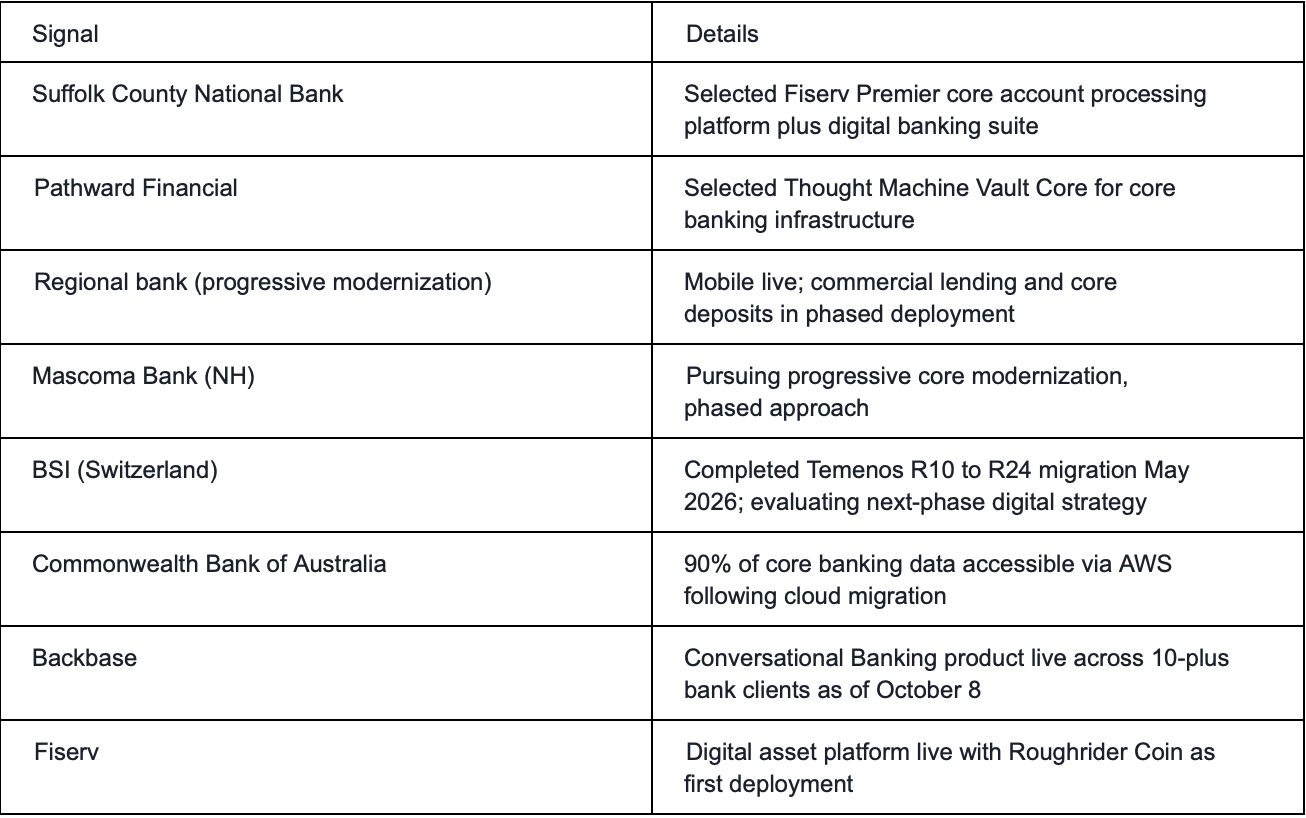
In our proprietary CB Radar database, this week’s signals reflect a market moving in two distinct speeds. A small number of institutions are completing major infrastructure migrations and asking what comes next. A larger number are making incremental vendor selections and platform upgrades. The gap between those two groups is widening, and it shows up most clearly when you look at who is deploying AI agents in production versus who is still evaluating AI pilots.
RICK’S STRATEGIC TAKE
➜ The 49% jump in AI job postings and the 1,721% surge in agent orchestration roles tell you something important about where banks actually are in this journey. The hiring surge is not a sign of confidence. It is a sign that banks committed to AI deployment before they had the operating model to support it. The talent gap is real, but the deeper gap is organizational: who owns AI governance, who has authority to stop a deployment, and who is accountable when an agent does something the bank did not anticipate. Most banks have not answered those questions clearly, and the hiring alone will not answer them. • Bank of America’s 16-pillar AI review framework and its emphasis on data traceability are worth studying regardless of your institution’s size. The principles scale down. You do not need Bank of America’s budget to establish a documented review process, assign clear ownership, and build data lineage into your AI deployments from the start. What you need is the discipline to treat AI governance as a standing operating model requirement rather than a project-by-project afterthought. The banks that build that discipline now will have a meaningful advantage when examiners start asking harder questions, and based on the regulatory signals this week, that is coming.
➜ The Thought Machine momentum across institution types, the Fiserv stablecoin platform launch, and CBA’s data accessibility milestone are all pointing at the same underlying reality: the infrastructure decisions banks are making right now are not reversible on a short timeline. Core platform selections, cloud architecture choices, and data accessibility investments lock in your capability ceiling for the next several years. If I were sitting in the CIO or CEO chair, I would want to know whether the decisions we are making today are expanding that ceiling or quietly constraining it.
For a deeper framework on what AI-ready core architecture actually requires, see CSP’s CB Architecture Series at coresystempartners.com.
Want the Full Picture?
Subscribe to BIS, the Banking Intelligence Service from Core System Partners, for the full breakdown including Rick’s Strategic Take on the governance gap, the CB Radar vendor tracking signals, and the regulatory pulse analysis covering what SR 11-7 does and does not cover for agentic deployments, delivered weekly. Banking Intelligence Service
For CSP’s full analysis of what the Fed and Treasury are actually concerned about—and a framework for what AI-ready architecture requires—visit Core System Partners.
Continue With Core System Partners
- Contact Us: https://coresystempartners.com/#contact
- The Strategic Flywheel (book): https://coresystempartners.com/resources/strategicflywheel/
- Core Insider (weekly newsletter): https://coresystempartners.com/resources/newsletter/