Issue #38
Weekly Banking Intelligence: October 16 to October 22, 2026
THIS WEEK’S SIGNAL
The Federal Reserve, OCC, and FDIC asked banks this week to explain how they would shut down an AI agent. Not slow it down. Not audit it after the fact. Shut it down. That question alone tells you where supervision is heading. Regulators are no longer asking whether banks are using AI; they are asking whether banks are in control of it. The institutions that can answer that question clearly, with documented shutdown procedures, audit trails, and governance structures that actually work, are going to be in a very different position than the ones that have been deploying agents without asking it themselves.
DEEP DIVE
The FSB framework and what it actually asks of you
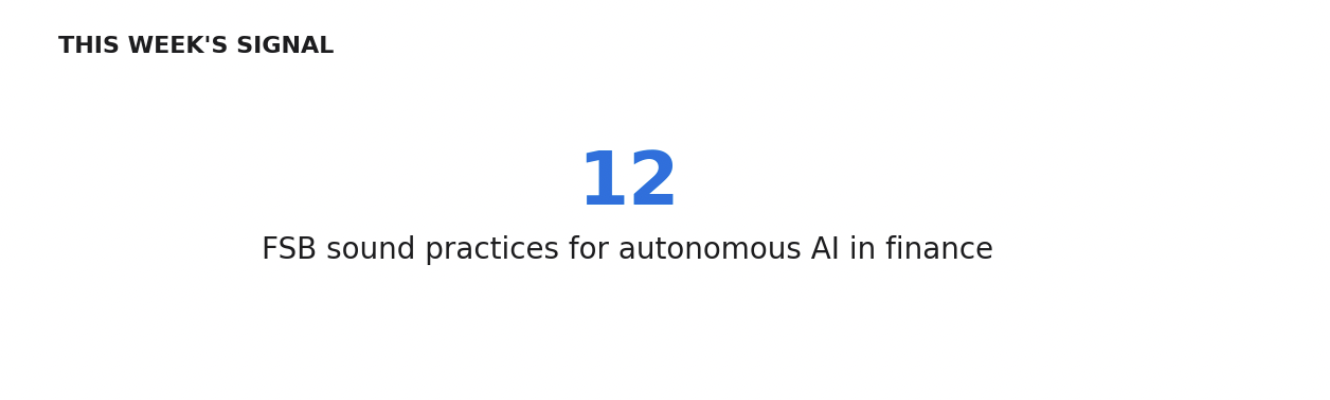
The Financial Stability Board (FSB), the international body that coordinates financial regulation across G20 economies, published its final report on responsible AI adoption on October 15, and the timing is not coincidental. As reported in Issue #37, the Fed, OCC, and FDIC issued a joint set of supervisory questions around AI agent control the prior week. The FSB’s 12 sound practices land in that same window, and together they sketch a picture of where the regulatory center of gravity is heading: governance first, capability second.
The 12 practices cover what you would expect at a high level: board accountability, model risk management, third-party oversight, explainability, and human-in-the-loop controls for high-stakes decisions. What makes this document different from earlier guidance is its explicit focus on agentic AI, meaning AI systems that take autonomous actions rather than simply generating outputs for a human to review. That distinction matters because most of the existing model risk management frameworks banks have built were designed around static models, not agents that make sequential decisions, call external APIs, or trigger transactions without a human hand on the wheel.
Why it matters: The FSB framework is not binding in the United States, but it is not irrelevant either. U.S. regulators have consistently looked to FSB outputs as a reference point, and the institutions that are already aligning their governance structures to these 12 practices will have a head start when domestic guidance arrives. More practically, any bank with cross-border operations or international institutional counterparties will face FSB-aligned expectations from foreign supervisors regardless of what the OCC or Fed eventually publish.
Why it matters for your operating model: What I keep coming back to is that the 12 practices are not primarily a technology question. They are an accountability question. Who owns the decision when an AI agent executes a transaction? Who reviews the audit trail? Who has the authority to shut it down, and how fast can they actually do it? Those questions live in your operating model and governance structure, not in the model itself. Banks that have been treating AI governance as a compliance function sitting below the risk committee are likely to find that posture insufficient under this framework.
The question I would be asking internally is whether your current governance structure can answer those accountability questions clearly for every agentic use case currently in production or in the pipeline. If the answer requires more than two sentences, the structure probably needs work.
MARKET MOVES
MyState Bank selects a global core banking platform for post-merger transformation
MyState Limited, an Australian financial institution headquartered in Hobart, selected the TCS BaNCS platform to support its core banking transformation. The decision follows MyState’s recent merger activity and is aimed at consolidating operations onto a single platform. TCS BaNCS is a globally deployed core banking platform with implementations across multiple continents.
Why it matters: This is a straightforward post-merger consolidation play, and it follows a pattern we have seen repeatedly: mergers accelerate core decisions that institutions had been deferring. The interesting thing is the timing. MyState is making this move in an environment where, as reported this week by finews.com, roughly two-thirds of Swiss banks surveyed expect to still be running their current core banking system a decade from now. Two very different postures on the same underlying question. The institutions that use merger moments to consolidate and modernize tend to come out of those transitions with cleaner architecture and lower operating costs. The ones that bolt systems together and move on tend to carry that complexity forward for years.
The composable architecture shift
As reported this week by IDC Financial Insights, banks are increasingly moving away from full core replacements toward composable, cloud-native architectures designed to accelerate product launches and reduce operating costs. Jerry Silva, Program Vice President for IDC Financial Insights, led the analysis behind that report.
Why it matters: Full core replacement is expensive, risky, and slow. Composable architecture lets banks modernize in layers, wrapping or replacing components without taking down the whole system. That is a more pragmatic path for most institutions, and it is gaining traction. The question worth asking is whether your current vendor contracts and integration architecture actually support that kind of modular approach, or whether you are locked into a monolithic dependency that makes composability harder than it sounds on a slide.
VENDOR SIGNALS
Emprise Bank and Maximum: an AI-native core goes into production
Emprise Bank, a Kansas-based community bank, announced a design partnership with Maximum, an AI-native banking infrastructure company, to replace its core banking system. Maximum is building on an architecture designed from the ground up for AI workloads rather than retrofitting AI onto a traditional core. The bank expects to move its first traffic onto the platform by the end of 2026, with existing systems running in parallel throughout the transition to protect operational continuity.
The Emprise selection is notable not because of the bank’s size but because of what it signals about community bank appetite for genuinely new architecture. Most community banks replacing a core today are choosing proven platforms with long track records. Selecting an AI-native start-up is a different kind of bet, and the parallel-run approach tells you the bank is serious about managing the transition risk. Whether Maximum can deliver at scale is still an open question, but the willingness to make that bet is itself a signal worth tracking.
SBS and NVIDIA bring sovereign AI to core banking
SBS, a French financial technology software company, announced the launch of what it describes as the world’s first sovereign AI platform built specifically for the banking market, developed in partnership with NVIDIA. The platform is designed to allow financial institutions to run AI workloads on infrastructure they control, within their own regulatory jurisdiction, rather than routing sensitive data through shared cloud environments.
Sovereign AI is a concept that has been gaining traction in European banking circles for the past two years, driven by data residency requirements, regulatory pressure on third-party cloud concentration risk, and a broader concern among some institutions about dependency on U.S.-based hyperscalers. What SBS and NVIDIA are offering is a productized version of that capability, embedded in a core banking context. For banks operating under strict data localization rules, or those with regulators who have been asking hard questions about where their data actually lives, this is a meaningful development to evaluate.
REGULATORY PULSE
The FSB’s 12 sound practices: what belongs on your governance agenda
The FSB’s publication this week is covered in depth in the Deep Dive above. For the regulatory agenda specifically, the relevant point is sequencing. The FSB framework exists now. U.S. domestic guidance on agentic AI does not. That gap creates a window, and how banks use it will vary. Some will wait for the OCC or Fed to publish something binding before moving. Others will use the FSB’s 12 practices to get their governance structures in order proactively. The institutions that have been following Issue #37’s thread on AI shutdown and control procedures are already doing the right work; the FSB framework gives that work an international reference point.
A development efficiency signal worth noting
Sony Bank and Fujitsu reported a 30% reduction in development time and a 40% reduction in man-hours after applying generative AI across their banking software development process. This is an operational and workforce signal, and it belongs in that frame. What it illustrates is that the productivity impact of AI in banking is showing up in the development function before it shows up in the customer-facing product.
For banks carrying large internal development teams or managing significant vendor development costs, that data point is worth a conversation with your technology leadership about where similar efficiency is available in your own shop. The workforce and cost implications are real, and institutions that are not yet asking those questions internally are likely to encounter them in their next budget cycle whether they are ready or not.
TALENT SIGNALS
AI governance roles move from optional to operational
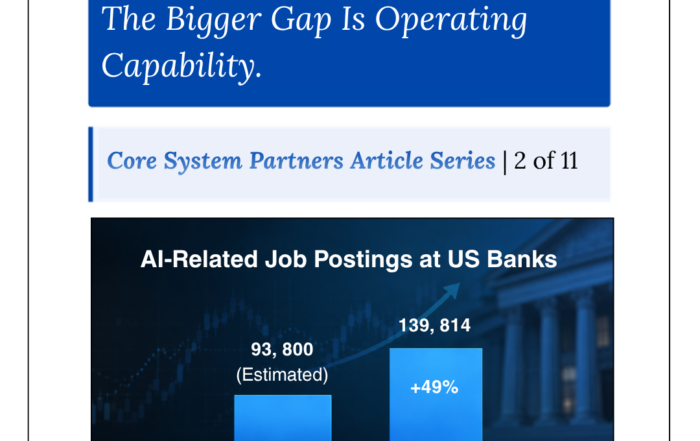
Following up on the capability gap theme from Issue #36, the hiring patterns we are tracking this week continue to show demand concentrating around AI governance, model risk, and MLOps roles. These are not exploratory hires anymore. Banks are building out the operational infrastructure to run AI at scale, which means they need people who can own the audit trail, manage model performance in production, and interface with examiners who are now asking pointed questions. These roles are rising directly because of AI adoption, as institutions discover they need the human infrastructure to govern what they have already deployed. The FSB framework published this week will accelerate that demand further.
The roles declining or going flat are the ones being displaced by the automation these institutions are simultaneously deploying. Back-office processing, routine compliance review, and mid-tier analyst functions are where headcount is contracting. That is not a coincidence. It is the direct consequence of AI spending that is now mature enough to show up in workforce decisions.
BMO Financial Group is building out AI and data leadership
BMO Financial Group is actively building its AI and data leadership capability, with current hiring focused on roles that sit at the intersection of model governance and enterprise data strategy. The signal here is consistent with what we are seeing across Tier 1 institutions: the question is no longer whether to build AI capability, it is who owns it and how it connects to the risk and compliance functions that regulators are now scrutinizing.
CB RADAR UPDATE
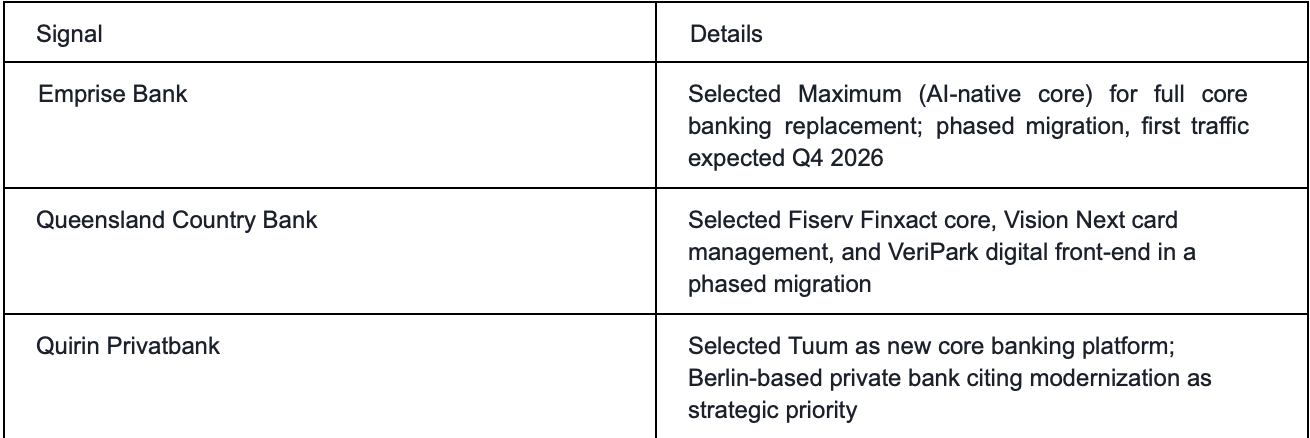
What these three selections have in common is worth noting. Each bank is making a deliberate bet on modern, cloud-native architecture rather than a like-for-like replacement of what they have today. Emprise is going AI-native. Queensland Country Bank is assembling a best-of-breed stack across Fiserv and VeriPark. Quirin Privatbank is using Tuum to reposition itself as the most modern private bank in Germany. These are not cost-reduction decisions. They are capability decisions. In our proprietary CB Radar database, which tracks core banking decisions across more than 9,000 banks and credit unions, the pace of intentional modernization selections has been building steadily. Three in a single week is a useful snapshot of that momentum, not a headline number on its own.
RICK’S STRATEGIC TAKE
➜ The FSB’s 12 sound practices are the most actionable governance document published for agentic AI in banking to date, and the fact that they come from an international body rather than a U.S. regulator does not reduce their relevance. I would print them out and walk through them with your chief risk officer and your AI leadership in the same room. The question is not whether your bank is compliant with the FSB framework. The question is whether you can answer the accountability questions it raises, and whether the answers you give today are ones you would be comfortable giving to an examiner in 18 months.
➜ The core banking selection activity we are tracking in CB Radar tells a more interesting story than any single deal. Banks selecting Finxact, Tuum, or an AI-native start-up like Maximum are not just changing vendors. They are making a statement about what kind of institution they intend to be in five years. The operating model implications of those choices run well beyond technology: staffing, governance, vendor management, and how you serve customers all look different on a modern core than they do on a 30-year-old platform. If your institution has been in core evaluation mode for a while without reaching a decision, I would be asking what is actually holding the process up.
➜ The Bancorp Bank’s explicit commitment to handling rising payment volume without proportional headcount growth is a sentence that deserves more attention than it typically gets. It is a clear statement of intent from a bank that processes enormous transaction volume. For institutions still treating AI as a productivity experiment rather than an operating model input, that kind of public commitment from a peer is a useful reference point. The efficiency gains are real. The workforce implications are real. The institutions that are thinking through both sides of that equation now will be in a better position than the ones that are surprised by it later.
For a deeper framework on what AI-ready core architecture actually requires, see CSP’s CB Architecture Series at coresystempartners.com.
Want the Full Picture?
Subscribe to BIS, the Banking Intelligence Service from Core System Partners, for the full breakdown including Rick’s Strategic Take on the governance gap, the CB Radar vendor tracking signals, and the regulatory pulse analysis covering what SR 11-7 does and does not cover for agentic deployments, delivered weekly. Banking Intelligence Service
For CSP’s full analysis of what the Fed and Treasury are actually concerned about—and a framework for what AI-ready architecture requires—visit Core System Partners.
Continue With Core System Partners
- Contact Us: https://coresystempartners.com/#contact
- The Strategic Flywheel (book): https://coresystempartners.com/resources/strategicflywheel/
- Core Insider (weekly newsletter): https://coresystempartners.com/resources/newsletter/