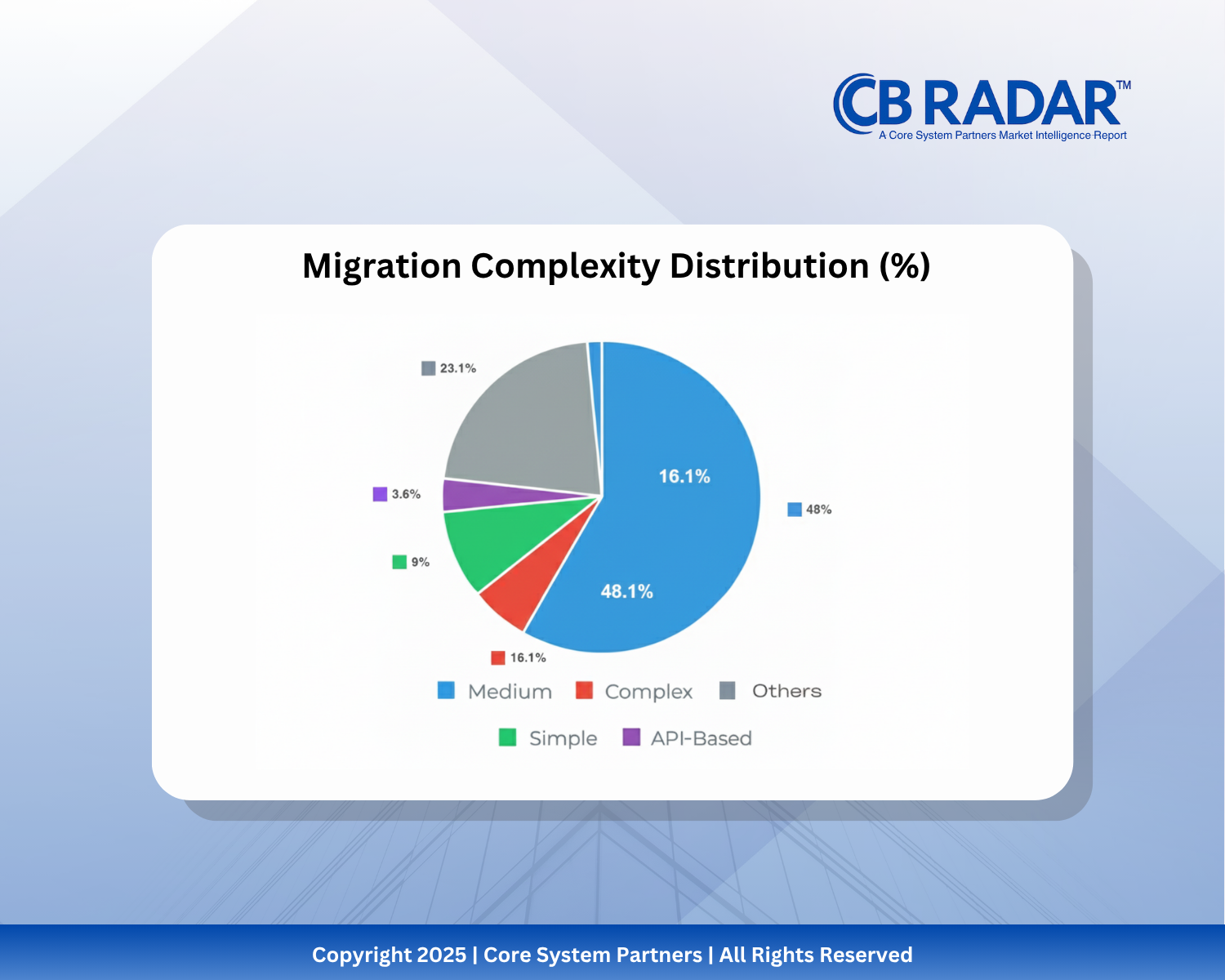
Banks with medium-complexity migration programs achieved the highest success rates, balancing ambition with delivery capacity.
In CB RADAR™ 2025, one trend stood out across the dataset: the majority of successful transformations were rated as medium complexity.
Not too simple, not too ambitious — just right.
While high-complexity programs often stumbled under their own weight, and low- complexity upgrades delivered limited value, it was the mid-range programs that consistently hit their marks.
“In core modernization, balance beats ambition.”
The Goldilocks Zone of Transformation
The findings suggest that success isn’t about how much you take on — it’s about
how much you can absorb.
- Low-complexity projects (e.g., digital channel refreshes or partial core modules) deliver quick wins but rarely move the strategic needle.
- High-complexity programs (multi-core replacements, enterprise-wide overhauls) promise transformation but risk delay, cost overrun, and fatigue.
- Medium-complexity efforts strike the balance: broad enough to create change, narrow enough to control.
- Manageable scope: Clear deliverables within 18–24 months.
- Defined ownership: Fewer competing governance layers.
- Integrated delivery: Teams that can iterate without losing direction.
- Phased design: Each stage delivers independent business value.
- Stable governance: Decisions are made fast and enforced consistently.
- Cultural readiness: Teams are trained to adapt, not just comply.
“The most successful programs didn’t try to do everything — they focused on what mattered.”
Why Medium Complexity Works
Mid-range programs tend to align better with business readiness. They have:
Banks that adopt this structure avoid the paralysis of scale while still generating visible value.
In short: medium complexity is where ambition meets realism.
The Risk of Going Too Big
Large-scale, multi-core replacements often collapse under competing priorities. The problem isn’t technology — it’s organizational bandwidth.
“Transformation failure isn’t caused by weak technology; it’s caused by overwhelmed organizations.”
When too many moving parts converge — multiple business lines, conflicting KPIs, unclear governance — complexity becomes chaos.
The irony is that the more ambitious the program, the more likely it is to be derailed by its own scope.
The Value of Focus
CB RADAR™ data shows that successful medium-complexity transformations share a few traits:
These characteristics create a repeatable transformation rhythm — sustainable progress rather than one-time heroics.
“The best programs behave less like projects and more like operating models.”
What It Means for the Next Wave
As banks plan their next round of modernization, the lesson is clear: Transformation scale should match organizational maturity, not aspiration.
A well-defined, medium-complexity approach doesn’t mean thinking small — it means executing smart.
It’s the difference between disruption that lasts and change that collapses under pressure.
What CB RADAR™ Reveals
CB RADAR™ 2025 reframes success not as a function of ambition, but of alignment.
Medium-complexity programs are where strategy, delivery, and culture converge and where transformation turns into traction.
Read the full CB RADAR™ 2025 report to see how complexity, governance, and delivery maturity intersect across 113 transformations worldwide.
And if you want to benchmark your own institution’s readiness against the market, you can also try our Core Banking Transformation Readiness Scorecard, which helps you see how your bank stacks up against the themes revealed in CB RADAR™.
CB RADAR™ is not a vendor pitch. It’s a reality check. And in a market where every decision carries long-term consequences, clarity is your strongest advantage.
#CoreBankingTransformation #CoreBankingBenchmarks