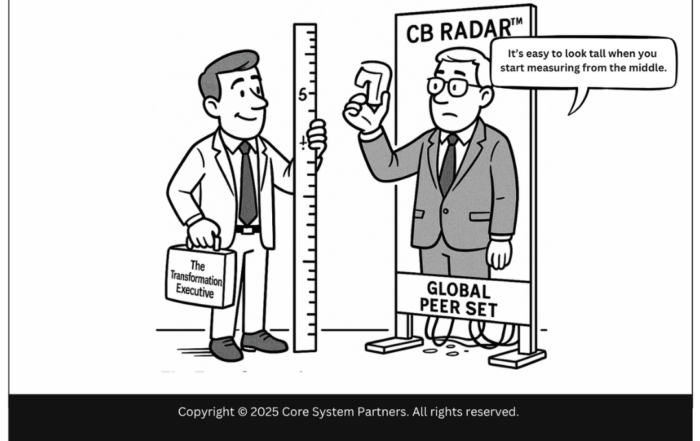
A quick reset before we dive in
We have decided to change the format of News of the Week.
BofA Eyes 12% Growth with AI Push
Bank of America held its first investor day in nearly 15 years today, and CEO Brian Moynihan didn’t hold back, forecasting 12% annual earnings-per-share growth over the next three to five years, a ROTCE target of 16-18%, and the consumer bank gunning for $20 billion in profits. AI isn’t a side note here; it’s load-bearing infrastructure for the whole strategy. Moynihan has previously disclosed that BofA used AI techniques to cut 30% out of coding workflows, effectively saving 2,000 people, and that Erica, their consumer AI assistant, is the equivalent of 11,000 full-time employees in saved capacity. The markets business is projecting nearly double revenue growth by 2030, and the investment bank wants to add 50-100 basis points of global dealmaking market share. Whether BofA can actually close the performance gap on its big bank peers, its stock has lagged all five closest rivals over five years, is the real test, but the message today was clear: responsible growth has a new co-pilot, and it runs on AI.
Sources: Yahoo Finance
Wall Street CEOs Get Real on AI and Jobs
Business Insider compiled the most candid CEO statements on record about AI and jobs, and the picture is more nuanced — and more ominous — than the talking points suggest. EY surveyed 240 financial services CEOs and found 60% expect AI to maintain or increase headcount in 2026, but the actual numbers inside the banks tell a different story: JPMorgan operations staff down 4%, Wells Fargo engineers 30-35% more productive with no offsetting hiring, Goldman explicitly constraining headcount growth, and Citi’s CFO expecting headcount to “continue trending down” as AI improves productivity. BofA’s Moynihan put it plainly: coding efficiency gains “saves us about 2,000 people.” Wells Fargo’s Scharf was the bluntest of all — “anyone who says they don’t think they’ll have less head count because of AI either doesn’t know what they’re talking about or is just not being totally honest about it.” Translation: the official line is “we’re redeploying people,” and the actual line is “we’re doing more with fewer people,” and both are true at the same time.
Sources: Business Insider
McKinsey Warns Banks Are Heading Straight for “Pilot Purgatory”
McKinsey dropped a new report this week arguing that banks are among the businesses best positioned to benefit from agentic AI, and simultaneously at most risk of squandering that advantage. The logic: 50-60% of a typical bank’s full-time equivalents are tied to service operations, making banking a prime target for AI-driven transformation second only to technology and engineering itself. But McKinsey’s warning is sharp, too many institutions are experimenting with narrow use cases without scaling, and they’re falling into what the firm calls “pilot purgatory,” where the pilots run forever and the ROI never materializes. To actually generate meaningful value, McKinsey says banks need to rewire entire domains. operations, frontline distribution, technology, data science, risk management. and embed AI at the core rather than bolting it onto processes designed for a different era. Here’s the thing: this isn’t new advice, but coming from McKinsey in early March 2026, it’s a signal that the gap between leaders and laggards is starting to look permanent.
Sources: Banking Exchange
Plaid Hits $8 Billion Valuation as Its Fraud Tools Grow 400%
Plaid quietly closed a new funding round last week that values the company at $8 billion, up from $6.1 billion just ten months ago — and while the primary purpose was employee liquidity rather than capital expansion, the numbers underneath tell the real story. Anti-fraud services grew roughly 400% annually, payments facilitation grew 250%, and together those newer product lines now represent more than 20% of annual recurring revenue, growing at nearly 93% year-over-year. The company connects over 8,000 applications to more than 12,000 financial institutions and has quietly evolved from “just” being banking infrastructure into a full-stack fraud detection, risk management, and credit underwriting platform. Basically, Plaid started as the plumbing that made fintech possible, and it’s now becoming the security system, the payment processor, and the credit engine — and with those growth rates and an IPO path becoming more visible, the $8 billion valuation looks conservative rather than ambitious.
Sources: TechFunding News
Survey: Banks Are Deploying AI Faster Than They’re Governing It
Wolters Kluwer published its Q1 2026 Banking Compliance AI Trend Report this week based on 148 financial institutions, and the findings are a useful reality check on how the industry’s AI ambitions are actually translating into practice. Only 31.8% of institutions surveyed have deployed AI or ML technologies into production — and of those, only 12.2% describe their AI strategy as “well-defined and resourced.” Meanwhile, 46.6% cite operational efficiency as their primary AI goal, but only 35.8% have established internal policies for ethical AI use, and just 26.4% are confident their AI initiatives comply with regulatory requirements. The governance gap is real: 58.8% of respondents said what would most help their AI strategy is clearer regulatory guidance — meaning over half of banks are essentially waiting for regulators to tell them the rules before they’ll commit to a governance framework. That’s not exactly a posture that inspires confidence when the same institutions are simultaneously telling investors how aggressively they’re deploying AI.
Sources: Wolters Kluwer
Credit Investors Sound AI Bubble Alarm
A new Bank of America survey of institutional credit investors found that 23% now say the threat of an AI bubble is their single biggest concern — up sharply from just 9% in December 2025, a near-tripling in three months. These aren’t retail investors momentum-trading AI stocks; these are insurance companies, hedge funds, and pension managers who buy investment-grade corporate bonds and track how much debt companies are taking on to fund AI infrastructure. The context: the four largest AI hyperscalers — Alphabet, Microsoft, Meta, and Amazon — are collectively on track to spend $700 billion on AI capital expenditures in 2026 alone, and all four stocks are down year-to-date. For banks, this matters in two directions: as heavy AI investors themselves, they’re exposed to questions about ROI timelines, and as lenders to the tech sector, they’re watching whether all that AI infrastructure debt starts to look shaky. Whether the bubble concern is prescient or just anxiety is genuinely unclear — but when bond market professionals triple their worry level in three months, that’s worth paying attention to.
Sources: Motley Fool
Don’t blink—the banking Singularity is accelerating.
If you’re finding these breakdowns valuable, give it a Like and Subscribe so we can keep the real conversations going.
Like this week’s highlights?
Don’t miss the next one.
Ready to Explore?
Subscribe to our newsletter for exclusive insights, transformation strategies, and the latest banking technology updates.