
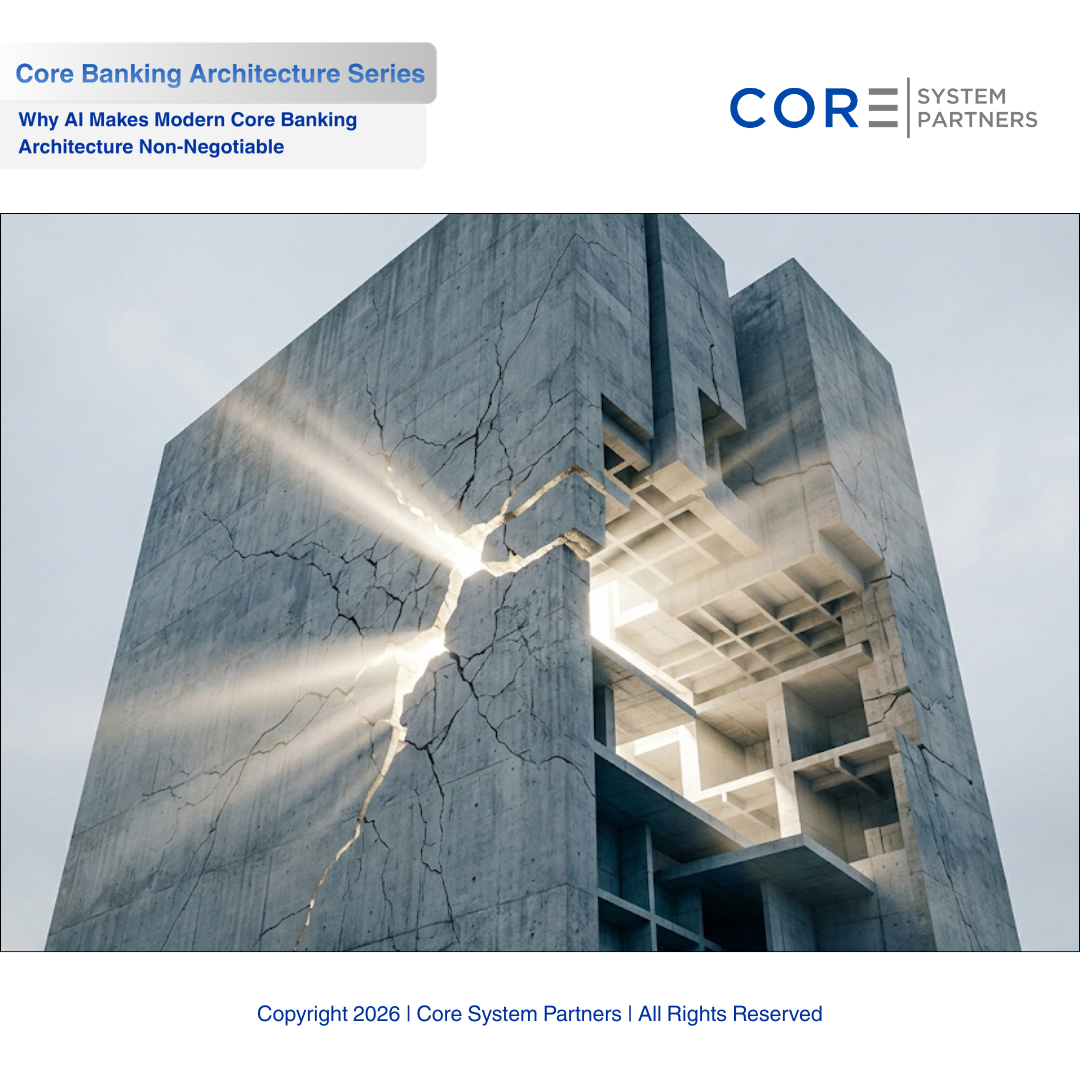
AI isn’t just another feature, it exposes weak architecture. Without a modular, well-governed, AI-ready core, intelligent automation simply won’t scale.
For years we’ve had the core architecture conversation.
Layered versus monolithic. APIs. Middleware. Event-driven design. Composability. Cloud. Data strategy. Governance. Operating models.
Most banks nodded along.
Some invested seriously.
Many patched.
A few postponed.
AI just ended the debate.
What used to be a strategic improvement project is now a survival requirement. Not because AI is magical. Not because consultants say so. Because AI exposes architectural weakness instantly. It does not politely coexist with brittle systems. It breaks them.
If your architecture cannot support AI natively, your AI strategy will stall before it delivers measurable value.
And that has consequences.
The AI Shockwave Is Architectural
Let’s be clear.
AI is not a feature. It is not a chatbot layer. It is not a reporting enhancement. It is not another digital initiative.
AI is an architectural force.
Large models and intelligent agents require:
- Consistent, trusted data
- Clear domain boundaries
- Real-time or near real-time event access
- Secure orchestration across systems
- Traceability and lineage
- Operational guardrails
If your stack cannot provide those things cleanly, AI initiatives either slow down dramatically or create unacceptable risk.
Executives who once hesitated on modernization are accelerating it. The revenue promise is large. The cost pressure is real. The architectural exposure is immediate.
Later is no longer an option.
Architecture Debt Is Now Visible
Every bank carries architectural debt. That is normal.
The question is whether that debt is manageable.
In the pre-AI era, debt could hide. You could add middleware. Build another integration. Stand up a reporting layer. Hire people to manually reconcile gaps. Deliver incremental digital improvements without fully cleaning up the stack.
AI does not tolerate that.
When a model needs context across deposits, lending, payments, and customer interactions, brittle integrations become bottlenecks. When regulators ask for explainability, fragmented data lineage becomes a compliance exposure. When AI agents begin orchestrating workflows, loosely governed APIs become operational risk.
The shortcuts taken over twenty years surface quickly.
Many executive teams are now recognizing something uncomfortable: the architecture we thought was good enough is not ready for intelligent automation at scale.
Digital Transformation Didn’t Fix the Foundation
We have seen the pattern repeatedly.
A bank launches a digital transformation. New mobile app. New CRM. API layer added. Some cloud migration. A few fintech partnerships.
It looks modern.
Underneath, the core architecture often remains tightly coupled and difficult to evolve.
That model worked when the objective was incremental channel improvement. It does not work when the objective is enterprise-wide intelligence.
AI is horizontal. It touches underwriting, servicing, fraud, marketing, treasury, call centers, compliance, operations, and executive decision-making.
If your architecture is vertically siloed, AI deployment becomes a negotiation every time you try to expand a use case.
That is not scalable.
What an AI-Ready Core Actually Requires
There is nothing exotic about the answer. It resembles what disciplined architecture leaders have advocated for years.
An AI-ready core stack requires:
1. Clear Domain Separation
Deposits, lending, payments, and customer data must have defined ownership and boundaries.
2. Modular Services and Clean Interfaces
Secure, documented, versioned APIs. Not ad hoc point-to-point integrations.
3. Event Visibility
The ability to detect and respond to business events in real time or near real time.
4. Unified Data Architecture With Shared Meaning
Strong data architecture is not just about structured schemas and consolidated storage. It also requires clarity of meaning across the enterprise.
A data model defines how information is structured and stored. Tables, fields, relationships, constraints. It governs transactional integrity.
An ontology defines what those entities mean and how they relate conceptually across domains. What is a customer across retail and commercial lines. What is an exposure across lending and treasury. What is a relationship versus a household versus a legal entity.
Most banks have data models. Few operate with a formal enterprise ontology. AI systems depend on both structure and shared meaning. Without semantic alignment, intelligent automation produces inconsistent or misleading outcomes.
We will examine this distinction in more detail in an upcoming article in this series.
5. Governance Embedded in the Stack
Model auditability, traceability, and explainability must be supported by infrastructure, not layered on manually.
6. An Operating Model That Supports Continuous Change
Architecture becomes a standing capability with cadence and authority.
None of this is new. What is new is the urgency.
Replacement or Evolution
Do you need to replace your core to become AI-ready?
Not always.
Some banks can modularize effectively around an existing core. They can introduce domain services, improve API discipline, strengthen data architecture, and formalize semantic alignment. With the right sequencing, this path can work.
Others face harder realities. Certain legacy platforms cannot support the decoupling and event exposure required. In those environments, incremental modernization becomes more expensive than structured replacement.
The decision should not be driven by hype. It should be driven by architectural facts.
We will examine both pathways in this series.
Regulators Are Watching the Architecture
Supervisors are not simply asking whether you use AI. They are asking whether you control it.
Can you trace a model’s output back to source data?
Can you reproduce decisions?
Can you demonstrate proper access controls?
Can you isolate failures?
These are architectural questions.
Banks that treat AI governance as a documentation exercise will discover that governance failures originate in structural design choices.
Architecture and risk are now inseparable.
This Is the Baseline
This Article defines the baseline.
Before debating advanced AI use cases, banks must determine whether their architecture can support intelligent systems safely and sustainably.
In the articles that follow, we will break down:
- The architectural capabilities required for AI readiness
- Modernization pathways under AI pressure
- Integration and event strategies
- Data structure versus enterprise meaning
- Governance and regulatory implications
- Vendor strategy in an AI-dominated market
- The operating model and talent shifts required
AI did not create the need for strong core banking architecture. It exposed the cost of avoiding it.
If you want to assess where your institution stands, explore the CSP Transformation Readiness Scorecard or schedule a working session. The gap between AI ambition and architectural readiness is measurable.
And measurable gaps can be closed.
#CoreBankingTransformation #CoreBankingArchitecture