
Issue #30
Weekly Banking Intelligence: August 21 to August 27
THIS WEEK’S SIGNAL
The tokenization of Wall Street is no longer a pilot program. Wells Fargo announced this week it will offer tokenized deposits to corporate and commercial clients this fall, joining JPMorgan and Citi, which already operate similar services. At the same time, U.S. fintech investment topped $80 billion in the first half of 2026, driven by infrastructure deals, not consumer apps. The money is flowing to the plumbing: payments rails, core banking, orchestration layers. The pattern is clear. The institutions that built the right foundation are now moving fast. The ones still working through their architecture backlog are watching from the sideline.
DEEP DIVE
The Workforce Math at BNY Mellon: What the Numbers Actually Tell Us
Bank of New York Mellon’s (BNY Mellon) AI story got more specific this week. The bank’s headcount has declined from approximately 53,000 to 48,000 employees as automation has expanded, with roughly 60% of repetitive operational tasks now handled by machines. The bank’s internal AI platform, Eliza, is now in use across virtually all staff. BNY Mellon has framed this as a deliberate efficiency strategy, not attrition.
Why it matters: I want to be careful here. The headcount reduction is real. The task-shift percentage is a number BNY Mellon is putting forward publicly. What we cannot independently confirm is whether the profitability improvement attributed to AI is fully causal or whether other factors, cost discipline, business mix, rate environment, are doing some of the work. The number that is harder to argue with is the operational one: 60% of repetitive tasks shifted to machines across a 48,000-person organization is a structural change, not a rounding error. If that holds under scrutiny, it is one of the clearest data points the industry has seen on AI’s operational impact at scale.
Why it matters: The operating model implication is the part most institutions are underestimating. BNY Mellon did not just deploy AI tools. It redesigned workflows, redefined roles, and built an internal platform that spans the enterprise. That takes governance, change management, and a leadership team willing to make hard decisions about what humans do and what machines do. The technology was probably the easier part. Most banks are still debating the governance question while BNY Mellon is reporting the results.
The EU Artificial Intelligence (AI) Act’s high-risk provisions, which include credit scoring and customer-facing decisioning, became applicable on August 2, 2026. BNY Mellon’s Eliza deployment, and any similar enterprise AI platform at a bank operating in Europe, now falls squarely inside that regulatory perimeter. Auditability, explainability, and human oversight are not optional features at this scale. They are compliance requirements.
For banks watching BNY Mellon and considering a similar path: the sequencing matters. Governance architecture and operating model design have to come before broad deployment, not after. The institutions that get this right will have built the control layer first. The ones that rush the deployment and retrofit the governance will pay for it, either in regulatory friction or in operational failures that are very public and very expensive.
MARKET MOVES
Tokenized Deposits: The Race Is Now Real
Wells Fargo’s announcement that it will offer tokenized deposits to corporate and commercial clients this fall is the signal that tokenization has crossed from experiment to competitive necessity. JPMorgan’s Kinexys platform and Citi’s equivalent service are already live. The total addressable market being cited across major bank disclosures is approximately $5.5 trillion in wholesale transaction flows that could move to blockchain-based settlement rails. This is not retail banking. This is the corporate treasury and institutional segment, where speed, finality, and programmability matter enormously.
Why it matters: The banks that are not in this conversation by early 2027 will be explaining to corporate clients why their settlement capabilities lag the competition. This is not a technology story at this point; it is a client retention story. The harder question for most institutions is not whether to offer tokenized deposits but whether their back-office infrastructure, compliance framework, and treasury operations are ready to support it. Announcing the product is the easy part.
Fintech Infrastructure M&A: $80 Billion and Counting
U.S. fintech investment topped $80 billion in the first half of 2026, and the composition of that capital tells the real story. The largest single transaction was Fidelity National Information Services’ (FIS) $24.3 billion acquisition of Worldpay, the Cincinnati-based payments processor. A $13.5 billion divestiture also featured in the top deals. What is notable is where the rest of the capital is concentrated: infrastructure. Core banking, payments rails, orchestration layers, and compliance tooling are attracting the serious money, not consumer-facing applications.
Why it matters: When strategic acquirers and private equity are both chasing the same infrastructure layer, it tells you something about where the durable value is expected to sit. For bank technology buyers, this has a practical consequence: the vendor landscape is consolidating, pricing power is shifting toward the infrastructure providers, and the negotiating window for favorable long-term contracts is narrowing. Banks that have not done a rigorous review of their infrastructure vendor relationships in the past twelve months should probably do one now.
VENDOR SIGNALS
Core Banking Modernization: Multiple Signals, One Direction
Three core banking signals this week, each worth tracking separately.
Pathward Financial (a federally chartered bank and payments-focused institution headquartered in Sioux Falls, South Dakota) selected Thought Machine for its core banking upgrade. Thought Machine, the London-based cloud-native core banking vendor, also crossed $100 million in annual recurring revenue (ARR) this week according to industry reporting. Separately, 10x Banking (another cloud-native core platform founded by former Barclays CEO Antony Jenkins) raised £40 million in new funding. These two data points arriving in the same week are not coincidental. The core modernization trade has moved from thesis to commercial proof.
Prevail Bank, a community bank based in Medford, Wisconsin, selected Jack Henry for its core processing platform and digital banking solutions. Jack Henry serves a large number of community and mid-size financial institutions across the United States. For community banks evaluating their options, the Jack Henry selection signals continued confidence in established domestic platforms alongside the growth of newercloud-native alternatives.
Flagstar’s Core Selection: What We Know and What We Should Be Careful About
Flagstar Bank selected a new core banking platform this week to replace its existing systems, which run on Fiserv’s DNA core and a Fidelity National Information Services (FIS) platform. The replacement has been described publicly as a “cloud-native” core. What caught my attention is that the specific platform selected has not been confirmed by name in the sources available to us, and that matters.
The term “cloud-native” is doing a lot of work in vendor marketing right now. A genuinely cloud-native core is built from the ground up on cloud infrastructure, with API-first architecture, continuous deployment capability, and no legacy batch-processing dependencies underneath. Several platforms currently marketed as cloud-native are, on closer inspection, legacy systems that have been containerized or hosted in the cloud without meaningful architectural redesign. That is a very different thing. Until we can confirm the specific platform Flagstar selected and assess its actual architecture, we are not in a position to validate the “cloud-native” characterization. We will follow this closely and report back when we have a confirmed name and a clearer picture of what is actually under the hood.
Bangko Sentral ng Pilipinas Funds Rural Core Modernization
The Bangko Sentral ng Pilipinas (BSP), the Philippines’ central bank, issued Memorandum M-2026-042 this week, committing to fund the implementation and multi-year Software-as-a-Service (SaaS) core banking subscriptions for eligible rural banks in the country. This is a regulator directly subsidizing core modernization for smaller institutions.
This model is worth watching regardless of geography. The BSP is essentially acknowledging that rural banks cannot self-fund the modernization required to meet modern regulatory and operational standards, and that systemic stability depends on getting them there anyway. Whether a similar policy posture emerges in other markets, including the U.S. community bank segment, is an open question. But the direction is clear: regulators in multiple jurisdictions are now treating core modernization as a financial stability issue, not just a competitive one.
REGULATORY PULSE
AI Control Layers: From Best Practice to Baseline Expectation
Financial institutions are increasingly building AI control layers before deploying AI agents, according to reporting from Global Banking and Finance this week. The logic is straightforward: regulators in the U.S., EU, and UK are now explicit that AI outputs affecting customers or credit decisions must be auditable, explainable, and subject to human review. Banks that deployed AI broadly without building the governance infrastructure first are now retrofitting it, which is significantly harder and more expensive than building it correctly from the start.
The operating model question here is as important as the technology question. An AI control layer is not just a software component. It requires defined ownership, clear escalation paths, documented model inventories, and ongoing monitoring processes. Those are organizational capabilities, not IT deliverables. The institutions that have assigned clear accountability for AI governance, not just AI deployment, are the ones positioned to scale without regulatory friction.
TALENT SIGNALS
AI Governance and Architecture Leadership: The Roles That Signal Institutional Seriousness
ANZ Bank (Australia and New Zealand Banking Group) is actively hiring a Head of Architecture, a signal that the bank is treating infrastructure and platform design as a leadership-level priority, not a technical function. State Street has brought on Kamaljit Singh as Managing Director of AI Transformation, where he will lead machine learning and AI initiatives across the institution. State Street is one of the largest custody and asset servicing banks in the world, and a hire at this level signals that AI transformation is now a named executive accountability, not a project.
These are not entry-level or mid-management hires. They are senior roles with enterprise-wide scope, and that distinction matters. When a bank creates a Managing Director-level AI Transformation role, it is making a statement about where decision-making authority sits and how seriously the institution is treating the operational change required. AI engineers, machine learning specialists, and AI governance leads are being added because AI adoption demands them. These roles are rising precisely because the work is scaling.
The other side of that equation is equally visible. Routine processing roles, middle-office analyst positions, and traditional compliance headcount that does not require AI-specific skills are contracting. BNY Mellon’s workforce numbers from the Deep Dive this week are the clearest illustration of that dynamic at scale. The talent market is telling the same story the technology market is: the institutions moving fastest on AI are restructuring around it, not layering it on top of existing operating models.
CB RADAR UPDATE
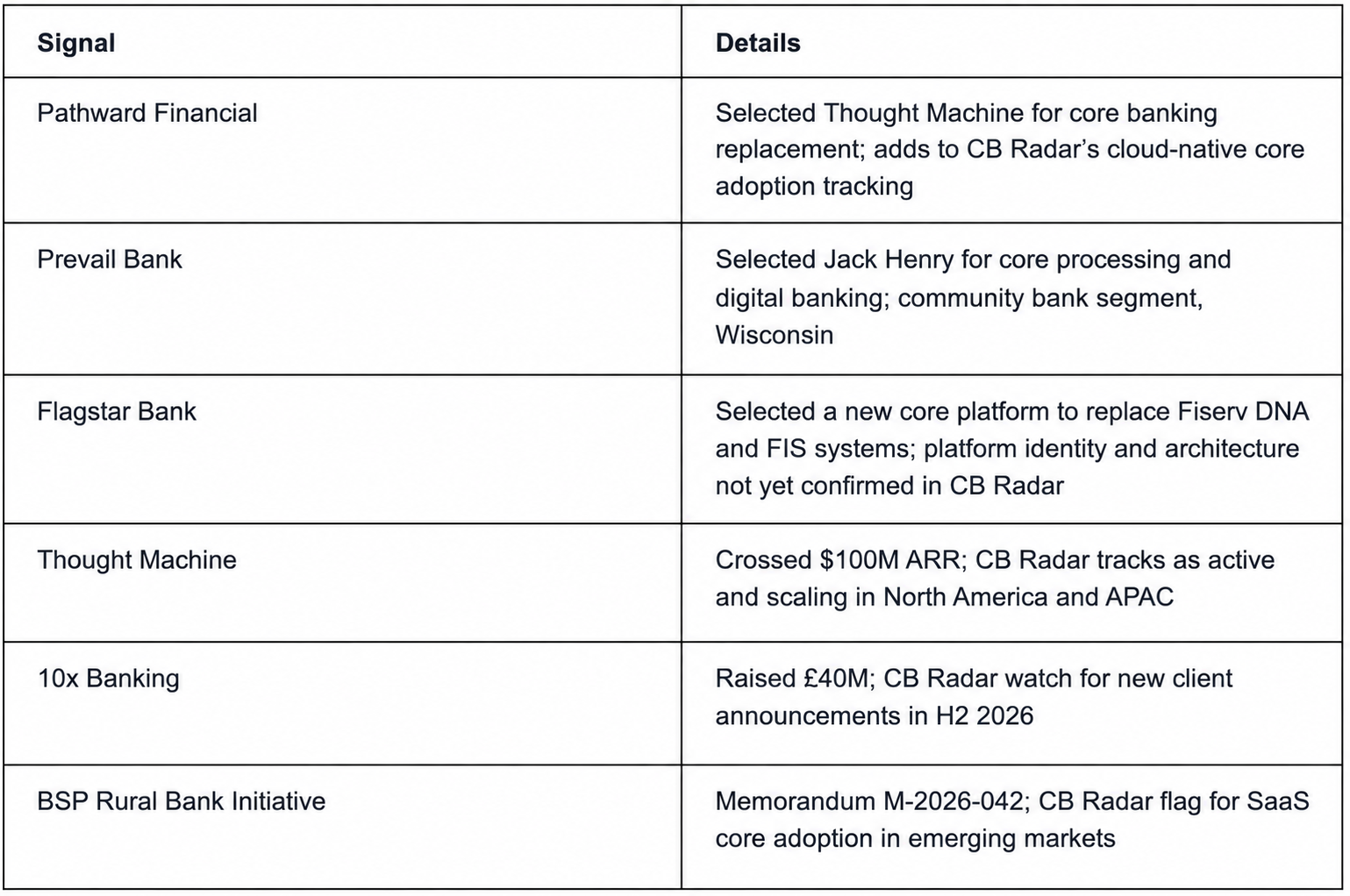
The pattern in our proprietary CB Radar database this week is worth noting directly. Three separate core selections were announced in a single week, spanning a federally chartered payments bank, a regional bank replacing a dual-core legacy environment, and a community bank in the Midwest. That breadth, across institution type, size, and geography, suggests the core modernization cycle is not concentrated in a single segment. It is moving across the market simultaneously. For vendors, that means demand is broad but so is competition. For bank buyers, it means the reference pool for evaluating new platforms is growing quickly, and peer benchmarking is more accessible than it was two years ago.
RICK’S STRATEGIC TAKE
➜ The tokenization conversation needs an honest internal assessment before it needs a product announcement. Wells Fargo joining JPMorgan and Citi in tokenized deposits is a legitimate competitive signal, and I understand why boards are asking about it. But the question I would want answered first is whether the back-office infrastructure, the compliance framework, and the treasury operations team are actually ready to support it. Announcing a tokenized deposit product and operating one reliably at scale for corporate clients are two very different things. If your institution is considering this, start with the operational readiness question, not the press release.
➜ BNY Mellon’s workforce numbers deserve a serious internal conversation, not a benchmarking exercise. The temptation is to compare headcount ratios and task-automation percentages and ask whether your institution is keeping pace. That misses the point. What BNY Mellon built is an enterprise-wide operating model redesign with AI as the organizing principle. The technology was probably not the hardest part. The governance, the role redesign, the change management, and the leadership decisions about what humans do and what machines do: that is where the real work happened. If your AI strategy does not include a serious operating model workstream, you are likely underestimating what this actually requires.
➜ On the regulatory front, I will say this plainly: we have been flagging the EU AI Act deadline and the revised U.S. model-risk guidance in this brief for months. The institutions that acted on those signals early are in a fundamentally different position today than the ones that treated them as future concerns. The gap between those two groups is now visible and measurable. If your AI governance infrastructure is not built to the standard these frameworks require, the cost of retrofitting it is going up, not down, with every passing quarter. The window to get ahead of this is not closed, but it is narrowing.
For a deeper framework on what AI-ready core architecture actually requires, see CSP’s CB Architecture Series at coresystempartners.com.
Want the Full Picture?
Subscribe to BIS, the Banking Intelligence Service from Core System Partners, for the full breakdown including Rick’s Strategic Take on the governance gap, the CB Radar vendor tracking signals, and the regulatory pulse analysis covering what SR 11-7 does and does not cover for agentic deployments, delivered weekly. Banking Intelligence Service
For CSP’s full analysis of what the Fed and Treasury are actually concerned about—and a framework for what AI-ready architecture requires—visit Core System Partners.
Continue With Core System Partners
- Contact Us: https://coresystempartners.com/#contact
- The Strategic Flywheel (book): https://coresystempartners.com/resources/strategicflywheel/
- Core Insider (weekly newsletter): https://coresystempartners.com/resources/newsletter/