A bank’s budget reveals its real priorities. Protecting lifecycle investment while balancing operations and new bets keeps transformation sustainable and reduces technical debt.
Every bank I’ve worked with says technical debt is a priority. Almost none of them fund it like one. It sits in the budget as the thing that gets cut first when a commercial leader wants one more dollar for something new and visible, because cleanup doesn’t show up on a board slide the way a new product launch does. Then, a few years later, the same executives are asking why every initiative takes twice as long as it used to.
Daniele Tonella, CTO of ING, gave me the clearest fix I’ve heard for this, and it comes as a number, not a platitude. Of the budget available for change (the money not already committed to running existing operations), roughly 40 percent should go to what he calls the “feng shui of tech”: cleaning up what you already have, reducing technical debt, converging on shared platforms. Only 60 percent funds genuinely new capability. Commercial leaders hate this ratio on instinct. Every dollar not building something new feels like a dollar wasted. Tonella’s answer is precise: without that 40 percent, complexity accumulates silently until the organization is dragged down by the weight of every decision it deferred. The 60/40 split is what buys the headroom, what Tonella calls “permanent agility,” to keep investing in new things year after year without the stack eventually eating you alive.
The second idea is subtler and, in my view, more dangerous when ignored: gravitational effects. Every significant initiative you fund adds recurring depreciation, licensing, and maintenance cost that doesn’t go away when the project ends. Tonella estimates seven to nine percent in additional recurring cost for every hundred spent on a new capability. Presented one year at a time, that’s easy to wave off. Presented across three to five years, it becomes impossible to miss.
“You see a billion and they tell you — of the billion I have 400 million of change budget and everyone wants to do new things and no one sees that this billion is going to become 1.2 billion without touching anything.”
— Daniele Tonella, CTO, ING
That’s not a hypothetical. That’s what happens when nobody’s forced to look at the multi-year view before approving the next round of discretionary spend.
The mechanism that makes both ideas real is a three-way budget split:
- Operate covers run health and the capacity that keeps services steady.
- Bets fund the change and innovation work meant to move outcomes this year.
- Lifecycle is a protected slice, ring-fenced for modernization and end-of-life work that nobody gets to raid when the quarter gets tight.
Treat lifecycle like rent, not like a deferrable cost. You’re going to pay it eventually either way, and paying it on your own schedule is cheaper than paying it on a vendor’s or a regulator’s.
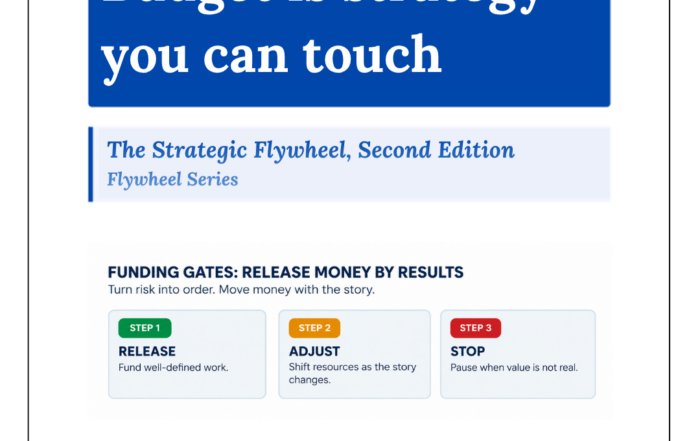
Then release the money the same way you’d release trust: by results, not motion. Tie funding tranches to the signals that actually prove movement:
- Adoption against target
- Benefit against the baseline set at kickoff
- Risk posture on the top items
- Exception recovery time
Green moves the next tranche. Yellow means a scope cut or a shorter window. Red means the funds go back to the pool so the next best bet can move instead.
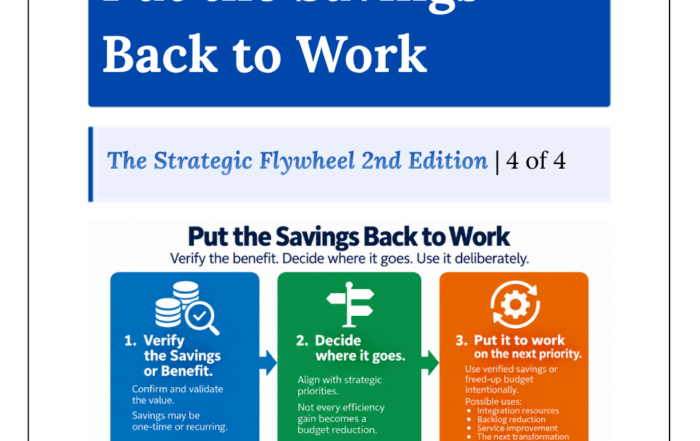
None of this is really about spreadsheets. A budget is the most honest strategy document a bank has, because unlike the strategy deck, nobody can nod along to it without actually committing something. When the multi-year gravity is visible and the lifecycle slice is protected, the flywheel gets funded on purpose instead of quietly mortgaged one budget cycle at a time.
— Rick Mavrovich