A companion to the forthcoming second edition of The Strategic Flywheel.
At Bank Leumi, the people we needed for transformation were already busy running the bank.
The back and middle offices were stretched thin. Employees resented being asked to take on more work. Project meetings were missed. Deliverables arrived late. Sometimes the reason stayed unspoken until we went looking for it.
I would sit down individually with the department heads and resource managers. My starting point was straightforward: production came first. Their teams had customers and daily responsibilities that still needed attention.
I also explained why the project needed them. They were the subject-matter experts. They understood the processes, systems and exceptions the transformation would affect. We needed that knowledge to do the work properly.
If they lacked capacity, I needed them to tell me. Then I could go to bat for the resources that would let them participate.
Cover the work the expert has to leave behind
The response was often skeptical. Bringing someone in from outside would hardly solve the problem if that person knew nothing about the bank’s systems or processes.
That was a fair objection. So we looked at covering suitable day-to-day responsibilities. With that work supported, experienced employees could spend time on the project.
The distinction mattered. We needed their institutional knowledge in the transformation. We could look for help with some of the operational work occupying their day.
That approach worked well enough that we brought former employees back from retirement. They were happy to return at consulting rates. Existing staff were pleased to see old colleagues again. The project gained access to people whose expertise it needed.
It was a practical arrangement with a human benefit. Familiar faces came back and employees could contribute to the transformation with support behind them.
Give managers a reason to be candid
The private conversations mattered as much as the staffing solution.
I was asking managers to be honest about what they could deliver. That meant taking their operational obligations seriously and following through when they needed help.
For a similar situation today, I would put the person’s existing work beside the project commitment. Identify what can be covered safely, what preparation the replacement needs and how much time can actually be released. The manager responsible for the operation should help make that assessment.
I would also agree on when the coverage ends. Set a period for the coverage and a point to review it. Keep enough overlap for the replacement to learn the work. Otherwise we risk creating a new operational burden while trying to release someone from an existing one.
Keep the agreement visible. If the employee is repeatedly pulled back into production, revisit the arrangement and the project dates. A capacity plan needs to survive contact with the working week.
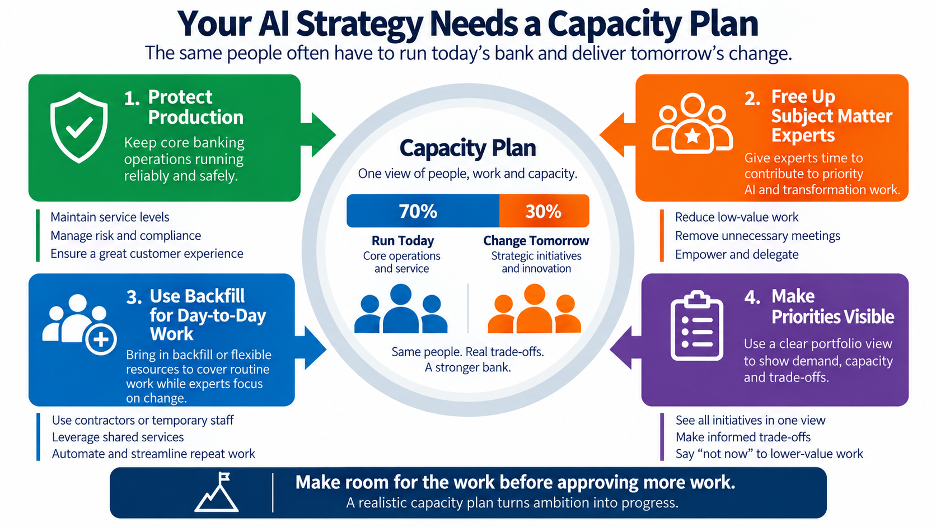
Backfill protects daily operations while experienced staff contribute to change. The 70/30 split is illustrative; leadership sets the allocation across Run, Change and Innovate for its own bank.
Bring the same honesty to AI
We covered Lloyds Banking Group’s AI recruitment plans in our June 29 Banking Intelligence Service brief. In its announcement, Lloyds described almost 300 agentic AI-related roles and reported responsible-AI training completed by more than 65,000 colleagues.
The investment in specialist skills and the existing workforce is worth examining. A community or regional bank will make different choices about scale. It still needs to decide how its experienced employees will participate.
Suppose your bank wants an assistant to help employees review applications. Someone must explain what a complete application looks like, choose difficult examples and assess the results. Those responsibilities require people who know the work.
An outside partner can bring engineering skills. Your own staff bring the context needed to judge whether the result belongs in the operation. Budget time for both contributions.
That is how I would apply the people decisions in our article, AI Is Moving Fast. Your Bank’s Operating Model Has to Keep Up. Run contributes knowledge while Change and Innovate work with it. Leadership makes the combined commitment workable.
Put the coverage beside the commitment
Before approving the next AI initiative, sit down with the managers whose teams appear in the plan. Agree on the work being added and what will be deferred, simplified or covered by someone else.
Backfill is one option. The important part is reaching a commitment the operating manager and the project team can both honor.
Your most experienced people have something the project needs. Give them a practical way to contribute it.
Make capacity part of your next approval decision. Take the OptimizeCore® Strategic Flywheel Readiness Assessment and use the readiness assessment to open a practical conversation about competing commitments and the support your employees need.
The forthcoming second edition of The Strategic Flywheel explores how leadership can give Run, Change and Innovate room to work together. Publication updates will appear on the book’s page.
#CoreBankingTransformation #BankingAI #BankingTransformation