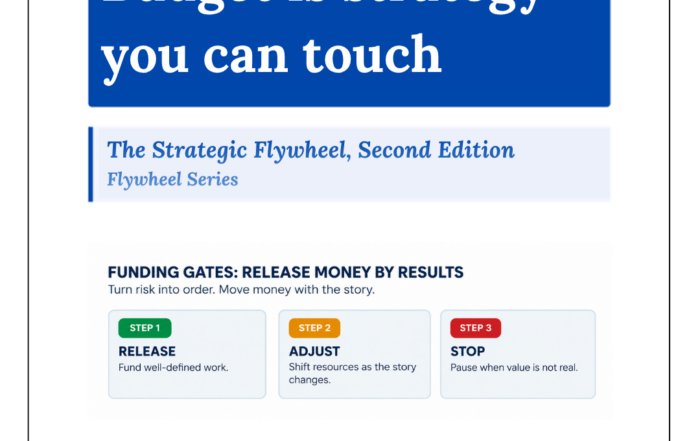
A companion to the forthcoming second edition of The Strategic Flywheel.
By the time I joined the transformation at the United Nations Federal Credit Union, the project was already two years behind schedule. People were tired. Getting operational and retail employees to give user acceptance testing and readiness the attention they needed was difficult.
Kara Mertzel led Learning and Development at the time. She and I organized a kickoff to explain why employees’ involvement mattered. We used something familiar: closing on a house.
Imagine your closing is next week and your only opportunity for a walkthrough is a few hours beforehand. You would want a checklist covering everything you expect to work. Turn on the bathroom light and the toilet should stay exactly as it is.
The same thinking applied to our readiness work. We needed to identify the situations employees would face after conversion and test them while there was still time to address the problems.
There were plenty of nodding heads in that room, including the CEO and members of the executive team. Their visible support helped.
Have the people doing the work define readiness
The workshops were where ownership began to take hold.
We asked employees to come prepared with their daily, weekly, monthly, quarterly and annual processes. Even work performed once a year belonged on the list.
Then we asked the subject-matter experts to stand up and explain those processes. They described the work and why they believed it would be affected by the transformation or fall outside its scope.
That changed the conversation. People were applying their own knowledge to the readiness decisions. They could see where the change touched their responsibilities and help establish what needed testing.
Most departments participated well. Where progress lagged, transparency and regular reporting made the outstanding work visible.
Kara brought the learning perspective. The operational teams brought the processes they understood. Leadership gave the work visible backing. Each contribution mattered.
Give AI the same walkthrough
In its May 2026 development announcement with Anthropic, FIS described a financial-crimes agent intended to assemble evidence while investigators retained decision-making responsibility.
That division of responsibility deserves a practical walkthrough. I would want the investigators helping define what they must see, how they challenge an incomplete result and what happens to a case needing further attention.
For an AI assistant reviewing lending documents, I would take the same approach. Have the employees who own that process bring difficult applications, outdated documents and conflicting information. Let them explain the checks they perform before accepting a package.
I would use the same process inventory to set the test scope. A short trial may never encounter an annual activity or expose the edge cases experienced employees know to watch for. Bring those situations into the evaluation deliberately, including unusual combinations and exceptions. Have the process owner explain what a correct result requires and when a case needs human review. Put any gap on the readiness list.
Agree on what the assistant may do. Preparing a summary, contacting a customer and changing an application record are separate permissions. The operational owner should help establish those limits while the pilot is being designed.
Give reviewers time to examine the evidence. If an employee has to reopen every document to trust the summary, count that work when assessing the benefit.
Then walk through an interruption. Applications keep arriving while the assistant is unavailable. The team needs a workable fallback and someone responsible for assigning priorities.
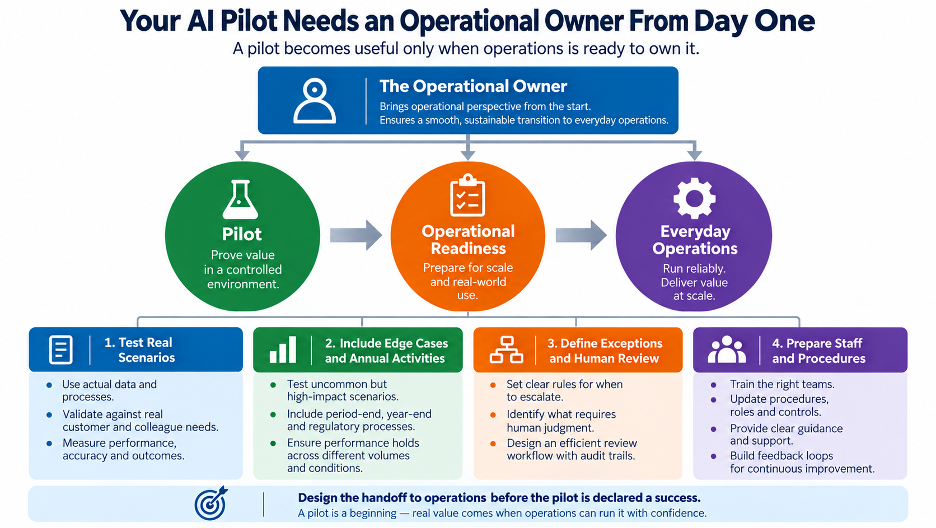
Operational ownership begins during the pilot and continues through readiness and everyday use. Testing covers real scenarios, annual activities, edge cases and human review.
Keep ownership after the release
The UNFCU experience is why I would involve operational employees from the beginning. Their knowledge helps define the test before a launch date starts driving every discussion.
Keep that involvement after release. Give staff a route to report errors, explain recurring exceptions and influence the next improvement. A finding may point toward better source data or a clearer procedure.
When the vendor proposes an update, repeat the relevant checks before widening its use.
Our article, AI Is Moving Fast. Your Bank’s Operating Model Has to Keep Up, describes the relationship among Run, Change and Innovate. Here it means operating experience shapes the experiment and continues to guide the work as it changes.
Before your next pilot begins, name the operational owner and protect time for employees to help define readiness. Bring the infrequent processes and awkward cases into the discussion early.
They are going to live with the result. Give them a meaningful say in what has to work.
Make capacity part of your next approval decision. Take the OptimizeCore® Strategic Flywheel Readiness Assessment and use the readiness assessment to open a practical conversation about competing commitments and the support your employees need.
The forthcoming second edition of The Strategic Flywheel explores how leadership can give Run, Change and Innovate room to work together. Publication updates will appear on the book’s page.
#CoreBankingTransformation #BankingAI #BankingTransformation