Issue #35
Weekly Banking Intelligence: September 25 to October 01, 2026
THIS WEEK’S SIGNAL
Chime is buying Stride Bank for $590 million. Valley Bank is buying Bluevine for $340 million. SmartBiz already owns CenTrust Bank. The direction of travel is now unmistakable: fintechs are not content to rent bank charters anymore. They are buying them. That changes the competitive picture for every community and regional bank in the country, and the institutions that should be paying the closest attention are the ones that have been quietly serving as the funding and compliance backbone for fintech partners without asking hard questions about what that relationship looks like in five years.
DEEP DIVE
The fintech-to-bank acquisition wave: what it means when your partner becomes your competitor
For years, the working model was straightforward. Fintechs brought the customer experience and the growth ambition; banks brought the charter, the balance sheet, and the regulatory standing. It was a partnership of convenience, and for a while it worked reasonably well for both sides. What this week’s activity suggests is that the most ambitious fintechs have decided that model has a ceiling, and they intend to go through it.
Chime’s $590 million all-cash acquisition of Stride Bank, an Oklahoma-headquartered community bank, is the clearest signal yet. Chime is one of the largest consumer fintechs in the United States by account volume, and Stride has been a key banking partner in its operating model. This acquisition is not about Chime entering banking. Chime is already in banking. This is about Chime deciding it no longer wants a landlord. As reported this week by Fintech Futures, the deal values Stride at approximately 1.5 times tangible book value, which is a reasonable price for the control and regulatory self-sufficiency that comes with charter ownership. Valley Bank’s $340 million acquisition of Bluevine, a Jersey City-based small business lending fintech, runs the same logic from the other direction: a bank acquiring a fintech to capture the origination capability and the customer relationship before a competitor does.
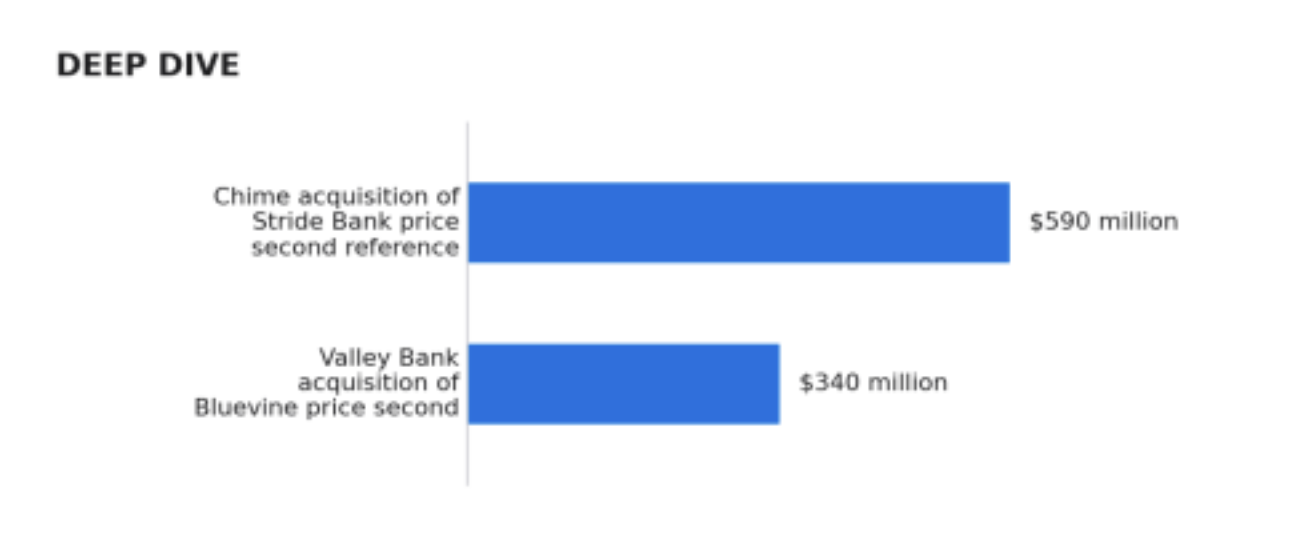
Chime acquisition of Stride Bank… vs Valley Bank acquisition of…. Source (verbatim from this brief): Chime’s $590 million all-cash acquisition of Stride Bank, an Oklahoma-headquartered community bank, is the clearest signal yet.
Why it matters: These are not isolated transactions. They are evidence of a structural shift in how fintechs think about scale. Once a fintech reaches a certain volume threshold, the cost and friction of operating through a partner bank starts to outweigh the cost of owning the charter outright. When that calculus flips, the fintech stops being a distribution partner and starts being a direct competitor. Any community or regional bank currently running a meaningful fintech partnership program should be asking whether its partners are approaching that threshold.
Why it matters for operating model and governance: The less obvious implication is what this means for the banks that are not being acquired. If the most capable fintechs are vertically integrating, the banks left serving the next tier of fintech partners are taking on more concentration risk, more regulatory exposure, and less negotiating leverage than they were a year ago. The OCC and FDIC have been signaling for months that they intend to scrutinize fintech-bank partnerships more carefully. Owning your own charter eliminates that exposure. Remaining a partner bank does not. As reported this week by PCBB, SmartBiz’s 2025 acquisition of CenTrust Bank followed exactly this logic: control over funding and lending by owning the deposit base directly. The pattern is not new. It is just accelerating.
The question I would be asking if I were running a bank with active fintech partnerships is this: what happens to our business model if two or three of our most significant fintech relationships decide to go the Chime route in the next 24 months? Do we have the customer relationships, the data, and the product capability to replace that volume? Most banks have not stress-tested that scenario seriously.
MARKET MOVES
Tekion, Increase, and Core Bank launch embedded banking in automotive retail
Tekion (a cloud-native automotive retail platform), Increase (a banking infrastructure company), and Core Bank announced a partnership this week to embed banking directly inside Tekion’s Automotive Retail Cloud. The arrangement puts deposit accounts, payments, and lending capabilities inside the dealership management workflow, accessible without leaving the platform.
Why it matters: Embedded finance is moving into vertical software platforms faster than most banks anticipated, and the distribution implications are significant. When banking is embedded inside an
industry-specific workflow, the institution that owns the customer relationship is the platform, not the bank. Core Bank is providing the charter and balance sheet here, which is a legitimate strategy, but it is worth noting that this is exactly the kind of arrangement that becomes complicated when the fintech partner decides it wants more control. The Chime-Stride story and this one belong in the same conversation.
VENDOR SIGNALS
Thought Machine and AWS launch AI-powered migration tool for core banking
Following up on Thought Machine’s selection by Deutsche Bank (Issue #33), the company announced this week a joint AI-powered migration solution with Amazon Web Services designed to accelerate legacy core banking migrations for Tier 1 banks. The tool is aimed at reducing the time and risk associated with data mapping, reconciliation, and cutover planning, which are consistently the longest and most expensive phases of any core replacement program.
This is worth watching closely, and not just because of the Thought Machine name. The deeper signal is that the migration problem is now being attacked with AI tooling, which changes the economics of core replacement in a meaningful way. For years, the primary argument for staying on a legacy core was not that the new platforms were inferior. It was that the migration was too risky, too expensive, and too disruptive to justify. If AI-assisted migration tools can compress timelines and reduce reconciliation risk materially, that argument gets harder to make. The institutions that have been deferring core decisions on migration-risk grounds should be watching this development carefully, because the cost-benefit calculation may be shifting under them.
FIS receives dual Gartner Magic Quadrant recognition for retail core banking
FIS received Leader recognition in the 2026 Gartner Magic Quadrant for Retail Core Banking Systems in North America for two separate platforms: FIS HORIZON, positioned for community and regional banks, and a second platform serving larger institutions. In the same week, FIS was selected by Kredittbanken for a cloud core system deployment.
Gartner recognition matters in this market because bank procurement committees use it, even when they should not use it exclusively. The more interesting signal is the dual-platform positioning. FIS is telling the market that it has a credible answer for community banks and for larger institutions simultaneously. Whether the underlying architecture and operating model support that claim at scale is a question worth asking before you take the quadrant placement at face value.
HSBC launches HSBCnio for corporate transaction banking
HSBC launched HSBCnio this week, an AI and API-driven platform targeting corporate transaction banking. The launch follows HSBC’s earlier September rollout of AI-powered trade finance documentation tools. The platform is designed to automate treasury management, payments, and trade workflows for corporate clients.
HSBC is running a coherent AI deployment strategy across its wholesale banking business, and HSBCnio is the latest visible piece of it. What is notable is the sequencing: back-office automation first (trade finance documentation), then client-facing capability (transaction banking platform). That is a disciplined approach, and it is consistent with what we observed in Issue #31 about institutions that did their governance and architecture work early moving faster and more coherently than those that did not. The banks competing for corporate treasury relationships should be paying attention to how quickly HSBC is compressing the product gap.
Finastra, Mastercard, and Bank of America at Sibos 2026
As reported this week by Trade Finance Global, Finastra, Mastercard, and Bank of America each unveiled AI-powered solutions at Sibos 2026, covering supply chain finance, payments, and treasury management. The announcements span three separate capability areas but share a common thread: AI is being applied to the workflow and data layers of wholesale banking, not just the customer interface.
Sibos tends to produce a lot of announcements that do not survive contact with implementation reality, so I would treat these with appropriate skepticism. What is worth noting is the concentration of AI deployment in wholesale and transaction banking specifically. That is where the margin is, that is where the data complexity is highest, and that is where the operating model changes will be the most significant. If your institution competes in this space, the question is not whether to deploy AI in these workflows. It is whether your data infrastructure and operating model are ready to support it.
REGULATORY PULSE
State AI supervisory framework and federal third-party risk guidance update
Following up on the regulatory split covered in Issue #34, two developments this week added texture to the picture. The Conference of State Bank Supervisors (CSBS) framework for AI supervision of state-chartered banks and nonbank financial institutions received additional public attention and legal analysis this week, with detailed commentary published on its scope and implications. Separately, as reported by Mayer Brown, the Federal Reserve, FDIC, and National Credit Union Administration (NCUA) issued proposed updates to interagency third-party risk management guidance on September 11, with the comment period now active.
These two tracks are moving on different timelines and under different authorities, which creates a genuine compliance planning problem for institutions operating across state lines. The CSBS framework is already in effect for state-chartered institutions. The federal third-party risk guidance is in proposed form and will likely be revised before finalization. Banks that operate under both federal and state oversight are now managing two overlapping frameworks that do not yet speak the same language. That is not purely a technology problem. It is a governance and compliance challenge, and it requires someone in the organization to own the coordination across both tracks.
State attorneys general warn Congress on AI systemic risk
A coalition of state attorneys general sent a formal warning to Congress this week asserting that AI deployment in financial services poses systemic risk to the financial system. As reported by American Banker, the warning specifically called out agentic AI, consistent with the Office of the Comptroller of the Currency’s (OCC) May 2026 statement that a formal request for information on banks’ use of agentic AI would follow shortly.
The significance here is not the warning itself. Regulators and attorneys general have been raising AI risk concerns for over a year. The significance is that agentic AI is now being named explicitly and formally in regulatory and legislative communications. That raises the probability of targeted supervisory action on agentic deployments specifically. If your institution is running or planning agentic AI in any customer-facing or credit-decision context, the governance documentation around those deployments needs to be examiner-ready now, not when the request for information lands.
TALENT SIGNALS
AI engineering and governance roles continue to expand
A major regional bank is hiring AI engineers and machine learning operations specialists across its technology organization, with a particular concentration in model risk and AI governance functions. The hiring pattern reflects what we have been tracking for several months: AI-related roles are expanding directly because of AI adoption, as institutions build the internal capability to deploy, monitor, and govern the systems they are putting into production.
At the same time, middle-office processing and routine analytical roles continue to contract at several large institutions. This is not a coincidence and it is not a contradiction. The same AI investments that are driving demand for engineers and governance specialists are reducing the need for headcount in roles that AI is now handling. The institutions managing this transition well are the ones that are being explicit about it internally rather than letting attrition obscure the pattern.
CB RADAR UPDATE
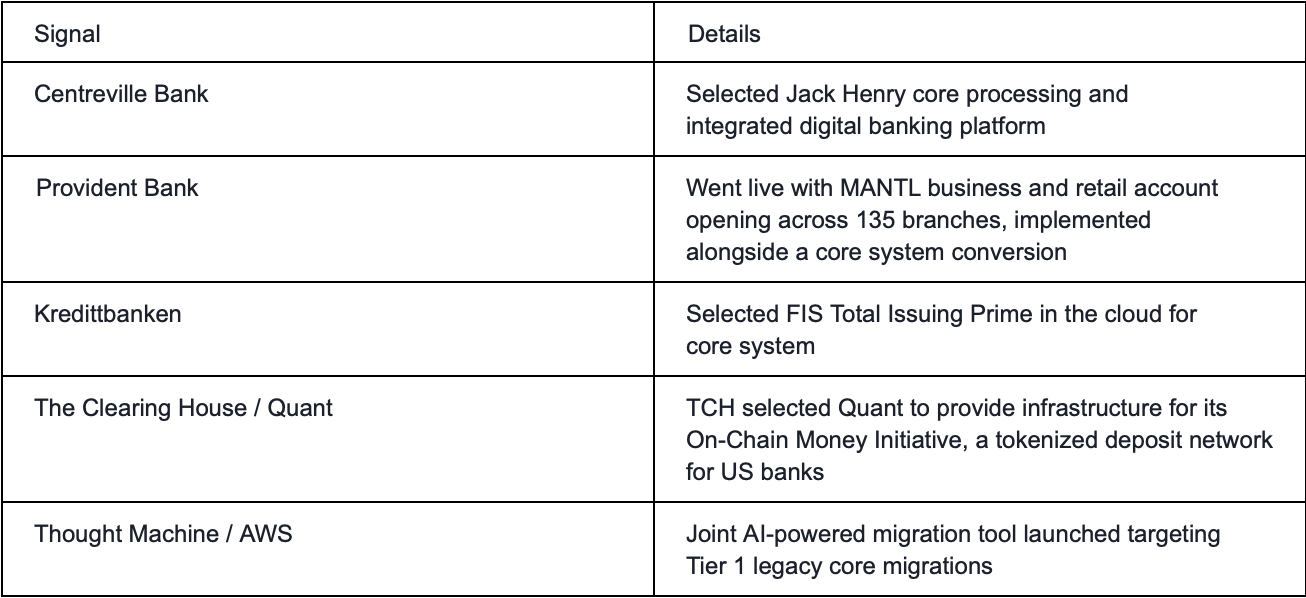
Three of the five CB Radar signals this week involve core decisions or go-lives, which is consistent with the acceleration we have been tracking since Issue #33. What stands out is the range: a community bank selecting Jack Henry, a regional bank going live with MANTL alongside a core conversion, a European bank selecting FIS for cloud core, and a Tier 1-focused migration tool from Thought Machine and AWS. The market is not consolidating around a single solution or a single tier. It is moving simultaneously across all segments, which means the competitive window for vendors and the decision urgency for banks are both higher than they may appear from any single transaction.
RICK’S STRATEGIC TAKE
➜ The fintech-to-bank acquisition story is the one I would bring to my board this week. Not because Chime buying Stride Bank is a threat to every institution, but because it forces a specific and uncomfortable question: if your most important fintech partnership relationships decided tomorrow to pursue their own charters, what does your business model look like? Most banks have not done that analysis. I think they should.
➜ The Thought Machine and AWS migration tool is worth a serious look from any institution that has been deferring a core decision because of migration risk. I am not suggesting the tool eliminates that risk. Migration complexity is real and it does not disappear because AI is involved. But if it meaningfully compresses timelines or improves reconciliation accuracy, the economics of staying on a legacy core get harder to defend, and the operating model conversation that has been on hold needs to come back to the table.
➜ On the regulatory side, the combination of an active CSBS AI framework and a federal third-party risk guidance update in proposed form is creating a coordination gap that most compliance functions are not set up to manage. Someone in your organization needs to own both tracks together. If that accountability does not exist today, it is worth establishing it before the federal guidance finalizes and the examination cycle catches up.
For a deeper framework on what AI-ready core architecture actually requires, see CSP’s CB Architecture Series at coresystempartners.com.
Want the Full Picture?
Subscribe to BIS, the Banking Intelligence Service from Core System Partners, for the full breakdown including Rick’s Strategic Take on the governance gap, the CB Radar vendor tracking signals, and the regulatory pulse analysis covering what SR 11-7 does and does not cover for agentic deployments, delivered weekly. Banking Intelligence Service
For CSP’s full analysis of what the Fed and Treasury are actually concerned about—and a framework for what AI-ready architecture requires—visit Core System Partners.
Continue With Core System Partners
- Contact Us: https://coresystempartners.com/#contact
- The Strategic Flywheel (book): https://coresystempartners.com/resources/strategicflywheel/
- Core Insider (weekly newsletter): https://coresystempartners.com/resources/newsletter/