A companion to the forthcoming second edition of The Strategic Flywheel.
On the bank transformations I worked on, savings generally went back into the overall financial pool. Then budget season came around again: submit the request, defend it, see it cut and work through the choices one more time.
I did not see those benefits directly earmarked to fund the next improvement. The following year’s proposal had to make its own case again.
We did find ways to stretch the budgets we had. One enterprise software negotiation stands out.
A saving with somewhere useful to go
On that transformation, we still needed people to build the integration between the core and other applications. We had a limited budget and a substantial enterprise software agreement to negotiate.
I was told there was little room to move on the vendor’s pricing. I asked to try.
We ultimately negotiated a one-time saving of $1.8 million on the agreement.
Were the Finance folks thrilled to see the savings move into the people bucket? Not exactly. We made a compelling case and got the funds moved to bring in the people needed for the integration work.
The agreement gave us room in the budget at a point when the program needed it. We could direct that room toward a specific piece of work.
This was a reallocation within an existing program. It gave us a way to complete necessary work with the money available.
Carry the decision into AI
Bank of America reported in July 2026 that more than 18,000 customer service representatives used EricaAssist and that it reduced average call time by nearly one minute per interaction.
That is the bank’s reported operating measure. For an institution seeing a comparable improvement, I would want management to decide what the time should accomplish.
Perhaps employees can resolve more customer issues. Perhaps a backlog comes down. Perhaps some of the capacity can support another improvement. Each possibility needs a corresponding decision and someone responsible for following it through.
Start by checking the whole process. Account for review, corrections and support. Examine whether work has moved to another team. Compare the result with the starting point and consider changes in volume or complexity that might explain part of it.
Then give the benefit the right name. Lower expenditure supports a financial saving. Time available for better service supports a different outcome. Counting the same hours as both reduced staffing cost and capacity for new work would overstate the result.
Match the benefit to the commitment
The software negotiation produced a one-time saving. That matters when deciding what it can fund. Work with an end date and a continuing operating expense need different funding plans.
I would have the business owner and finance agree on that distinction before allocating the saving. It avoids promising recurring capacity on the strength of a benefit that happens only once.
The same care applies to AI. Allow for the costs of keeping the capability useful, including support, review and subsequent changes. Establish what remains after those responsibilities are covered.
For time savings, look at how they appear during the day. A few minutes across many employees may improve responsiveness while offering little uninterrupted time for project work. The operating manager needs to assess what can realistically be protected.
Leadership can then choose a destination. Reducing expenditure may be appropriate. So might improving service or funding a necessary change. Make the choice explicit and check whether it happens.
In our negotiation, we could identify the work the saving helped fund. I would want the same visibility when an AI project presents its benefits.
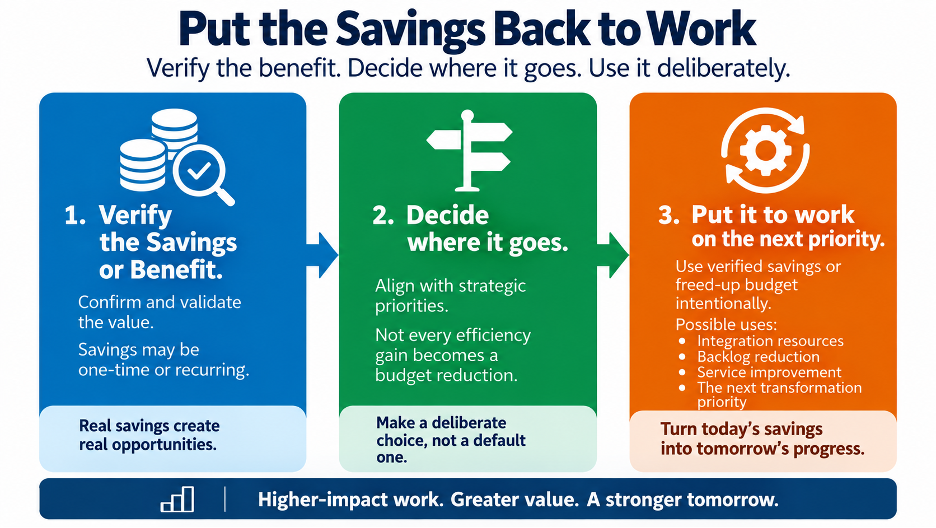
Verify the benefit, decide where it goes and put it to work. One-time and recurring savings call for different funding commitments; released time is distinct from a reduction in spending.
Make the next improvement a deliberate choice
In The Strategic Flywheel, the connection among Run, Change and Innovate includes how benefits and learning influence the next investment. Our article, AI Is Moving Fast. Your Bank’s Operating Model Has to Keep Up, puts that decision alongside priorities, people and technology.
A bank can begin with one initiative. Agree on the baseline, examine the net benefit and record the decision about its use. At the next review, look for the corresponding change in spending, service or available capacity.
Give finance and the operating owner the same measure to follow. When the benefit changes, revisit the commitment before another team builds its plan around money or time that is no longer available.
A saving creates a choice. Put that choice in front of the people authorized to make it and follow the result into the work.
Put the next funding decision alongside your bank’s readiness to deliver. Take the OptimizeCore® Strategic Flywheel Readiness Assessment to start a discussion about priorities, resources and the work that verified benefits could support.
The forthcoming second edition of The Strategic Flywheel explores how leadership can give Run, Change and Innovate room to work together. Publication updates will appear on the book’s page.
#CoreBankingTransformation #BankingAI #BankingTransformation