Issue #41
Weekly Banking Intelligence: November 06 to November 12, 2026
THIS WEEK’S SIGNAL
Two of Canada’s most recognizable financial institutions made core banking decisions this week, and they went in different directions. Vancity selected Temenos. CIBC selected Thought Machine’s Vault Core. One is a credit union modernizing to compete. The other is a major bank rebuilding its retail foundation. What caught my attention is not which platform they chose. It is that both institutions decided the cost and risk of staying put finally outweighed the cost and risk of moving. That calculation is shifting across the industry, and if you have not revisited it recently at your institution, this week is a reasonable prompt to do so.
DEEP DIVE
Canada’s core moment: two decisions, one clear pattern
Vancity, Canada’s largest community credit union, announced on October 26 that it had selected Temenos to modernize its core banking operations. The move is framed as foundational to Vancity’s next phase of growth, not a technology refresh for its own sake. A few days later, CIBC confirmed it is adopting Thought Machine’s Vault Core as the foundation for its retail banking technology modernization. CIBC described the move as raising the bar for banking in Canada. Two institutions, two different vendor choices, the same underlying conviction: the current architecture cannot carry them where they need to go.
Why it matters: These are not pilot programs or innovation lab experiments. Vancity and CIBC are making commitments that will reshape their operating models, their data structures, their integration layers, and ultimately how their teams work for years. The vendor selected matters far less than the readiness of the institution to execute. Core replacements fail or stall far more often because of change management, governance, and internal capability gaps than because of platform limitations.
What I would be asking if I were in the room at either institution: Do we have a clear owner for this program who has actually done it before? Have we mapped every downstream system that touches the core, not just the obvious ones? What does our data quality look like today, because whatever problems exist in the current system will not disappear when the new one goes live? And have we had an honest conversation with our board about what this costs when it runs long, because they almost always run long?
The Thought Machine signal is worth watching separately. CIBC is now the second significant Thought Machine win in this brief’s coverage period, following the report on CLICX, the new Thai digital bank formed by Krungthai Bank, Advanced Info Service, and PTT Oil and Retail Business, which also selected Vault Core as its technology foundation. Thought Machine is accumulating reference clients across very different market contexts: an incumbent Canadian major bank on one side, a greenfield Southeast Asian digital bank on the other. That range matters for any institution evaluating the platform’s maturity and scalability.
Why it matters: For community banks, regional banks, and credit unions watching from the sidelines, the CIBC and Vancity decisions will generate a wave of case study material over the next 12 to 18 months. Pay attention to what they report on implementation complexity, integration challenges, and workforce impact. Those will be more useful than any vendor demo.
MARKET MOVES
Morgan Stanley acquires Vinyl Equity
Morgan Stanley announced on November 9 that it plans to acquire Vinyl Equity, a Chicago-based fintech that operates as a Securities and Exchange Commission (SEC)-registered transfer agent. Vinyl Equity runs digital-native infrastructure for managing corporate stock plans, an operational function that most large banks and brokerages have historically outsourced or handled through legacy systems. Morgan Stanley is bringing that capability in-house as part of a deliberate expansion of its wealth management platform.
Why it matters: This is a plumbing acquisition, not a headline acquisition, and that is exactly why it deserves attention. Morgan Stanley is not buying a product or a brand. It is buying operational infrastructure it has decided is too central to its wealth strategy to leave in someone else’s hands. The question worth asking at your institution is whether there are similar dependencies sitting inside your operating model, functions you rely on but do not control, that are becoming more strategically important as your business evolves. Vertical integration of this kind tends to accelerate once a large institution decides a capability is core to its competitive position.
TabaPay’s acquisition of Transact Bank
As reported this week by several financial technology publications, payments company TabaPay agreed on September 2, 2026, to acquire Transact Bank, a nationally chartered bank based in Denver. TabaPay is a payments infrastructure company, and the acquisition gives it direct access to the banking charter and the regulatory standing that comes with it, allowing it to operate as a sponsor bank rather than depending on third-party banking relationships to move money.
Why it matters: This deal is worth understanding in the context of the broader sponsor bank model. Fintechs that depend on bank partners for charter access carry a structural vulnerability: the partner bank can reprice, exit, or face regulatory pressure that affects the fintech’s operations. Acquiring a charter removes that dependency. It also adds a new layer of regulatory obligation that many fintechs have historically avoided. The question is whether TabaPay’s leadership has fully internalized what it means to operate under OCC supervision, not just what it means to own a bank.
VENDOR SIGNALS
Glia passes $100 million in annual recurring revenue
Glia, a provider of AI-powered customer interaction technology built specifically for financial institutions, reported this week that it crossed $100 million in annual recurring revenue (ARR) in the third quarter of 2026, with AI solution sales up 93% year over year, while remaining cash-flow positive. That combination of growth rate and profitability is unusual in enterprise software and worth noting.
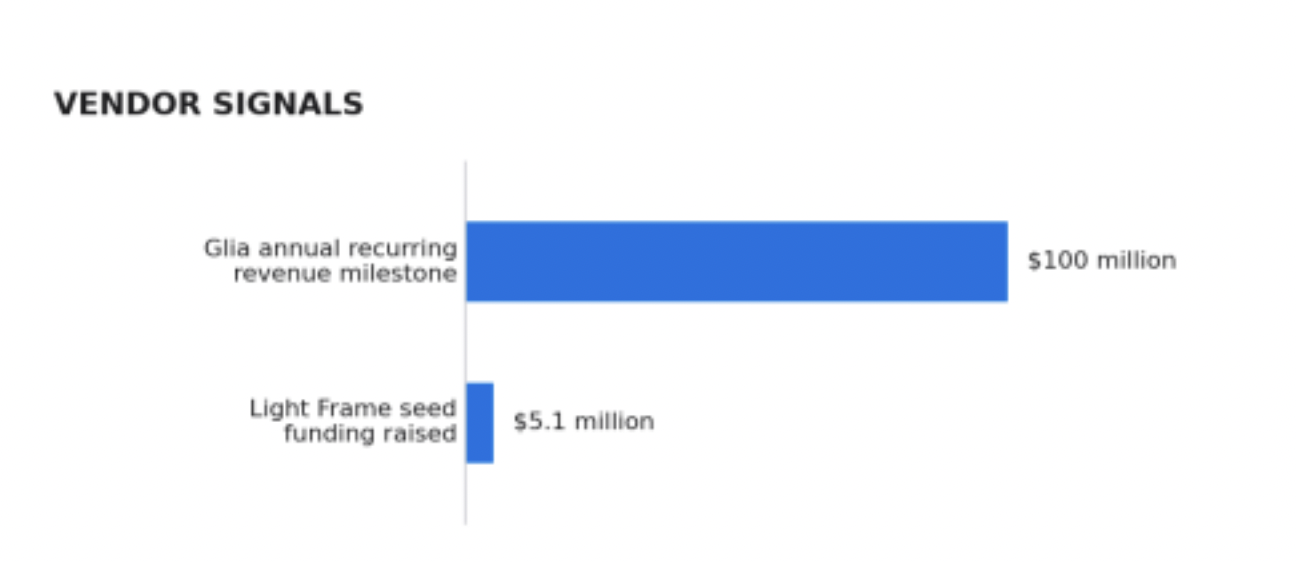
The signal here is not just about Glia. It is about what the number confirms: vertical AI built for banking, not adapted from a general-purpose platform, is finding real purchase with financial institutions. Banks are paying for solutions that understand their regulatory context, their workflow constraints, and their customer interaction patterns without requiring significant customization. Glia’s growth rate suggests that once an institution deploys a purpose-built AI interaction layer, the expansion within that institution tends to be substantial. If you are evaluating AI for customer-facing operations and you have not looked at what vertical-specific vendors are actually delivering in production, the Glia numbers are a reasonable argument for doing that work.
OCC expands its AI supervisory framework to cover superintelligence and agentic AI
Following up on Issue #40’s coverage of the OCC’s initial AI supervisory framework, the OCC released an expanded examiner framework this week covering what it now formally calls “Super Intelligence” and agentic AI in banking. The updated framework sets out 16 components, including defined purpose and permitted use, risk classification, human-in-the-loop and human-on-the-loop controls, model risk management extensions, data governance, third-party risk, operational resilience, testing, documentation and auditability, and a risk-tiering structure. The framework applies across credit decisioning, payments, fraud detection, customer service, operations, risk management, and market activities.
Sixteen components is a meaningful scope expansion from where the OCC started. The addition of “human-on-the-loop” controls alongside “human-in-the-loop” controls is particularly significant: it signals that regulators are distinguishing between systems that require human approval before acting and systems that act autonomously but must remain observable and interruptible. If your institution has deployed or is evaluating agentic AI in any of the covered domains, the 16-component structure is worth mapping against your current governance model. Not as a compliance exercise. As a readiness check.
Light Frame raises seed funding to modernize wealth management infrastructure
Light Frame, an early-stage company targeting what it describes as 30-year-old core infrastructure in the wealth management space, raised $5.1 million in seed funding this week. The company’s premise is that modern core platforms like Mambu and Thought Machine have addressed retail and commercial banking but that wealth management infrastructure has seen no comparable modernization.
That is a fair observation. Wealth management operations at most institutions run on a combination of legacy portfolio accounting systems, manual reconciliation processes, and point solutions layered over decades. Whether a seed-stage company can address that problem at scale is an open question, but the investment signals that the gap is real and that investors see it as addressable. Institutions with significant wealth management operations should be watching this space, less for Light Frame specifically and more for the broader signal that infrastructure modernization pressure is arriving in a part of the business that has largely been left alone.
REGULATORY PULSE
OCC’s 16-component agentic AI framework: what changes for examiners
The OCC’s expanded framework, covered above in Vendor Signals in the context of deployment readiness, has a second dimension worth addressing separately: what it means for examination. Examiners now have a structured 16-component checklist for evaluating agentic AI deployments. That means the informal, principles-based conversation about AI risk that many institutions have been having with their examiners is about to become more structured and more specific.
Banks that have been deploying AI agents in production without documented governance against each of those 16 components are carrying examination risk they may not have fully priced. The institutions that will handle this most smoothly are the ones that built governance structures proactively, not the ones that are now reverse-engineering documentation to match a framework they have not seen before. As previously covered in Issue #37, regulators have been signaling for months that they expect banks to be in control of their AI systems, not just aware of them. The 16-component framework is the operational expression of that expectation.
TALENT SIGNALS
No specific named hiring appointments surfaced in the curated input this week that meet our sourcing standard for named institutions. The broader pattern from McKinsey’s Global Banking Annual Review 2026, released this week, is worth noting: investment banking functions benefited significantly from market volatility in 2025 and 2026, which is showing up in selective hiring in trading, risk, and capital markets roles at institutions with active markets businesses. That is a near-term cyclical signal, not a structural one.
The structural signal continues to be what we have observed over the past several issues: AI engineering, model risk, and AI governance roles are expanding because institutions are deploying AI at scale and need the people to build, manage, and supervise it. Operational and processing roles in areas being automated are contracting as a direct consequence of that same deployment. Those two trends are not in tension. They are the same story told from two different seats in the organization.
CB RADAR UPDATE
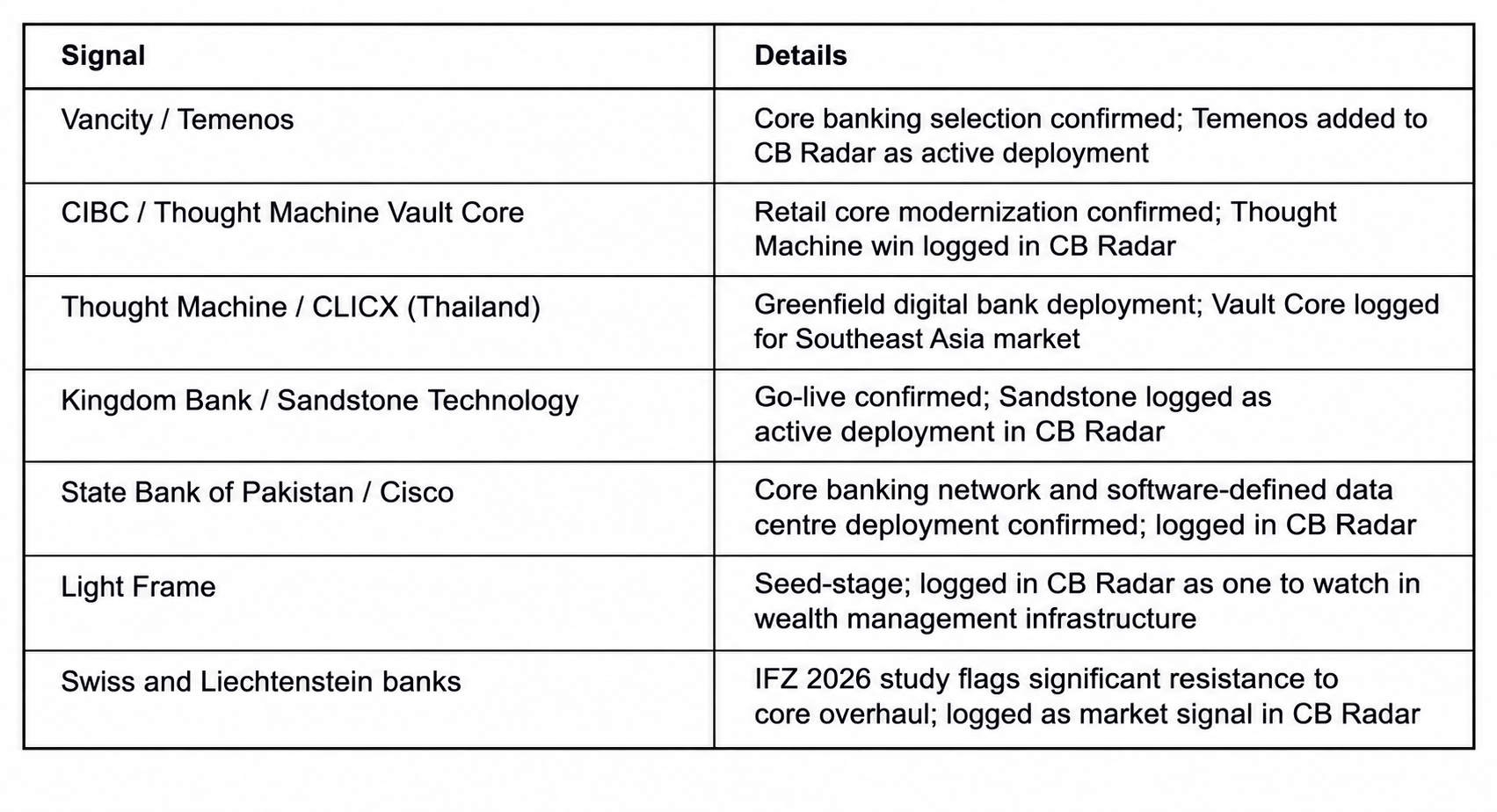
The pattern in our proprietary CB Radar database this week is notable for its geographic spread. Core banking activity is not concentrated in a single market. Deployments and selections logged this week span Canada, Thailand, Australia (Kingdom Bank via Sandstone Technology), Pakistan, and Europe, with the Swiss and Liechtenstein resistance data adding useful context about where modernization pressure exists but has not yet converted to action. Thought Machine appears in two separate CB Radar entries this week across two very different deployment contexts, which is the kind of reference-client accumulation that changes vendor evaluation conversations.
RICK’S STRATEGIC TAKE
➜ The Canada story this week is really a readiness story. Vancity and CIBC both made the decision to move. The harder question is whether they are ready to execute. Core modernization programs at institutions of that size involve operating model redesign, workforce change, data remediation, and governance complexity that the vendor selection process rarely surfaces. The institutions that succeed are the ones that treat this as a business transformation program that happens to involve technology, not a technology program that will eventually affect the business. I have seen both approaches. They produce very different outcomes.
➜ The OCC’s 16-component agentic AI framework deserves more attention than it is getting in the trade press. Most of the coverage this week focused on the fact that the framework exists. What matters more is what the 16 components actually require in practice: documented purpose, defined risk tiers, observable and interruptible autonomous systems, third-party risk coverage, and auditability across every domain where agents are deployed. If your institution has agentic AI in production today and you cannot map your current governance to each of those components, that is a gap worth addressing before your next examination, not after.
➜ The Glia $100 million ARR number is the kind of data point that should prompt a conversation with your leadership team about how you are evaluating AI vendors. General-purpose AI platforms adapted for banking and purpose-built vertical AI platforms are not the same thing, and the performance gap between them tends to be most visible in regulated, workflow-intensive environments like financial services. The question I would bring to that conversation is not which platform is winning in the market. It is whether your current evaluation criteria are actually capturing the difference.
For a deeper framework on what AI-ready core architecture actually requires, see CSP’s CB Architecture Series at coresystempartners.com.
Want the Full Picture?
Subscribe to BIS, the Banking Intelligence Service from Core System Partners, for the full breakdown including Rick’s Strategic Take on the governance gap, the CB Radar vendor tracking signals, and the regulatory pulse analysis covering what SR 11-7 does and does not cover for agentic deployments, delivered weekly. Banking Intelligence Service
For CSP’s full analysis of what the Fed and Treasury are actually concerned about—and a framework for what AI-ready architecture requires—visit Core System Partners.
Continue With Core System Partners
- Contact Us: https://coresystempartners.com/#contact
- The Strategic Flywheel (book): https://coresystempartners.com/resources/strategicflywheel/
- Core Insider (weekly newsletter): https://coresystempartners.com/resources/newsletter/