
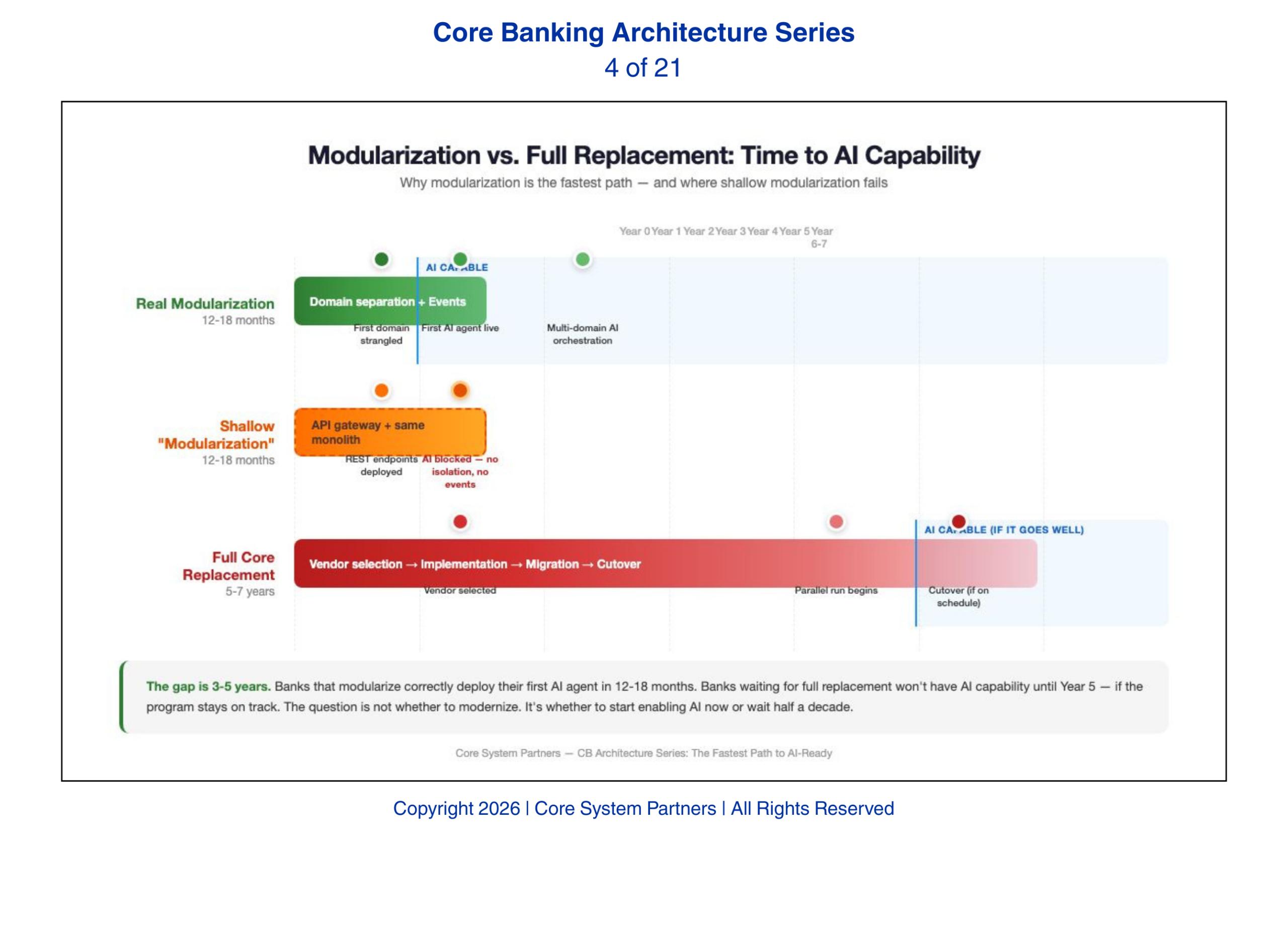
Most banks don’t need to replace their core to become AI-ready but they must modularize it properly, separating domains, exposing events, and aligning data meaning so AI can operate without complex integrations.
Every bank we talk to asks the same question: do we need to replace our core?
Usually, no. Not yet. What most banks need is to make the core they already have operable by AI. That means modularization — real modularization, not the cosmetic version most institutions have settled for.
Full core replacement takes five to seven years when it goes well. It takes longer when it does not. Banks cannot wait that long to deploy AI that matters. Effective modularization can yield meaningful AI capability in twelve to eighteen months. But the gap between what most banks call modularization and what actually qualifies is enormous.
What Modularization Actually Means
Modularization is not adding an API layer on top of a monolith. That is decoration. It is the architectural equivalent of putting a modern lobby on a building with no plumbing.
Genuine modularization requires domain separation. It means defining which system owns which data and which processes, establishing clean interfaces between those domains, and exposing events that other systems — including AI agents — can consume. The payments domain owns payment initiation, routing, and settlement. The lending domain owns origination, decisioning, and servicing. The customer domain owns identity, relationship structure, and preference management. Each domain publishes what it knows. Each domain consumes what it needs through defined contracts.
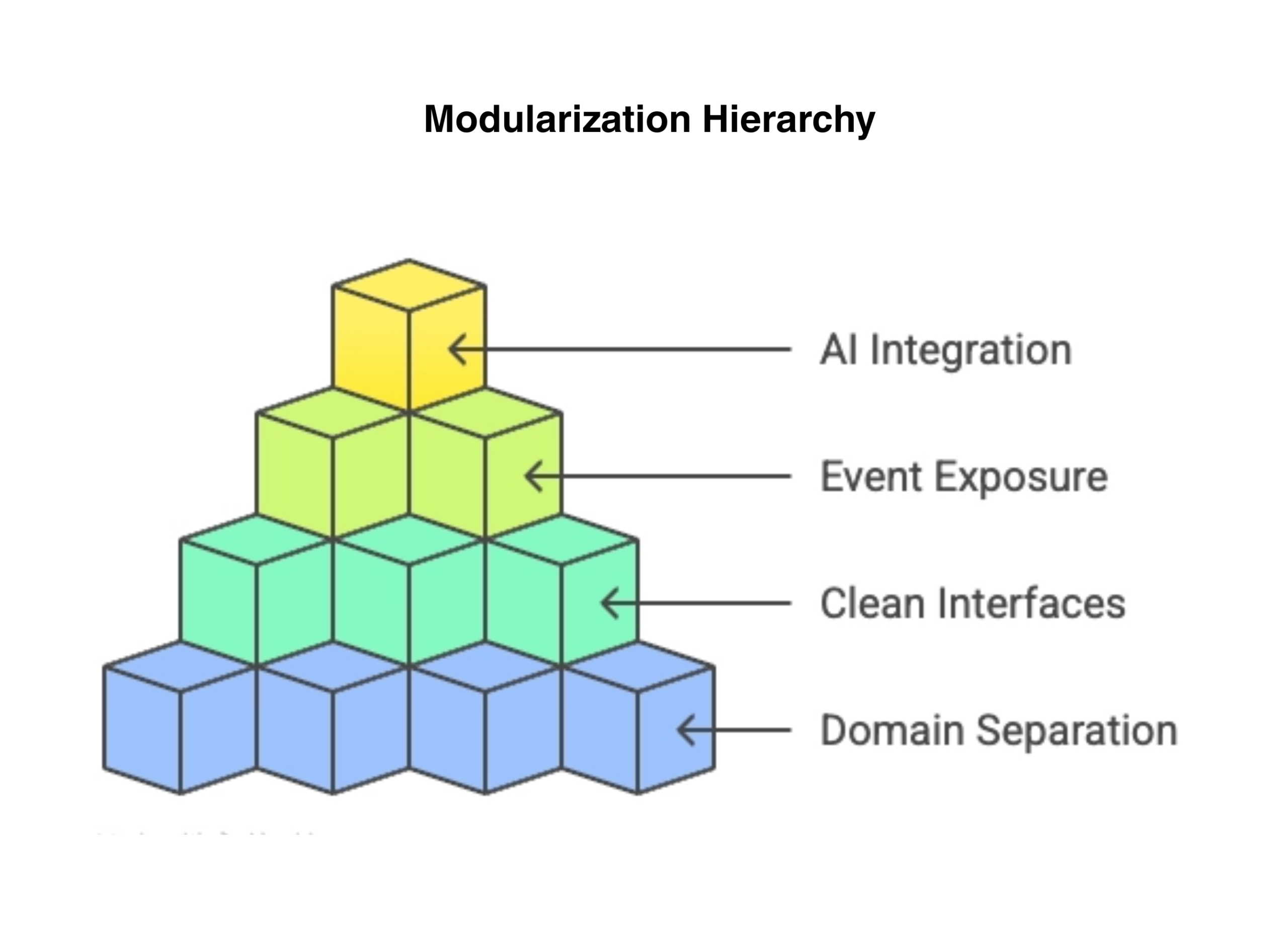
AI-ready architecture is built step-by-step: domain separation, clean interfaces, event exposure, then AI integration.
The test is simple. Can a new AI agent connect to the payments domain without touching the core? Can a fraud detection AI model subscribe to transaction events without a custom integration project? Can a next-best-action engine query the customer domain without pulling data from three systems that define “customer” differently?
If the answer to any of these is no, the architecture is not modular. It is just decorated.
The test of modularization is not whether your architecture looks modern. It is whether AI can operate on it without a six-month integration project.
The Shallow Modularization Trap
Most banks that claim to be modularizing are doing something much shallower than domain separation. They are building API gateways that sit in front of the same monolithic core, translating legacy protocols into REST endpoints. The data still lives in one place. The business logic still runs in one process. The coupling is still absolute — it is just hidden behind a gateway.
This creates a specific failure mode when AI enters the picture. An AI orchestration engine calls the API gateway expecting a clean, well-defined interface to the payments domain. What it actually gets is a passthrough to a monolithic core that processes the request alongside every other function the core handles. Latency is unpredictable. Failure in one domain cascades to all domains. The AI agent cannot retry a failed payment call without risking duplicate processing because the core has no idempotency guarantees at the domain level.
Banks that built API gateways in the 2018-2022 era and called it modernization are now discovering that those gateways do not provide the isolation AI requires. The gateway translated the protocol. It did not separate the architecture.
Domain Services Done Right
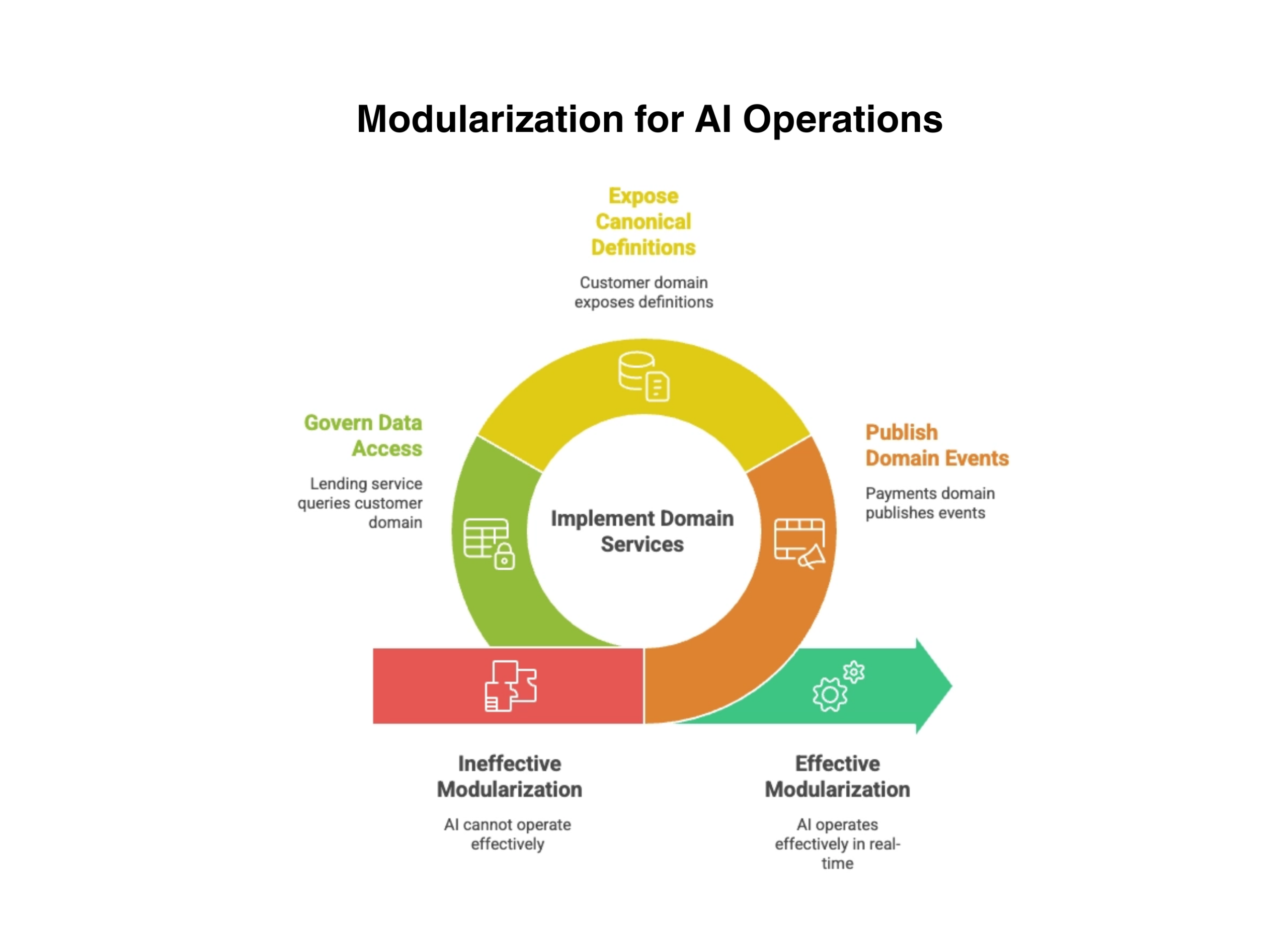
AI operates effectively when modular domain services expose canonical definitions, governed data access, and real-time events.
Effective modularization produces domain services — bounded contexts with their own data stores, their own business logic, and their own event streams. This is not theoretical computer science. This is practical architecture that determines whether AI can operate on your bank.
A well-modularized payments domain publishes events when a payment is initiated, when it clears, when it fails, and when it settles. An AI agent monitoring for unusual payment patterns subscribes to that event stream directly. It does not query the core on a batch schedule. It does not wait for an overnight extract. It sees payment events as they happen, in real time, with the context the domain provides.
A well-modularized customer domain maintains a canonical definition of customer — resolving the ontology problem from the previous article — and exposes that definition through APIs that any authorized system can query. When the next-best-action engine asks who this customer is, it gets one answer, not three conflicting ones.
We worked with an institution that had modularized its lending domain on paper. Clean APIs, separate team, its own roadmap. But the lending service still read customer data directly from the core’s shared database rather than querying the customer domain through a governed interface. When they deployed an AI model for credit risk scoring, it consumed customer attributes that the customer domain had already deprecated. The AI model was confident. Its inputs were stale. No one caught it for four months because the coupling was invisible — buried in a shared database, not exposed through a contract.
That is the difference between modularization that enables AI and modularization that merely reorganizes the technology department’s org chart.
Event Exposure as the Critical Capability
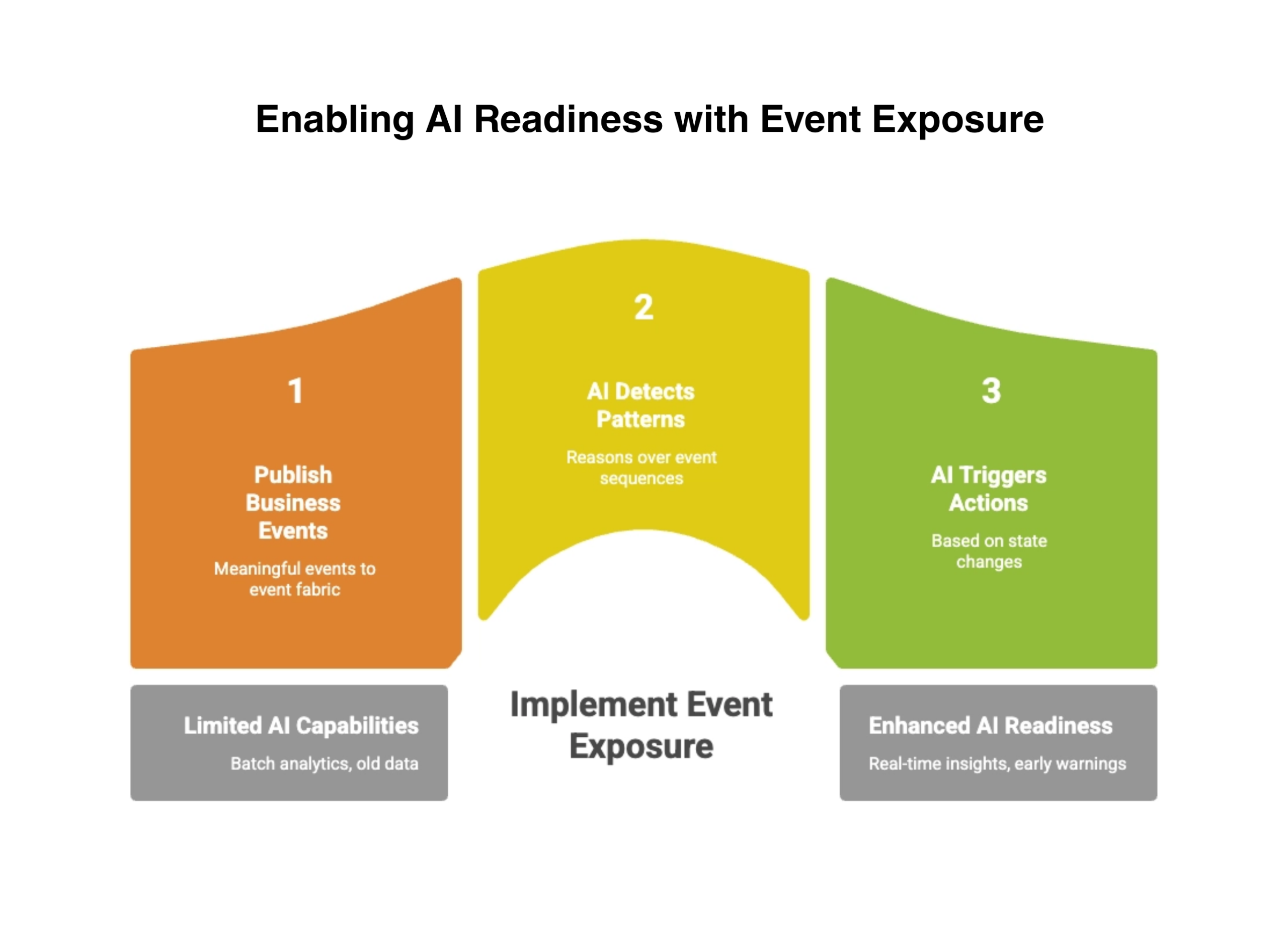
AI becomes operational when banking systems publish meaningful business events in real time.
The single most important capability that modularization must deliver for AI readiness is event exposure. AI systems reason over events. They detect patterns in sequences. They trigger actions based on state changes. Without events, AI is limited to batch analytics — looking at yesterday’s data to make today’s decisions.
Event exposure means every domain publishes meaningful business events to a shared event fabric. Not database change logs. Not raw transaction records. Business events with semantic meaning: a customer opened an account, a payment exceeded a threshold, a loan entered delinquency, a wire transfer was initiated to a new beneficiary.
Consider what happens without this. A bank deploys an AI model to detect early signs of commercial loan distress. The AI model needs to see payment behavior, covenant compliance triggers, and relationship activity across the commercial portfolio — as they happen. Without event exposure, the model runs on data that is twelve to twenty-four hours old. In commercial lending, a day-old view of a deteriorating borrower is not early warning. It is a late reaction.
Banks that modularize without building event exposure have done half the work. They have separated the domains but left the AI deaf to what those domains are doing.
Without event exposure, your AI is not predicting. It is reporting. And by the time it reports, the opportunity — or the risk — has already moved.
The Ontology Connection
Modularization without fixing the data ontology is incomplete. This is the bridge from the previous article that demands emphasis. You can have perfectly modular services that still speak different dialects of “customer” and “account.” A modular payments service that defines account as a funding source and a modular lending service that defines account as a credit facility will produce clean, well-structured, semantically incompatible data.
AI does not care how well-structured your services are if the data they produce cannot be reconciled. Modularization and ontology governance must proceed together. Every new domain service must adopt the enterprise ontology. Every event must use the canonical vocabulary. This is the discipline that separates modernization from reorganization.
What Comes Next
Modularization works for most banks. But not all.
The diagnostic signal is straightforward: if every attempt to separate a domain from the core triggers a cascade of dependencies that pull you back into the monolith, the core is not modularizable. You are not dealing with an architecture that can be decomposed. You are dealing with an architecture that was never composed in the first place — it grew, and everything grew together.
When that is the reality, incremental modularization becomes more expensive than structured replacement. The next article addresses that harder question: when replacement becomes the only viable path, how does a bank recognize it, and how does it execute without losing five years?
Where to Start
The distance between shallow modularization and genuine domain separation is measurable. So is the cost of getting it wrong.
Core System Partners’ Transformation Readiness Scorecard gives leadership teams a structured assessment of their architectural gaps — including modularization maturity, event readiness, and ontology alignment — in under an hour, with clear prioritization of where to act first.
If your institution is ready to move from awareness to action, visit https://coresystempartners.com/contact to start the conversation.
Next article in the series: Rip-and-Replace in the AI Era: When Replacement Becomes the Only Path
Return to: Why AI makes modern core banking architecture non-negotiable
#CoreBankingTransformation #CoreBankingArchitecture