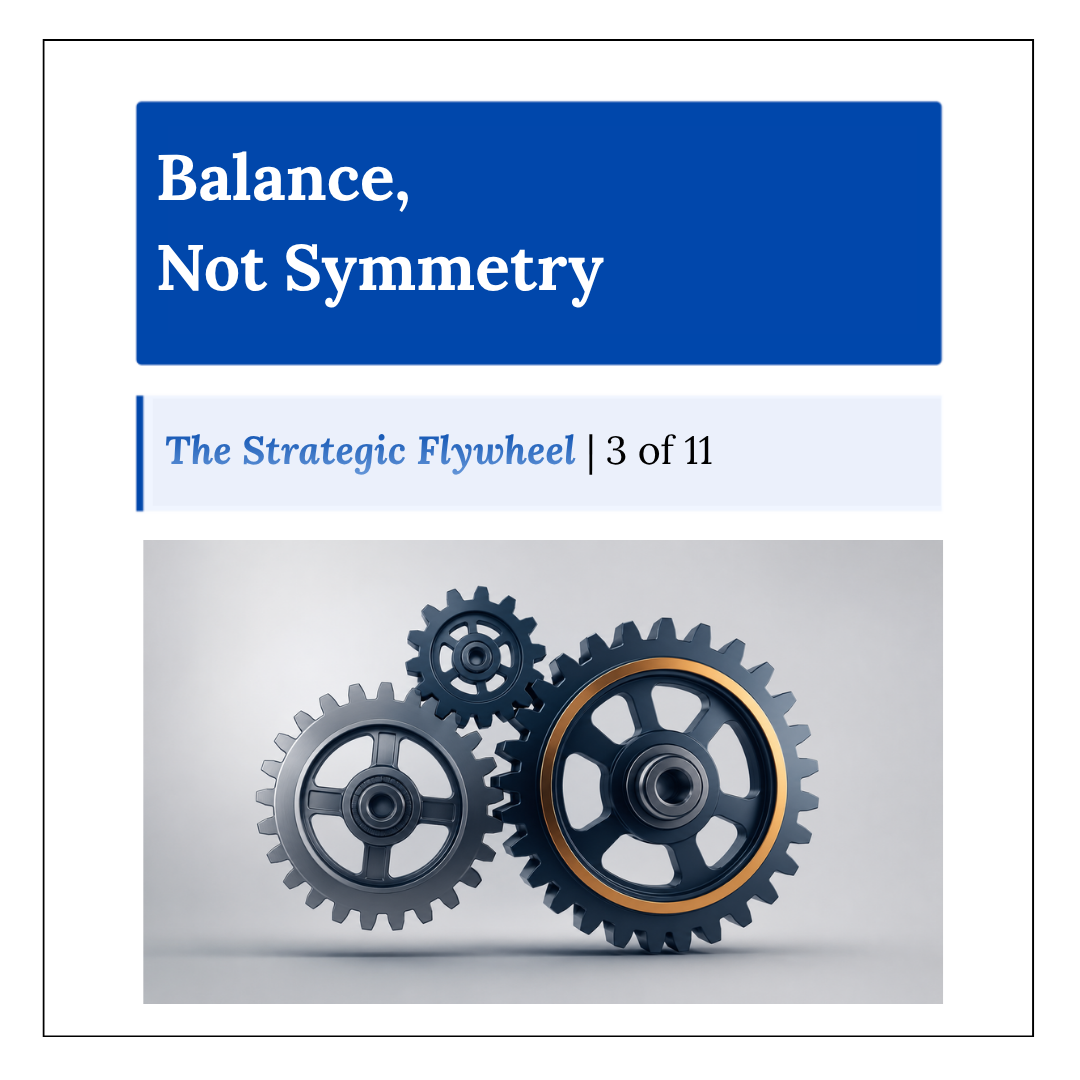
Transformation isn’t about giving equal time to Run, Change, and Innovate, it’s about deliberately shifting focus as business priorities evolve while maintaining long-term strategic balance.
Early in my career I watched a bank try to solve this the tidy way: a third of the roadmap to Run, a third to Change, a third to Innovate, redrawn every quarter like a pie chart that was supposed to prove fairness. It never survived contact with an actual week. A payments incident would blow the Run slice past its line. A vendor upgrade would eat into Change. Innovation, the gear with the least political muscle in the room, quietly gave up whatever was left. Everyone had followed the plan. The plan just wasn’t real.
Here’s the correction that actually holds up: the goal is balance across the quarter, not symmetry in a week. Each gear speeds up or slows down as risks and seasons change, and that’s not drift, that’s the system working. A bank in the middle of an outage should be running harder than it’s changing that week. A bank mid-migration should be changing harder than it’s innovating. What matters isn’t equal weight at every moment. It’s that the trade-offs are visible, and that a quarter later you can point to what moved, on purpose, and why.
I pushed on this hard with Ben Gurdus, who spent decades running core technology at Citibank, because his instinct cuts against the tidy version even further. When I asked whether banks should fix their operational foundation before attempting real innovation, he didn’t hedge: “You have to innovate because at some point the processes… they have to change. Very often you don’t have a choice, you have to do the innovation when your run-the-bank systems are in poor shape.” His point wasn’t that sequence is irrelevant. A bank that runs well will find Change cheaper and Innovation faster, and he’d be the first to say so.
“It will be easier to innovate had the running and changing of the bank in the past been done much better. But we cannot change the past.”
— Ben Gurdus
That’s the case for simultaneity in one line: you don’t get to wait for perfect footing. A bank in genuine operational distress still has to run, change, and innovate at the same time, just with very different weights on each gear than a bank that’s already stable. The mistake is confusing “different weights” with “no plan.” Without a way to make those weights visible, “different weights” quietly becomes “whichever gear screamed loudest this week,” and that’s how innovation always ends up the one that starves, not because anyone decided it mattered less, but because nobody decided anything at all.
The instrument that keeps this honest is a Balance Dashboard: one view, read the same way every month, showing the capacity split across Run, Change, and Innovate alongside the trend lines that tell the truth about outcomes and risk:
- Adoption against target
- Benefit against baseline
- Risk posture on the top few items
- Exception recovery time
- Where customers abandon a journey out of friction
None of that requires equal thirds. It requires that leaders look at the split on purpose, once a month, and make a call instead of letting the calendar make it for them.
Balance isn’t a compromise between the three gears. It’s the discipline of choosing, visibly, which one needs more of you this quarter, and being able to prove it wasn’t an accident.
— Rick Mavrovich