Issue #24
Weekly Banking Intelligence: July 10 to July 16, 2026
THIS WEEK’S SIGNAL
The three largest core banking providers in the United States have each now committed to a major AI partner. Fiserv went with OpenAI. FIS chose Anthropic. Jack Henry announced this week it is deploying Google AI across its platform. Together, those three vendors run the core systems for more than 70% of U.S. depository institutions. That is not a technology story. That is a structural shift in how the industry will be governed, audited, and competed.
Why it matters: If your core provider has already picked an AI partner, your institution’s AI roadmap is now partially determined by someone else’s contract, and your leadership team needs to understand what that means before your next planning cycle.
DEEP DIVE
The Core Provider AI Alignment Is Now Complete. What Happens Next Is the Hard Part.
Jack Henry’s announcement this week that it is deploying Google AI across its platform confirms something worth sitting with for a moment. Every major core provider has now aligned with a hyperscaler AI partner. This did not happen gradually. It happened in roughly 18 months. And for the community and mid-size institutions that rely on these platforms, the implications run deeper than most leadership teams have had time to discuss.
Let’s follow that logic for a minute. Jack Henry serves approximately 7,400 community and mid-size financial institutions, according to the American Banker report citing the company’s own figures. When Jack Henry embeds Google AI into its core, those institutions do not get to opt out of the underlying architecture. They get the capability, but they also inherit the dependency, the data-sharing model, the vendor roadmap, and the governance assumptions baked into that partnership. That is a meaningful shift in how much control a community bank actually has over its own technology posture.
Why it matters: For the roughly 7,400 institutions on Jack Henry’s platform, the question is no longer whether to adopt AI. The question is whether your institution understands what you are getting, what you are giving up, and how your risk and compliance teams will govern something you did not design. Most community bank boards have not had that conversation yet.
The KPMG 2026 Banking Technology Survey, cited in multiple reports this week, found that active AI use in financial services has more than doubled from 30% in 2024 to 75% in 2026. Separately, 51% of banks are now piloting AI agents specifically to boost productivity, according to PYMNTS. Those numbers tell you adoption is accelerating well ahead of most institutions’ governance frameworks. The gap between what banks are deploying and what they actually understand about what they are deploying is widening, not narrowing.
Why it matters: The operating model implications here are just as significant as the technology ones. Who owns AI governance at your institution? Is it the CIO? The Chief Risk Officer? A committee that meets quarterly? When AI is embedded in your core platform and running autonomously on customer interactions, quarterly oversight is not a governance model. It is a liability.
Here is what I think people are missing in the coverage of the core provider AI race. Most of the commentary focuses on which hyperscaler each vendor chose and what features will be available. That is the easy part. The harder question is what happens when something goes wrong. When a Google-powered Jack Henry system makes a credit decision, generates a customer communication, or flags a transaction, and that output is wrong or discriminatory or simply inconsistent with your institution’s risk appetite, who is accountable? Your core vendor? Google? Your own compliance team? That accountability chain is not clearly defined in most institutions today, and the regulatory environment is moving fast enough that it will be tested before most banks are ready.
MARKET MOVES
Stripe and Advent Make a $53 Billion Run at PayPal
Stripe and private equity firm Advent International submitted an acquisition offer valuing PayPal at over $53 billion, according to reporting from Axios citing Reuters. If completed, this would be the largest fintech acquisition in history, and one of the more unusual deal structures in recent memory: a venture-backed payments company, Stripe, leading a bid for a publicly traded payments incumbent more than twice its own last private valuation.
Why it matters: This is not just a payments story. If Stripe absorbs PayPal’s merchant network, consumer reach, and regulatory licenses, the combined entity becomes a serious competitor to bank-owned payment rails and embedded finance offerings. Banks that have been slow to build or acquire modern payments infrastructure should be watching this closely. The gap between bank-grade payments capability and fintech-grade payments capability just got potentially larger overnight.
Axos Financial Acquires Arc Technologies
Axos Financial (Nasdaq: AX), a digital bank, signed a definitive agreement to acquire Arc Technologies, a San Francisco-based fintech that provides treasury and capital markets tools to technology companies and growth-stage businesses. The deal gives Axos a modern, AI-native software platform and direct access to a segment, technology companies and venture-backed startups, that most traditional banks have struggled to serve efficiently.
Why it matters: This is a clean example of what “buying capability” looks like in practice. Axos is not building an AI-native treasury stack from scratch. It is acquiring one, along with the customer relationships and the talent that built it. Banks that are still debating whether to build or buy modern fintech capabilities are watching competitors make that decision for them.
Fintech Funding Concentrates as Deal Count Falls
Venture funding into fintech climbed nearly 23% year over year in the first half of 2026, even as deal count fell more than 25%, according to Crunchbase data. Larger deals, those over $100 million, rose 23% quarter over quarter in Q2. Investors are writing fewer checks and making them much larger, concentrating capital into a smaller number of companies they believe can scale.
Why it matters: When capital concentrates like this, the fintech landscape consolidates faster than most bank strategy teams anticipate. The vendors your institution evaluated 18 months ago may look very different today, either better capitalized and growing faster, or quietly running out of runway. Your vendor risk assessments should reflect the current funding environment, not the one from your last review cycle.
VENDOR SIGNALS
Jack Henry Deploys Google AI Across Its Core Platform
Jack Henry (Nasdaq: JKHY) announced this week that it is embedding Google AI into its core banking platform, completing what is now a clean sweep of hyperscaler AI alignments among the top three U.S. core providers. The deployment is intended to serve the approximately 7,400 community and mid-size financial institutions on Jack Henry’s platform, with applications spanning cybersecurity, customer experience, and operational efficiency. The American Banker report on this announcement noted explicitly that all three major core providers have now picked an AI partner, a milestone worth marking.
Why it matters: Community and mid-size banks that have been waiting to see how the AI landscape shakes out before committing resources now have a clearer picture. Your core provider has made its bet. The question for your institution is whether you have the internal capability to govern, customize, and get real value from what your vendor is about to hand you. Technology without readiness is just cost.
SBS Embeds AI Directly Into Core Banking
SBS, a global financial technology company, announced the launch of SBS AI Foundation this week, embedding enterprise AI directly into its core banking, lending, and payments platform. SBS describes its client base as more than 1,500 financial institutions globally. The product is designed to move AI from a bolt-on capability to a native component of core operations.
Why it matters: The direction of travel in core banking is clear. AI is moving from the periphery into the engine room. Institutions that have been treating AI as a separate initiative sitting alongside their core platform are going to find that distinction increasingly difficult to maintain. The integration question is becoming the governance question.
Standard Chartered Commits to Broadcom for Cloud Infrastructure Across 54 Markets
Standard Chartered announced a long-term strategic commitment with Broadcom (Nasdaq: AVGO) to deploy VMware Cloud Foundation across the bank’s operations in 54 markets. The deal is framed around security, resilience, and always-on availability, which are the right priorities for a bank operating across that many jurisdictions with that much regulatory complexity.
Why it matters: Large global banks are locking in multi-year infrastructure commitments that will shape their AI and modernization options for years. Cloud foundation decisions made today constrain or enable everything that runs on top of them. If your institution is still treating infrastructure as a back-office procurement question rather than a strategic architecture decision, you are likely to find yourself with fewer good options later.
REGULATORY PULSE
The Financial Stability Board Releases AI Sound Practices Consultation Report
The Financial Stability Board (FSB) released a consultation report this week proposing 12 sound practices for responsible AI adoption by financial institutions. The report covers organization-wide AI governance and each stage of the AI development and deployment lifecycle. It includes case studies drawn from real-world implementation by financial institutions, which makes it more useful than most regulatory guidance of this type.
Why it matters: The FSB’s 12 practices are not binding today, but consultation reports from bodies like the FSB have a reliable history of becoming the basis for binding guidance within 12 to 24 months. Institutions that treat this as a reading exercise rather than a gap assessment are going to be scrambling later. Pull this document. Run it against your current AI governance framework. Find out where the gaps are before your regulator does.
Fed Vice Chair Bowman: Let Banks Set Their Own AI Timelines
Federal Reserve Vice Chair for Supervision Michelle Bowman stated publicly on July 14 that she does not want government directing which technology banks use or when they use it. The position is consistent with a broader deregulatory posture at the Fed under current leadership, and it stands in notable contrast to the more prescriptive approach being developed in Europe.
Why it matters: U.S. banks are currently operating in a relatively permissive regulatory environment for AI adoption. That window is unlikely to stay open indefinitely, particularly as AI agent deployments scale and the first significant AI-related compliance failures become public. The institutions that use this period to build genuine governance capability, rather than just moving fast because they can, will be in a much stronger position when the regulatory posture shifts.
U.S. Bankers Are Asking for More AI Regulation, Not Less
An American Banker opinion piece this week highlighted a counterintuitive dynamic: U.S. bankers are expressing more appetite for AI regulatory clarity than their European counterparts, even as the U.S. regulatory environment remains lighter. The reasoning is straightforward. Regulatory clarity reduces uncertainty, and uncertainty is expensive when you are making multi-year technology investments.
Why it matters: When the people deploying the technology are asking for clearer rules, that is a signal worth taking seriously. It suggests the industry recognizes that the current ambiguity creates as many risks as it removes. Boards and audit committees should be asking whether their AI governance frameworks are robust enough to withstand a more demanding regulatory environment, regardless of when that environment arrives.
TALENT SIGNALS
JPMorgan’s Earnings Call Surfaces an Uncomfortable Data Point
JPMorgan Chase CEO Jamie Dimon, in remarks accompanying the bank’s Q2 2026 earnings, referenced AI-driven job reductions alongside continued technology investment. The bank’s 2026 technology budget is approaching $20 billion, with a meaningful share directed toward AI. The earnings coverage made clear that productivity gains from AI are already showing up in headcount decisions, not just in future projections.
Why it matters: When the largest bank in the country confirms AI-driven job reductions in an earnings call, that is no longer a hypothetical. It is a data point. Institutions that are still treating workforce implications of AI as a future planning item need to move that conversation into the present. The operating model changes are happening now, and the talent strategy needs to reflect that.
BMO Harris Bank Is Hiring AI Governance Leads
BMO Harris Bank is actively hiring for AI governance and risk roles, a signal consistent with what we are seeing across Tier 1 institutions. As AI deployment accelerates, the demand for people who can govern it, audit it, and explain it to regulators is rising accordingly.
Why it matters: AI governance roles are growing precisely because AI adoption is growing. This is not a compliance cost. It is a capability investment. Institutions that staff governance after deployment rather than alongside it are creating risk exposure that will be difficult to unwind. The talent market for experienced AI governance professionals is already competitive and getting tighter.
The Relationship Banker Is Coming Back, Differently
Multiple reports this week, including commentary from Jouk Pleiter, CEO of Backbase (a digital banking platform provider), argue that AI is enabling a resurgence of relationship banking by freeing bankers from administrative tasks and allowing them to focus on client engagement. The argument is that the banker is not being replaced by AI but rather being repositioned by it.
Why it matters: This framing matters for workforce planning and for culture. The institutions that will navigate the AI transition most successfully are not the ones eliminating bankers. They are the ones redefining what a banker does. That requires deliberate job redesign, retraining investment, and leadership clarity about what the human role looks like in an AI-augmented institution.
CB RADAR UPDATE
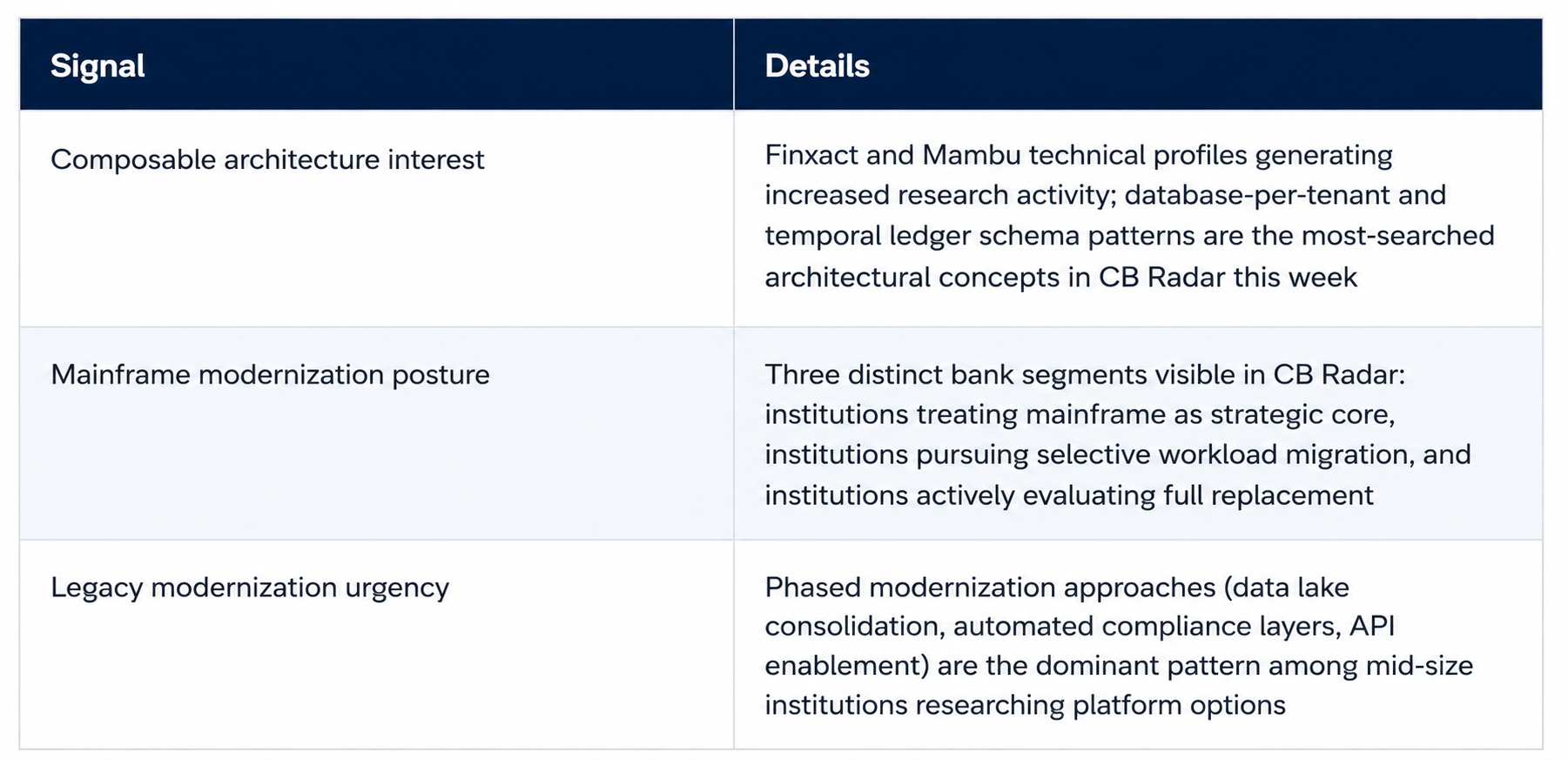
Why it matters: The CB Radar signals this week reinforce a pattern we have been watching for several months. Institutions are not choosing between legacy and modern. They are choosing how fast to move and in what sequence. The vendors that are winning are the ones that can meet banks where they are architecturally and operationally, not just where they aspire to be. The core provider AI alignment data in CB Radar also suggests that the window for institutions to negotiate meaningful customization or governance terms with their core vendors is narrowing as those vendors lock in their own partner commitments.
RICK’S STRATEGIC TAKE
➜ The core provider AI alignment story is the most structurally significant development in community and mid-size banking this year. Not because of the technology. Because of the governance implications. Most institutions on these platforms did not choose Google, OpenAI, or Anthropic. Their core vendor chose for them. That is a board-level conversation, not an IT conversation. Who at your institution is tracking what your core provider’s AI partner agreements actually say about your data, your liability, and your options if something goes wrong?
➜ The Stripe-PayPal bid, the Axos-Arc acquisition, and the fintech funding concentration data all point in the same direction. Capital is moving toward scale and AI-native capability, and it is moving fast. Banks that are still in the evaluation phase of their digital and payments strategy are not just behind on technology. They are behind on the competitive positioning that technology enables. The institutions I am watching closely are the ones that have already made their bets and are now focused on execution. The ones still debating the strategy are losing time they do not have.
➜ The regulatory environment is more permissive right now than it will be in 24 months. The FSB consultation, the Bowman statement, and the American Banker commentary on U.S. banker appetite for regulatory clarity all point to the same conclusion: the rules are coming, the shape of them is becoming clearer, and the institutions that build genuine AI governance capability now, rather than waiting for mandates, will have a meaningful advantage when the environment tightens. Use this window. Do not assume it is permanent.
For a deeper framework on what AI-ready core architecture actually requires, see CSP’s CB Architecture Series at coresystempartners.com.
Want the Full Picture?
Subscribe to BIS, the Banking Intelligence Service from Core System Partners, for the full breakdown including Rick’s Strategic Take on the governance gap, the CB Radar vendor tracking signals, and the regulatory pulse analysis covering what SR 11-7 does and does not cover for agentic deployments, delivered weekly. Banking Intelligence Service
For CSP’s full analysis of what the Fed and Treasury are actually concerned about—and a framework for what AI-ready architecture requires—visit Core System Partners.
Continue With Core System Partners
- Contact Us: https://coresystempartners.com/#contact
- The Strategic Flywheel (book): https://coresystempartners.com/resources/strategicflywheel/
- Core Insider (weekly newsletter): https://coresystempartners.com/resources/newsletter/