Issue #25
Weekly Banking Intelligence: July 17 to July 23, 2026
THIS WEEK’S SIGNAL
Bank of America told investors this week that more than 200,000 of its employees are now using AI-enabled capabilities, including productivity tools, coding support, and agentic workflows. That number, coming directly from CEO Brian Moynihan on the Q2 2026 earnings call, is not a pilot update. It is a scale announcement. Meanwhile, the UK’s Financial Conduct Authority (FCA) published the Mills Review, identifying AI as a systemic driver of change through 2030 and laying out seven priority recommendations for the industry. Regulators and large banks are moving in the same direction at the same time, and the gap between institutions that are ready for this moment and those that are not is widening faster than most boards realize.
Why it matters: If you are still debating whether AI adoption is real or premature, this week’s signals should settle that debate. The question now is whether your operating model and your architecture can actually absorb what is coming.
DEEP DIVE
Bank of America’s AI Scale Announcement: What 200,000 Users Actually Means Brian
Moynihan’s Q2 earnings disclosure was straightforward: more than 200,000 Bank of America employees are actively using AI-enabled tools. That includes productivity applications, developer coding assistants, and, notably, agentic AI capabilities. This is not a headline number manufactured for investor relations. It is a deployment figure, and it deserves careful attention.
Here is what I think people are missing. Getting 200,000 employees onto AI tools is not primarily a technology achievement. It is an operating model achievement. Somebody had to decide which workflows to target first. Somebody had to train people, manage change, define governance guardrails, and figure out what “good” looks like when an AI agent is completing tasks on behalf of a banker. That organizational infrastructure is as hard to build as the technology itself, and most institutions have not started building it.
The agentic piece is where things get particularly interesting. Agentic AI does not just assist a human. It takes action. It initiates processes, makes decisions within defined parameters, and completes multi-step tasks without constant human intervention. When that capability is deployed at scale inside a regulated financial institution, the questions of accountability, audit trail, and model governance become very real, very fast. Who owns the output when the agent makes a mistake? How does that get documented for examiners? What happens when an agentic workflow crosses a compliance boundary?
Why it matters: Bank of America is not just ahead on technology. It is ahead on the organizational capability to absorb technology at scale. That gap compounds. Every quarter that a mid-tier bank runs a pilot while BofA runs at 200,000 users, the distance grows. Catching up later is not impossible, but it requires more than buying better software.
Why it matters for your operating model: The institutions that will struggle most with agentic AI are not the ones with the worst technology. They are the ones with the most fragmented data environments and the least defined process ownership. If your teams cannot clearly articulate who owns a workflow today, you are not ready to hand that workflow to an agent. That is not an indictment of your technology team. It is a readiness question for your entire leadership structure.
MARKET MOVES
Bank of Maldives Selects Finastra Essence for Core Banking Modernization
Finastra, a global financial technology company serving banks of all sizes, announced that the Bank of Maldives has selected Finastra Essence to modernize its core banking operations. This is a straightforward core replacement in a smaller market, but it is worth noting in the context of a broader pattern.
Why it matters: Finastra continues to accumulate core banking wins in international markets. For community and regional banks in the U.S. evaluating core vendors, the relevant question is not whether Finastra can win deals abroad. It is whether the platform investment being made in international deployments translates into product capability that benefits domestic clients. Vendor momentum in one market does not automatically transfer to another, and due diligence on roadmap alignment remains essential.
VENDOR SIGNALS
Temenos Secures 15 Number-One Rankings in the 2026 IBS Intelligence Sales League Table
Temenos, the Swiss core banking software company, secured 15 number-one rankings across major banking categories in the 2026 IBS Intelligence Sales League Table, including recognition as a Regional Leader in North America. The IBS Sales League Table is one of the more credible independent measures of core banking vendor deal activity.
Why it matters: Temenos has had a turbulent few years, and this result signals that its sales momentum is recovering. For banks currently in vendor evaluation, this matters because league table performance reflects real deals, not marketing claims. It also means Temenos will be showing up more aggressively in competitive situations. If you have not refreshed your vendor landscape assessment recently, this is a reason to do so.
Skaleet Named Europe’s Best Core Banking Solution 2026 by Euromoney
Skaleet, a French cloud-native core banking platform, was recognized by Euromoney as Europe’s best core banking solution for 2026. The award was supported in part by Crédit Agricole’s decision to build a pan-European digital savings platform on Skaleet, running core banking functions across onboarding, payment accounts, savings, and SEPA payment processing.
Why it matters: Skaleet is not a household name in the U.S. market, but the Crédit Agricole deployment is a legitimate reference. A tier-one European bank building a pan-European platform on a cloud-native core is the kind of signal that shifts vendor conversations. Composable, API-driven platforms are winning real enterprise mandates, not just fintech pilots. That is relevant context for any bank currently evaluating its core modernization path.
Wells Fargo Enables Plain Language Queries Across Core Technology Platform
Wells Fargo introduced a capability this week that allows plain language queries against its core technology platform, simplifying access for internal teams and accelerating decision-making. Details on the underlying technology were limited, but the direction is clear.
Why it matters: This is a quiet but meaningful signal. When a bank the size of Wells Fargo starts building natural language interfaces into its core infrastructure, it is not doing that for novelty. It is doing it because the speed of access to core data is becoming a competitive variable. Banks that require weeks of IT engagement to answer operational questions are at a structural disadvantage compared to institutions where business leaders can query their own systems directly.
REGULATORY PULSE
UK FCA Publishes the Mills Review: AI as a Systemic Risk to 2030
The UK’s Financial Conduct Authority published the Mills Review this week, describing AI as a systemic driver of change in financial services through 2030. The review identifies four “system shifts” reshaping the industry and sets out seven priority recommendations for regulators and institutions. This is not a discussion paper. It is a framework the FCA intends to act on.
Why it matters: The FCA is signaling that AI is no longer a product-level risk to be managed by individual compliance teams. It is being framed as a systemic risk requiring coordinated regulatory response. U.S. institutions with UK operations or UK regulatory exposure need to track this closely. More broadly, the Mills Review is likely to influence how other regulators frame AI governance requirements, including in the U.S. The direction is toward more structure, more documentation, and more accountability, not less.
Reserve Bank of India Releases Draft Model Risk Management Guidance
The Reserve Bank of India (RBI) released draft guidance on regulatory principles for model risk management, covering the development, validation, deployment, and oversight of both traditional and
AI-driven models. The consultation period is active, with a final framework expected later this year. Why it matters: The RBI guidance mirrors the trajectory of U.S. model risk management expectations, and it is a useful leading indicator. Regulators globally are converging on similar principles: document your models, validate them independently, govern their outputs, and demonstrate oversight. If your model risk framework was built around traditional statistical models and has not been updated for generative AI and agentic systems, it is already behind where examiners are heading.
Financial Stability Board Consultation on AI Governance Closes; Final Report Expected October 2026
The Financial Stability Board (FSB) closed its consultation period on AI governance this week. Responses will be published, and a final report is expected in October 2026 as part of the U.S. G20 work program.
Why it matters: October is not far away. When the FSB publishes a final AI governance framework under a G20 mandate, it carries significant weight with domestic regulators in member countries. Institutions that have not yet developed a coherent AI governance structure will find themselves reacting to that report rather than being positioned ahead of it. Now is the time to close that gap.
TALENT SIGNALS
Bank of America Promotes Sonali Theisen and Kevin Milsom to Lead Digital Assets and AI
Bank of America promoted Sonali Theisen to head of global digital assets, with a focus spanning stablecoins, tokenized deposits, custody, and crypto trade settlement. Kevin Milsom was elevated alongside her to lead AI-related efforts. Both moves were announced this week and reflect a deliberate organizational decision to put senior leadership directly accountable for these domains.
Why it matters: This is not a technology hire. It is an organizational design decision. BofA is creating senior accountability for AI and digital assets at the leadership level, which means these functions now have a seat at the table when strategy is set, budgets are allocated, and risk decisions are made. Banks that have not made equivalent organizational moves are operating with a structural disadvantage, not just a technology gap. The question I would be asking is: who in your organization owns AI outcomes, not just AI projects?
BMO Harris Bank Is Hiring AI Governance and MLOps Talent
BMO Harris Bank is actively building out its AI governance and machine learning operations (MLOps) capabilities, with open roles reflecting a deliberate investment in the infrastructure needed to manage AI at scale.
Why it matters: AI governance and MLOps roles are rising precisely because AI adoption is accelerating, and institutions are discovering that deploying models is the easy part. Managing them in production, monitoring for drift, maintaining audit trails, and satisfying examiner expectations requires dedicated capability that most banks do not yet have in-house. BMO’s investment here is a signal that serious AI deployment requires serious operational infrastructure behind it.
CB RADAR UPDATE
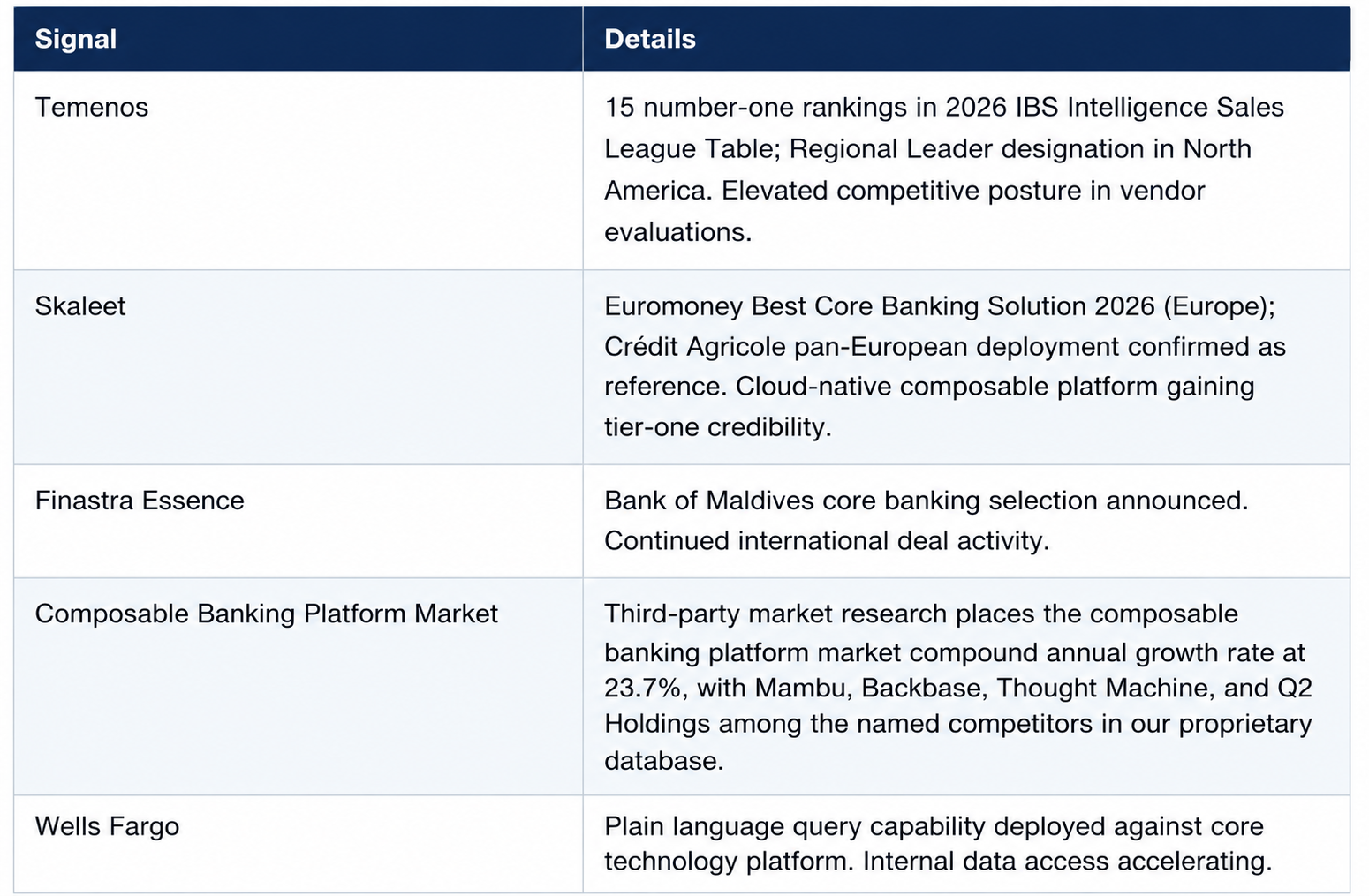
Why it matters: The CB Radar signals this week reinforce a pattern we have been tracking for several months. The core banking vendor landscape is not consolidating. It is stratifying. Established players like Temenos are defending share aggressively while cloud-native specialists like Skaleet are winning enterprise mandates that would have gone to legacy vendors five years ago. For bank buyers, this means the evaluation process is more complex than it used to be, and the cost of a wrong selection is higher. Vendor financial stability, implementation track record, and roadmap credibility all deserve more scrutiny than they typically receive in a competitive RFP process.
RICK’S STRATEGIC TAKE
➜ The BofA earnings call was the most important data point of the week, and it had nothing to do with the financial results. When a CEO tells investors that 200,000 employees are using AI in production, including agentic capabilities, that is a capability statement. It tells you something about the bank’s operating model, its governance infrastructure, and its organizational readiness that no technology announcement can replicate. The banks I worry about are not the ones that have not bought AI tools. They are the ones that have bought tools but have not built the organizational muscle to use them at scale.
➜ The regulatory signals this week, from the FCA’s Mills Review to the RBI’s model risk draft to the FSB consultation closing, are all pointing in the same direction. AI governance is moving from voluntary best practice to examined expectation. If your AI governance framework is still a slide deck rather than an operational reality, the window to get ahead of this is closing. Examiners do not grade on a curve when the expectations have been published in advance.
For a deeper framework on what AI-ready core architecture actually requires, see CSP’s CB Architecture Series at coresystempartners.com.
Want the Full Picture?
Subscribe to BIS, the Banking Intelligence Service from Core System Partners, for the full breakdown including Rick’s Strategic Take on the governance gap, the CB Radar vendor tracking signals, and the regulatory pulse analysis covering what SR 11-7 does and does not cover for agentic deployments, delivered weekly. Banking Intelligence Service
For CSP’s full analysis of what the Fed and Treasury are actually concerned about—and a framework for what AI-ready architecture requires—visit Core System Partners.
Continue With Core System Partners
- Contact Us: https://coresystempartners.com/#contact
- The Strategic Flywheel (book): https://coresystempartners.com/resources/strategicflywheel/
- Core Insider (weekly newsletter): https://coresystempartners.com/resources/newsletter/