Issue #27
Weekly Banking Intelligence: July 31 to August 06, 2026
THIS WEEK’S SIGNAL
The agentic AI conversation just ran into a wall, and the wall has a name: core banking architecture. Multiple signals this week, from a $30 million bet against legacy cores to Fiserv’s agentOS launch to a widely-read technical post on compliance friction, are all pointing at the same problem. Banks cannot deploy autonomous AI workflows on infrastructure that was never designed to support them. The operating model question is catching up fast too. Who owns the decisions an agent makes? Who governs the audit trail? Who is accountable when the agent is wrong?
Why it matters: If your institution is still running on a legacy core and your AI roadmap includes agentic workflows, you have a sequencing problem that no amount of middleware will fully solve.
DEEP DIVE
Agentic AI Meets Its Architectural and Governance Limits
The idea of AI agents handling end-to-end banking tasks, from loan origination to fraud adjudication to customer onboarding, has moved well past the whiteboard. Banks are actively piloting this. The problem is that the infrastructure underneath most of these pilots was built for batch processing, nightly reconciliation, and human checkpoints at every decision node. Agentic workflows require real-time data access, continuous auditability, and the ability to execute consequential decisions without a human in the loop. Most legacy cores were not designed for any of those three requirements simultaneously.
Vamsi Chemitiganti, a practitioner who writes regularly on core banking technology, published a detailed analysis this week on exactly this friction point. His argument is straightforward: agentic AI has moved quickly in customer support and back-office document processing because those workflows sit outside the core. The moment you try to embed an agent into credit decisioning, regulatory reporting, or deposit operations, you hit compliance walls that legacy architecture cannot clear. The data models are wrong. The audit trails are incomplete. The real-time connectivity simply is not there.
What caught my attention is how this connects to the operating model side of the problem. Bretton AI’s CEO made a pointed observation this week: the real competitive question is not how much AI a bank deploys, it is whether the bank can govern a platform that is performing increasingly consequential work autonomously. That is a governance and operating model challenge as much as a technology one. Most banks have not answered the question of who owns an agent’s decisions, how those decisions get reviewed, and what the escalation path looks like when an agent gets it wrong.
Fiserv’s agentOS, which the company is targeting for broad availability this month, is an attempt to solve part of this problem from the vendor side. Fiserv’s co-president described it as the first place where banks can run Fiserv’s agents, build their own, and deploy from a curated partner set, all under unified governance, identity, and audit controls. That is a serious product commitment from a company with deep bank relationships. But it also raises a legitimate question: does a bank running agentOS on an aging core actually solve the underlying problem, or does it add a governance layer on top of infrastructure that still cannot support real-time agentic execution at scale?
Why it matters: Banks that have not yet addressed core modernization are not just behind on technology. They are behind on the foundational capability required to deploy, govern, and audit autonomous AI workflows. The two problems are now the same problem.
Why it matters for operating model: The governance question is not a future concern. Regulators are already asking about it. If your AI strategy does not include a clear answer to who owns agent decisions and how they are audited, that gap will surface in your next examination.
MARKET MOVES
Fintechs Are Out-Acquiring Banks for the First Time on Record
A report released this week documents a structural shift in financial services M&A: for the first time on record, fintech companies have out-acquired banks in deal volume. The report, which examines how licensed financial companies are valued, bought, and sold in the current cycle, frames this as more than a cyclical anomaly. Fintechs are acquiring distribution, licenses, talent, and data assets at a pace that traditional banks, constrained by regulatory capital requirements and slower approval timelines, simply cannot match right now.
The broader fintech M&A environment remains active, driven by AI capability acquisition, international expansion, and financial infrastructure modernization. The pattern worth watching is not the volume of deals but what is being acquired. When fintechs buy, they tend to buy capabilities. When banks buy, they tend to buy customers. Those are very different acquisition philosophies, and over time they produce very different competitive positions.
Why it matters: If fintechs are systematically acquiring AI capabilities, distribution infrastructure, and regulatory licenses faster than banks can, the capability gap compounds with each deal cycle. Banks that are not actively thinking about what they need to own versus partner versus acquire are making a strategic choice by default.
Maximum Raises $30 Million to Challenge Legacy Core Providers
Maximum, a startup positioning itself as an AI-native operating system for banks, launched this week with a $30 million seed round led by CRV. The founder, Randy Fernando, has a track record of building and selling fintech companies to Acorns and Marqeta. The company’s thesis is direct: legacy cores cannot power AI agents, and the three vendors that control most of the market have neither the incentive nor the architecture to fix that.
Thirty million dollars is a seed round, not a market disruption. But the signal matters. Sophisticated venture capital is making a directional bet that the core banking market is vulnerable in a way it has not been before. The AI agent capability gap is the opening, and Maximum is not the only company looking at it.
Why it matters: Core providers should take this seriously, not because Maximum will replace them next year, but because the narrative around legacy core limitations is gaining real momentum with investors, bank boards, and the press. Narrative shapes procurement conversations.
10x Banking Reaches EBITDA Positive, Raises £40 Million
10x Banking, the cloud-native core platform serving Westpac, JPMorgan Chase, and Old Mutual, raised £40 million from AshGrove Capital this week after reaching EBITDA-positive status in Q4 2025. This is a
meaningful commercial milestone. Cloud-native core providers have been promising profitability for years. 10x has now demonstrated it.
Why it matters: EBITDA-positive status at a cloud-native core provider changes the risk calculus for bank buyers. The “will they still be here in five years” question gets easier to answer. Expect this to accelerate 10x’s pipeline conversations with institutions that were waiting for financial proof before committing.
VENDOR SIGNALS
Temenos Deepens AI Capabilities and Reshapes Leadership
At the Temenos Community Forum 2026, the company announced new AI-powered capabilities across its core banking, digital banking, and financial crime mitigation product lines. The same week, Temenos appointed new product and technology chiefs to lead its AI strategy and product development roadmap. Taken together, these moves suggest Temenos is making a deliberate push to position its platform as AI-ready at the core level, not just at the interface layer. The leadership changes matter as much as the product announcements. New product and technology chiefs signal a shift in internal priorities, and the direction here is clearly toward embedding AI deeper into the platform rather than layering it on top. Whether the underlying architecture can support what the roadmap promises is the question bank buyers should be pressing in their next vendor conversations.
MCBANK Selects Jack Henry for Full-Stack Modernization
Louisiana-based MCBANK, which raised more than $225 million from over 550 investors to support its transformation into a regional commercial and private bank, selected Jack Henry this week as its core technology partner. The engagement includes Jack Henry’s core processing platform, the Banno Digital Platform, the Managed Secure Cloud cybersecurity offering, and the treasury management suite. This is a full-stack commitment, not a point-solution purchase. MCBANK’s growth strategy involves organic expansion and acquisitions across the Gulf South, which means the technology foundation has to scale with the business. Selecting a full-stack partner at this stage, before the growth phase rather than during it, reflects a level of planning discipline that many community banks skip. Jack Henry’s community bank footprint is substantial, and this deal reinforces its position as the platform of choice for community institutions with serious growth ambitions.
Finastra and nCino Add International Core Wins
Bank of Maldives selected Finastra’s Essence platform for core banking this week. Separately, Hiroshima Bank, a subsidiary of Japan-based Hirogin Holdings, selected nCino for a consumer lending overhaul. nCino describes itself as the platform for agentic AI banking, and the Hiroshima engagement is a signal that its agentic lending narrative is resonating in international markets. Finastra’s Essence win in the Maldives is a smaller deal geographically but reflects continued demand for modern core platforms in markets where legacy infrastructure is a significant constraint. Two international core decisions in the same week is not a coincidence. It is a reflection of how global the modernization cycle has become.
Regions Bank’s Core Journey Gets a Public Telling
Tearsheet published a detailed account this week of Regions Bank’s core modernization journey, with particular focus on the complexity of managing hundreds of integration points simultaneously. The piece highlights what experienced practitioners already know: a core replacement at a bank the size of Regions is not primarily a technology project. It is a program management challenge involving data, compliance, risk, and organizational change moving in concert. The public documentation of Regions’ experience is useful for any institution still in the planning phase. The lesson is not that modernization is impossible. The lesson is that underestimating the integration and change management complexity is where programs fail.
REGULATORY PULSE
The EU AI Act’s High-Risk Provisions Take Effect August 2, 2026
The EU AI Act’s high-risk provisions became enforceable this week, with August 2, 2026 as the compliance date for AI systems classified as high risk. For banks, the relevant categories include AI used in credit scoring, underwriting, fraud detection, and customer risk classification. The Act does not prohibit these uses. It requires governance documentation, human oversight mechanisms, and cybersecurity controls appropriate to the risk level. The intersection with DORA (the Digital Operational Resilience Act) adds a second layer: banks must demonstrate that their AI systems are operationally resilient, not just governed.
Why it matters: Many U.S.-headquartered banks with EU operations have been treating the AI Act as a compliance checkbox exercise. The August 2 enforcement date turns that into a real accountability moment. The institutions that built governance frameworks alongside their AI deployments are in a much better position than those that built the deployments first and the governance later.
The Fed and OCC Are Asking Hard Questions About AI Governance
The Financial Brand published analysis this week on the growing regulatory scrutiny of AI deployments at U.S. banks. The OCC and the Federal Reserve have been watching AI adoption closely over the past two years, and the pattern regulators are seeing is consistent: banks moved fast on deployment and slow on governance. Examiners are now asking specific questions about model risk management frameworks for generative AI, audit trails for automated decisions, and board-level oversight of AI risk.
Why it matters: Speed of deployment without governance infrastructure is exactly the pattern regulators flag in examination findings. If your AI governance framework has not been updated to reflect generative AI and agentic workflows, that gap is likely to surface in your next supervisory engagement. This is not hypothetical. Examiners are already in the building asking these questions.
TALENT SIGNALS
Liberty Bank Hires a Dedicated AI Leadership Role
Liberty Bank, a Connecticut-based community bank with a strong regional presence, is hiring a head of AI to lead the implementation of AI initiatives and strategies across the organization. For a community bank of Liberty’s size, this is a notable commitment. Dedicated AI leadership at the executive level has been largely a Tier 1 and Tier 2 bank story until recently. The fact that it is now showing up at community banks is a signal that the AI governance and strategy conversation has moved down-market.
Why it matters: Community banks that are hiring dedicated AI leadership now are building the internal capability to govern and direct AI deployments rather than simply consuming vendor-packaged solutions. That is a meaningfully different operating posture, and it will produce meaningfully different outcomes over time. AI leadership roles are rising because AI adoption demands them, not in spite of it.
Standard Chartered Links Headcount Reduction Directly to AI
Standard Chartered’s $1 billion share buyback, announced as part of a cost-cutting program, is explicitly tied to AI automation and the reduction of back-office jobs. This is not a restructuring program that happens to include some AI. The bank is directly connecting AI investment to headcount reduction in middle and back-office functions.
Why it matters: Standard Chartered is one of the first major international banks to make the link between AI spend and back-office headcount reduction explicit and public. Other banks are doing the same math. The difference is that Standard Chartered said it out loud. Expect this framing to become more common as AI-driven efficiency gains become quantifiable and reportable to shareholders.
CB RADAR UPDATE
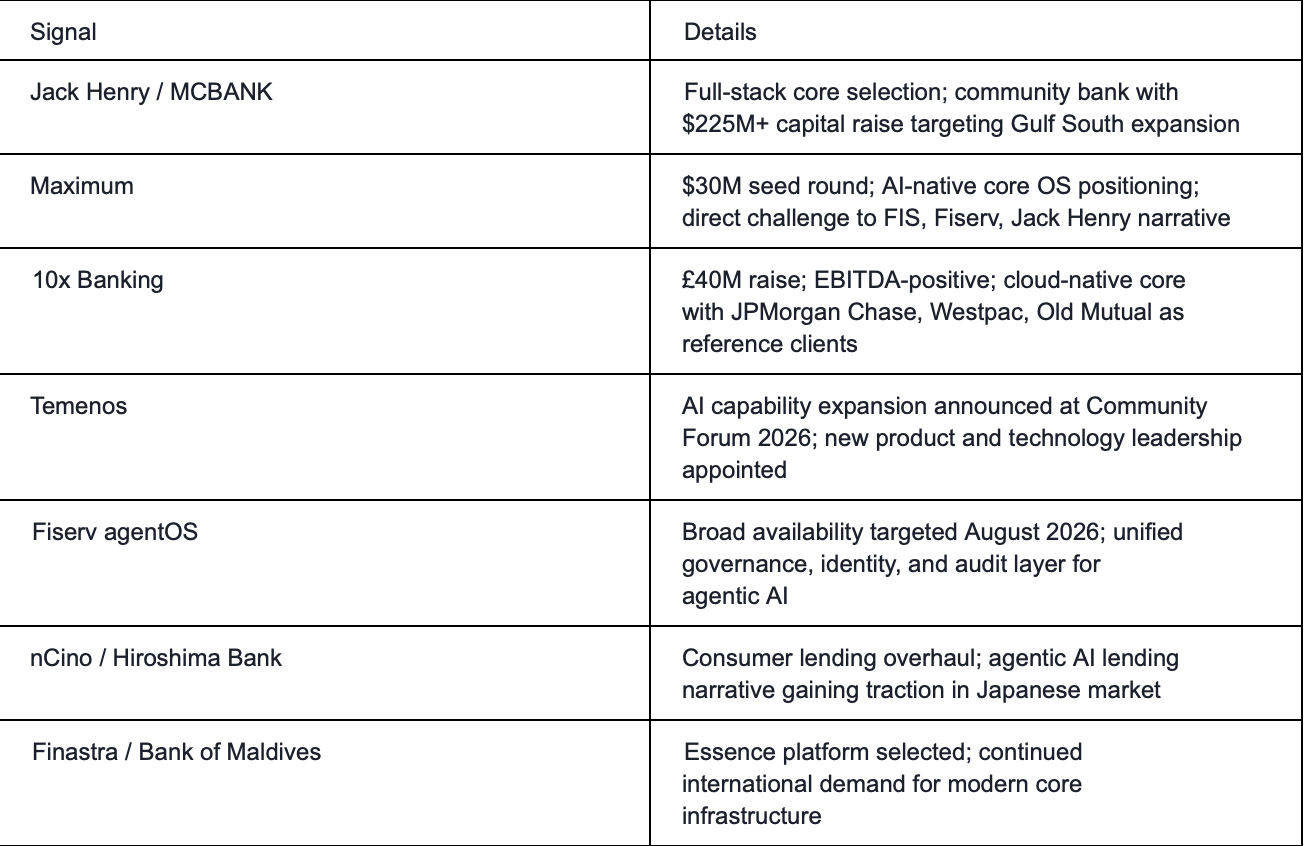
The CB Radar entries this week cluster around a single theme: the market is actively sorting between vendors that can credibly support agentic AI workflows and those that cannot. Maximum’s launch, Fiserv’s agentOS availability, 10x’s commercial proof point, and Temenos’s AI capability push are all responses to the same buyer question. Bank procurement teams should be asking every core and platform vendor on their shortlist to demonstrate, specifically, how their architecture supports real-time agentic execution and audit continuity. Vendor positioning claims are not sufficient. Architecture documentation and reference client conversations are the standard.
RICK’S STRATEGIC TAKE
➜ The agentic AI conversation has arrived at the same place every major technology wave in banking eventually arrives: the core. You can build agents on top of legacy infrastructure. You can add governance layers, middleware, and abstraction. But at some point, the architecture underneath either supports what you are trying to do or it does not. We are at that point. The institutions that treated core modernization as a long-term project may find it has become a near-term constraint. • Regulators on both sides of the Atlantic are no longer asking whether banks have AI. They are asking whether banks can govern it. The EU AI Act enforcement date this week and the OCC and Fed scrutiny in the U.S. are not isolated signals. They are the beginning of a sustained supervisory focus on AI governance. The banks that built governance alongside deployment are in a different conversation with their examiners than the banks that built deployment first. That gap will widen.
➜ The fintech out-acquiring banks story deserves more attention than it is getting. When fintechs systematically acquire capabilities faster than banks can, the competitive gap does not stay constant. It compounds. Banks that are not actively managing their capability acquisition strategy, whether through build, buy, or partnership, are falling behind in ways that will be difficult to recover from in a three-to-five year window.
For a deeper framework on what AI-ready core architecture actually requires, see CSP’s CB Architecture Series at coresystempartners.com.
Want the Full Picture?
Subscribe to BIS, the Banking Intelligence Service from Core System Partners, for the full breakdown including Rick’s Strategic Take on the governance gap, the CB Radar vendor tracking signals, and the regulatory pulse analysis covering what SR 11-7 does and does not cover for agentic deployments, delivered weekly. Banking Intelligence Service
For CSP’s full analysis of what the Fed and Treasury are actually concerned about—and a framework for what AI-ready architecture requires—visit Core System Partners.
Continue With Core System Partners
- Contact Us: https://coresystempartners.com/#contact
- The Strategic Flywheel (book): https://coresystempartners.com/resources/strategicflywheel/
- Core Insider (weekly newsletter): https://coresystempartners.com/resources/newsletter/