Issue #28
Weekly Banking Intelligence: August 07 to August 13, 2026
THIS WEEK’S SIGNAL
Banks are moving beyond AI pilot projects and into large-scale production, but the gap between those who can execute and those who cannot is getting wider. The pressure to modernize core banking infrastructure is now compounded by the need for robust AI governance and dependency management, as highlighted by this week’s regulatory and vendor actions. The accelerating convergence between fintechs and banks, both in M&A and platform partnerships, is breaking down old boundaries. Why it matters: Executives cannot afford to treat AI, core modernization, and governance as separate initiatives; they are now inseparable, and the winners will be those who align technology, operating model, and risk management in a coordinated push.
DEEP DIVE
The most significant pattern this week is the shift from experimental AI pilots to production deployments, with a special focus on agentic AI – systems capable of managing multi-step workflows, making decisions, and interacting with both people and other systems. The Monetary Authority of Singapore (MAS) made waves by confirming that agentic AI is now explicitly covered inside binding bank rules. For years, banks have treated AI as an add-on to existing processes. Now, the regulatory bar is rising: the MAS expects banks to demonstrate not just technical controls, but mature governance and operational safeguards for AI agents that can initiate and escalate financial actions.
Why it matters: This is not just a Singapore story. The MAS is often a bellwether for global regulatory direction, especially in technology risk management. The U.S. and E.U. are lagging, but their supervisors are watching this closely. Executives in any jurisdiction need to assume that agentic AI will attract heightened scrutiny and will require more robust controls than simple automation.
The industry is also seeing clear signs that architecture and operating model readiness are becoming existential. Lloyds Banking Group announced plans to cut £2 billion in costs as part of an AI-powered strategy. The savings are not coming from incremental tweaks, but from re-engineered processes and
significant reductions in manual and middle-office work. At the same time, Moody’s is warning that banks’ dependence on a concentrated pool of AI vendors – primarily the big U.S. cloud and AI firms – creates new systemic risks: outages, pricing power, and even strategic lock-in.
Why it matters: Most banks are not prepared for the operating model and governance challenges of scaled AI. If you cannot explain how your architecture supports agentic AI with auditability and resilience, you are not ready. If you cannot show how your vendor dependencies are managed, you are exposed.
CB RADAR implication: The institutions already on flexible, API-driven cores are moving faster. Those still on monolithic legacy platforms are hitting walls – not just on technology, but on talent, vendor leverage, and regulatory comfort.
MARKET MOVES
Fintech M&A has reached a new milestone.
For the first time on record, fintech companies have out-acquired banks in the global M&A cycle, according to N5Deal’s 2026 report. This is not just a volume story. Fintechs are targeting regulated financial companies to secure banking licenses, customer bases, and infrastructure, especially in payments and core banking.
Fold, a bitcoin-focused financial services company, announced it has selected Lead Bank as its new core banking partner. Fold will begin transitioning customer accounts to Lead Bank later this year, signaling a more integrated approach to digital asset banking and traditional financial services.
Why it matters: The market for core banking partnerships is shifting as fintechs seek deeper infrastructure integration, and as banks look to tap into new client segments and fee streams. For incumbents, the question is whether to compete, partner, or become acquisition targets themselves.
VENDOR SIGNALS
Temenos, a global core banking solutions provider, continued to showcase its focus on scalability and agility at this year’s Banking Transformation Summit. The message is clear: banks need platforms that can support AI-driven change at enterprise scale, not just incremental improvements. Temenos is positioning its platform as the backbone for banks seeking to move faster in AI adoption.
Nucleus Software used the latest edition of its Banking Transformation Summit to reinforce the need for “responsible AI” – a theme echoed across multiple vendors this week. The consensus is forming: AI is only as useful as the controls, transparency, and governance built around it.
Sopra Steria, Infosys Finacle, and Backbase are all referenced in new market sizing reports as key players in the digital banking platform market, which is projected to reach over $31 billion globally by 2031. These vendors are investing heavily in cloud-native, API-first platforms designed to future-proof banks against both technology and regulatory shocks.
The interesting thing this week is how quickly the vendor ecosystem is coalescing around the need for end-to-end AI support – workflow orchestration, explainability, resilience, and integration with both legacy and modern cores. The banks that have already invested in modular, composable architecture are the ones able to actually absorb these new capabilities.
REGULATORY PULSE
The MAS’s confirmation that agentic AI is covered under binding rules is the clearest signal yet that regulators are moving from principles to enforceable requirements. In the U.S., the situation remains fragmented: banks are left to navigate a complex patchwork of state-level rules, sectoral regulations, and evolving guidance on AI, privacy, and cybersecurity. Multiple sources noted that banks are now expected to develop and document their own AI governance frameworks, even as federal rules lag.
Why it matters: The regulatory perimeter is expanding. “We’ll figure it out later” is no longer a defensible position. Boards and executives should expect to be questioned not just on AI strategy, but on governance, escalation paths, and resilience in the face of vendor outages or rogue agentic behavior.
TALENT SIGNALS
Lloyds Banking Group’s cost-cutting announcement is a direct reflection of AI-driven automation: headcount reductions are expected in both middle and back office roles, especially in routine processing and administration. At the same time, banks like BMO Harris Bank are hiring for AI engineers, machine learning engineers, and AI governance leads. The talent market is bifurcating: AI roles are rising because banks need to build, deploy, and oversee these new systems. Traditional roles are declining as automation takes hold.
Why it matters: The battle for AI talent is not just about technology. It is about credibility with regulators, the ability to control your own destiny, and the speed at which you can adapt. Executives need to ask whether their HR and technology teams are aligned on both upskilling and workforce transition.
CB RADAR UPDATE
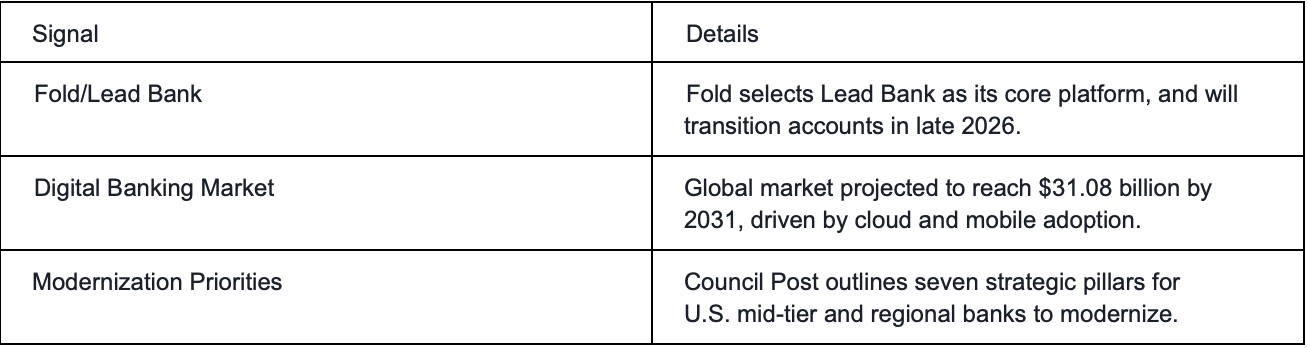
Why it matters: The CB Radar signals all point to a market where speed and flexibility in core platforms are becoming prerequisites, not differentiators. Partnerships like Fold and Lead Bank are examples of how non-traditional players are leapfrogging legacy institutions. Meanwhile, the sheer scale of the digital banking platform market shows that the vendor landscape is consolidating – and that the next wave of M&A may be driven as much by architecture as by customer acquisition.
RICK’S STRATEGIC TAKE
➜ The shift to agentic AI is not theoretical anymore. Regulators are moving, and the vendors are racing to keep up. If you have not already mapped how agentic systems are governed in your bank, you are behind.
➜ The real gap is less about technology and more about operating model readiness. Savings from AI are showing up where processes and governance have already been rethought – not just where new tools were dropped into old workflows.
➜ Fintechs are now out-acquiring banks in M&A. That is a wake-up call. If your core modernization program is still stuck in the planning phase, you may find yourself negotiating from a position of weakness, not strength.
For a deeper framework on what AI-ready core architecture actually requires, see CSP’s CB Architecture Series at coresystempartners.com.
Want the Full Picture?
Subscribe to BIS, the Banking Intelligence Service from Core System Partners, for the full breakdown including Rick’s Strategic Take on the governance gap, the CB Radar vendor tracking signals, and the regulatory pulse analysis covering what SR 11-7 does and does not cover for agentic deployments, delivered weekly. Banking Intelligence Service
For CSP’s full analysis of what the Fed and Treasury are actually concerned about—and a framework for what AI-ready architecture requires—visit Core System Partners.
Continue With Core System Partners
- Contact Us: https://coresystempartners.com/#contact
- The Strategic Flywheel (book): https://coresystempartners.com/resources/strategicflywheel/
- Core Insider (weekly newsletter): https://coresystempartners.com/resources/newsletter/