Issue #29
Weekly Banking Intelligence: August 14 to August 20, 2026
THIS WEEK’S SIGNAL
A parallel financial system is forming, and it is not waiting for permission. The signals this week converged around a single pattern: AI agents are beginning to move money, negotiate terms, and settle transactions through infrastructure that routes around traditional banking rails entirely. Stablecoin networks are signing mandates, Stripe is acquiring AI model routing capability, and the argument that banks control the interface to money is getting harder to defend. The question is not whether this is real. The question is how fast it moves and whether your institution is positioned to participate or just to watch.
DEEP DIVE
The Parallel Economy Is Not a Forecast Anymore
The Moonshots podcast framing got attention this week: a parallel AI economy forming around agent-to-agent transactions, post-IPO capital flows from companies like SpaceX and Anthropic, and a payment and settlement layer that does not run through a traditional bank. The hosts put a number on it, suggesting this parallel system could become ten times larger than incumbent New York finance within ten to twenty years. That is a provocative claim, and the timeline is speculative. But the underlying mechanics are not.
Here is what is concrete. The x402 payment protocol, which enables AI agents to pay each other directly over HTTP without human intervention, has processed roughly 169 million payments. That is not a pilot. Visa is reporting a stablecoin transaction run rate of approximately $7 billion. The Trusted Agent Protocol and Agent Pay frameworks are being designed specifically so AI systems can initiate and settle financial transactions autonomously. And the AP2 standard is attracting signed mandates from institutions that want to participate in agent-to-agent commerce before the rails are locked in by someone else.
Why it matters: The interface to money is shifting. Banks have historically owned that interface because they owned the account, the card, the wire, and the relationship. AI agents do not need a card. They need a credential, a payment protocol, and a counterparty that accepts settlement in the form the agent is using. If stablecoin networks and protocol-layer infrastructure establish those rails first, banks do not automatically get included. They get integrated on someone else’s terms, or they get bypassed.
The deposit tokenization race is the banking industry’s response to this, and it is accelerating. JPMorgan, Citi, HSBC, and Wells Fargo (with a Fall 2026 launch planned for select clients) are all building tokenized deposit platforms. The theory is sound: if agents need to move value, give them a bank-issued digital deposit they can use programmatically. But the execution window is narrowing. Stablecoin networks already have live volume. Tokenized deposit platforms are still in controlled rollouts.
Why it matters: The banks that get the operating model right on tokenized deposits will not just be protecting existing relationships. They will be building the credential infrastructure that AI agents use to transact. That is a very different business than issuing a debit card. It requires real-time settlement capability, API-first architecture, programmable compliance controls, and governance frameworks that do
not exist in most institutions today. The technology is actually the easier part of this. The harder part is deciding who owns the product, who owns the risk, and what happens when an agent makes a decision the bank did not anticipate.
The PYMNTS piece this week framed it clearly: most current AI-powered banking capabilities are orchestration layers sitting on top of legacy systems, not genuine transformation of execution. That distinction matters enormously here. An agent-ready payment infrastructure requires connected, API-driven operations with real-time visibility across data and transactions. Banks carrying significant legacy architecture are likely to have a harder time getting there, not because the technology is unavailable, but because the underlying plumbing was not built for this.
MARKET MOVES
Stripe Acquires OpenRouter
Stripe announced Wednesday it is acquiring OpenRouter, a startup that operates as a marketplace for AI model routing, allowing developers to access and switch between large language models through a single API. The deal price was not disclosed. Stripe is already embedded in more payment flows than most banks touch directly, and this acquisition extends that position into the AI infrastructure layer.
Why it matters: Stripe is not buying a product. It is buying the ability to sit between AI applications and the models those applications run on, while also processing the payments those applications generate. That is a vertically integrated position in the agent economy that no traditional bank currently holds. If AI agents increasingly use Stripe for both model access and payment settlement, the bank becomes a funding source and a compliance backstop, not the primary relationship. That is a narrower role than most banks would choose.
Fintech Charter Applications Continue to Accelerate
Per American Banker, fintech charter applications and approvals are running at elevated pace in 2026, a continuation of the momentum that began under Comptroller Gould’s tenure. The regulatory posture from the Office of the Comptroller of the Currency (OCC) has shifted toward engagement rather than skepticism, and fintechs are responding.
Why it matters: Every fintech that receives a bank charter is a competitor that now has direct access to the Federal Reserve payment system, deposit insurance, and the regulatory legitimacy that comes with a charter. The competitive dynamics change when a fintech stops being a partner candidate and becomes a licensed bank. The institutions that should be paying closest attention are regional and midsize banks, because that is where the overlap in customer segments is highest.
VENDOR SIGNALS
FIS Launches Project Keystone
FIS launched Project Keystone this week, a digital money network for regulated financial institutions built on Lyriq, a proprietary platform designed to let banks issue, transfer, and settle real bank deposits in digital form. The platform includes compliance controls, access management, and auditability built into the architecture rather than added on top.
This is a direct play for the tokenized deposit market, and the timing is deliberate. FIS is giving its bank clients a path to participate in programmable money without requiring them to build their own infrastructure
or navigate the stablecoin landscape independently. Whether Keystone gains traction will depend heavily on interoperability: a tokenized deposit network that only works within the FIS ecosystem is useful but limited. The banks that need this capability most are the ones trying to serve commercial clients who are already experimenting with on-chain settlement.
Fiserv and Flagstar: A Core Modernization Signal Worth Watching
Flagstar Bank (approximately $87.7 billion in assets as of June 30, 2026) selected Finxact, Fiserv’s cloud-native core banking platform, as the foundation for its modernization strategy. Fiserv acquired Finxact in 2022 specifically to compete in the modern core segment, and this is a meaningful validation of that investment. Flagstar is not a community bank. It is one of the larger regional institutions in the country, and a deal at this scale signals that modern core adoption is moving up-market.
What I’d watch here is the operating model transition, not just the technology selection. Moving a bank of Flagstar’s size and complexity to a new core involves loan accounting, deposit processing, regulatory reporting, and integration with dozens of downstream systems. The platform decision is the beginning of a multi-year program. The institutions that have done this well planned the operating model redesign before they signed the contract.
Delfi Names Glen Fossella as Chief Revenue Officer
Delfi, an agentic AI banking tools company, appointed Glen Fossella as Chief Revenue Officer to scale its commercial push into financial institutions. The hire signals that Delfi is moving from product development into active market pursuit.
The agentic AI vendor space is crowding quickly, and the institutions evaluating these tools are still early in understanding what governance and oversight frameworks they need before deployment. Vendors that get to the right conversations early, while banks are still forming their views, tend to have structural advantages in later procurement decisions.
REGULATORY PULSE
EU AI Act: General Applicability Now in Force
The European Union (EU) AI Act became generally applicable on August 2, 2026. Transparency requirements are now enforceable, and the AI Office along with national authorities has begun implementation. High-risk provisions for certain sensitive use cases have been extended, but the baseline obligations are live.
For banks operating in European markets, this is no longer a planning exercise. The compliance posture has to be operational. What I keep hearing from institutions is that the harder problem is not understanding the rules; it is knowing which AI systems inside the organization actually qualify as high-risk under the Act’s definitions, and who owns the documentation and audit trail for each. Most banks have deployed AI in more places than their governance teams have catalogued.
AI Governance: The Autonomy Control Question
Multiple sources this week, including reporting from ETBFSI and Global Banking and Finance, captured a consistent theme from bank CEOs: the challenge with AI agents is not building them, it is deciding how much autonomy to grant and how to retain meaningful human control. The UK’s Financial Conduct Authority (FCA) noted in July 2026 that one in five consumers in its research would consider AI acting autonomously within pre-set parameters, a signal that consumer appetite for agentic banking exists even as regulatory frameworks are still forming.
The governance gap here is real. Banks are deploying AI agents into transaction monitoring, fraud detection, credit assessment, and customer interaction faster than they are building the oversight structures to match. That asymmetry is where regulatory exposure accumulates. The institutions that will be in the strongest position are the ones that treat AI governance as an operating model problem, not a compliance checkbox.
TALENT SIGNALS
AI Governance and Oversight Roles Are Filling Quickly
The pattern this week reflects a market catching up to its own deployment pace. BMO Harris Bank is hiring AI governance leads and model risk officers specifically scoped to agentic systems, a role that did not meaningfully exist in most job architectures eighteen months ago. The demand is driven directly by AI adoption: as banks deploy more autonomous systems, the oversight function has to scale alongside it.
This is not a compliance-for-compliance’s-sake hiring cycle. Banks that are serious about deploying AI agents into consequential decisions (credit, fraud, customer resolution) need people who understand both the technical behavior of the systems and the regulatory expectations around model risk management. That combination is scarce, and the institutions that find it early are building a capability that will matter.
Traditional Processing and Middle-Office Roles Continuing to Compress
Across the Tier 1 and large regional segment, the pattern of reduced hiring in routine middle-office processing, document review, and non-AI compliance roles continues. This is a direct consequence of automation absorbing work that previously required headcount. The banks that are managing this transition well are redeploying affected staff into oversight, exception handling, and relationship functions rather than simply reducing headcount. The ones that are not will face a different kind of problem when the AI systems need human judgment and there is no one positioned to provide it.
CB RADAR UPDATE
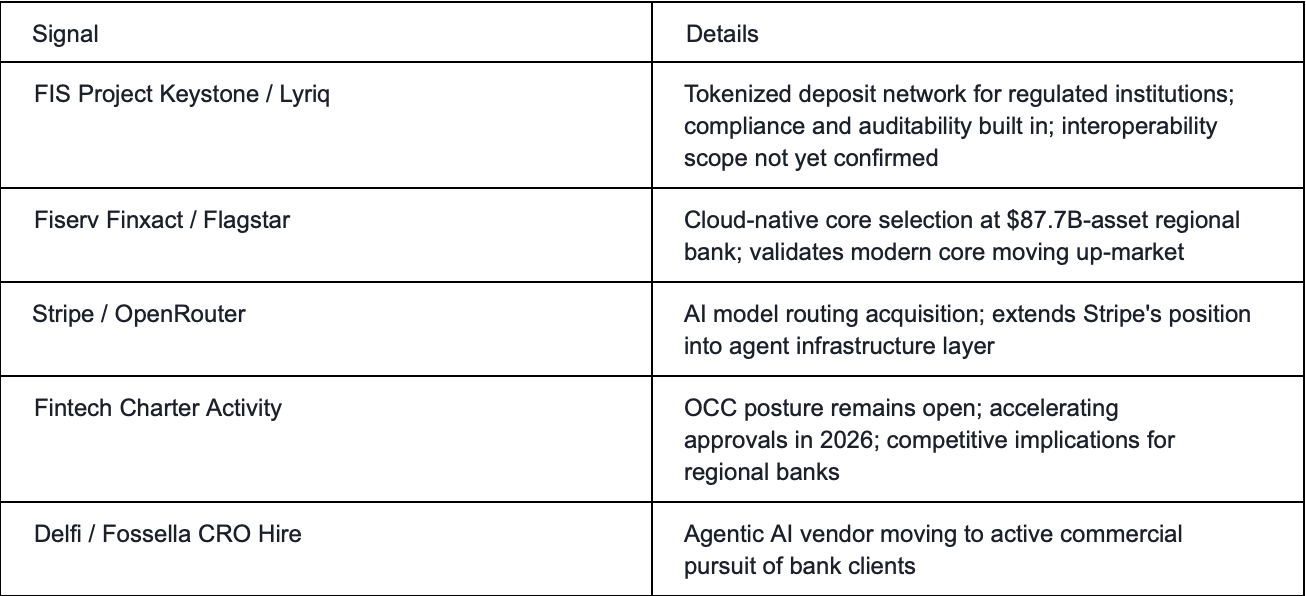
The pattern in our proprietary CB Radar database this week is convergence around the programmable money layer. FIS and Fiserv are both making moves designed to keep banks inside the value chain as money becomes more programmable, one through a tokenized deposit network, the other through a modern core that can support API-driven product design. The Stripe acquisition sits outside the traditional banking vendor landscape entirely, which is exactly why it belongs on the radar. The institutions that are only watching their existing vendor relationships for signals about where this market is going are watching the wrong set of actors.
RICK’S STRATEGIC TAKE
➜ The parallel economy argument is easy to dismiss as podcast hyperbole, and the ten-times-larger-than-New-York-finance number probably deserves skepticism. But 169 million x402 payments and a $7 billion Visa stablecoin run rate are not projections. Those are current numbers. I have seen banks make the mistake of waiting for a trend to be undeniable before they start preparing for it. By the time it is undeniable, the operating model decisions have already been made by someone else.
➜ The Flagstar and FIS announcements in the same week are worth reading together. One bank is rebuilding its core foundation. One major vendor is building the digital money network it expects those cores to connect to. That sequence is not coincidental. The institutions that modernized their cores are in a position to participate in what comes next. The ones that did not are adding complexity to an already complicated situation.
➜ The governance and autonomy question that bank CEOs raised this week is the right question, and I do not think the industry has a good answer yet. Deciding how much autonomy an AI agent gets is not a technology decision. It is a risk appetite decision, an operating model decision, and a board-level accountability question. The banks that frame it only as a technology problem will build the wrong controls.
For a deeper framework on what AI-ready core architecture actually requires, see CSP’s CB Architecture Series at coresystempartners.com.
Want the Full Picture?
Subscribe to BIS, the Banking Intelligence Service from Core System Partners, for the full breakdown including Rick’s Strategic Take on the governance gap, the CB Radar vendor tracking signals, and the regulatory pulse analysis covering what SR 11-7 does and does not cover for agentic deployments, delivered weekly. Banking Intelligence Service
For CSP’s full analysis of what the Fed and Treasury are actually concerned about—and a framework for what AI-ready architecture requires—visit Core System Partners.
Continue With Core System Partners
- Contact Us: https://coresystempartners.com/#contact
- The Strategic Flywheel (book): https://coresystempartners.com/resources/strategicflywheel/
- Core Insider (weekly newsletter): https://coresystempartners.com/resources/newsletter/