Issue #31
Weekly Banking Intelligence: August 28 to September 03, 2026
THIS WEEK’S SIGNAL
Bank of America, U.S. Bank, Lloyds, and Deutsche Bank all surfaced this week with concrete AI deployment details, and the pattern across all four is the same: the institutions moving fastest are the ones that did their architectural and governance homework first. What caught my attention is that the conversation has quietly shifted from “are we doing AI” to “how do we govern what the AI is already doing.” That is a meaningful change. The executives asking the right questions right now are not asking whether to deploy AI. They are asking who owns the decision when the AI is wrong, how you audit what the model did, and whether your operating model can absorb the change at scale.
DEEP DIVE
AI Deployment at Scale: The Governance Gap Is Now the Execution Gap
Bank of America is accelerating AI across advisory, payments, and internal engineering workflows, and as reported this week by QA Financial, it is one of the clearest case studies in the industry of what happens when testing and governance collide with real production velocity. The bank is not experimenting. It is running AI in live workflows, and the governance infrastructure required to do that responsibly is proving to be as demanding as the technology itself.
The same week, U.S. Bank’s playbook was examined at the 2026 Digital Banking Conference, as reported by American Banker. Their framework is straightforward and worth paying attention to: pick the right work, define outcomes, productize and reuse, invest in skill development, scale responsibly, and prepare for agents. Six steps. What is notable is that “prepare for agents” is the last step, not the first. That sequencing reflects hard-won experience. You cannot govern agentic workflows until you have disciplined the simpler ones.
Lloyds Banking Group has committed to enterprise-wide agentic AI deployment in 2026, expecting the systems to add £100 million in value by automating fraud investigations and complex complaints. That is not a pilot number. That is a board-level commitment with a financial target attached to it. The operating model implication is significant: Lloyds is explicitly routing routine cases to AI and reserving human judgment for complex ones. That is a workflow redesign, not a technology deployment.
Why it matters: The gap between banks that can execute AI at scale and those that cannot is no longer primarily a technology gap. It is a governance and operating model gap. QA Financial’s reporting on AI core banking this week made the point directly: for quality assurance teams, the shift brings decision quality, data traceability, and recovery performance into focus alongside transaction processing accuracy. Banks that have not yet built the governance infrastructure to answer those questions are going to find that deploying the technology is the easy part.
Why it matters for architecture and operating model: The PYMNTS report on AI payback timelines this week noted that most banks wait six years for meaningful AI return. The institutions beating that curve, including Deutsche Bank, which reportedly cut certain task completion times from two years to three months, share a common characteristic. They had already done significant work on their underlying data and systems infrastructure before they tried to deploy AI on top of it. The operating model lesson is equally important: you need someone who owns AI outcomes, not just AI tools. That accountability question is where most institutions are still working things out.
MARKET MOVES
Deutsche Bank Private Bank: From 15 Core Systems to Two
Deutsche Bank’s private bank signed a decade-long agreement with Thought Machine, the London-based cloud-native core banking platform provider, to replace a fragmented estate of 15 core banking systems with two modern, cloud-based platforms. Vault Core will serve as the primary platform for banking and lending across personal banking and wealth management. GFT Technologies, the Stuttgart-based banking technology transformation specialist, was simultaneously named as Deutsche Bank’s transformation partner for the program. The scope covers Germany’s retail division, with Deutsche Bank publicly citing progress in simplifying legacy technology as the rationale.
Why it matters: A 15-to-2 consolidation at a systemically important institution is not a technology upgrade. It is a fundamental restructuring of how the bank operates. The ten-year contract length signals that Deutsche Bank is treating this as a generational commitment, not a platform refresh. For other large European banks still running similarly fragmented core estates, this deal sets a visible benchmark. The more immediate question for any institution watching this: GFT’s role as transformation partner is as significant as the Thought Machine selection itself. Platform selection is the starting line. The transformation capability sitting alongside it determines whether the institution actually crosses the finish line.
SACOMBANK: Vietnam’s Hybrid Cloud Core Move
Saigon Thuong Tin Commercial Bank (SACOMBANK), one of Vietnam’s largest commercial banks by assets, completed an upgrade of its Temenos core banking platform this week, migrating from an on-premises deployment to a hybrid cloud environment. IBM is supporting the infrastructure layer. The move is positioned around scalability, performance, and faster product innovation.
Why it matters: This deal is notable less for its geography and more for the hybrid cloud path it represents. Full cloud migration remains politically and operationally complex for many banks. Hybrid cloud is becoming the practical middle step for institutions that need modern scalability without a complete infrastructure overhaul. Temenos and IBM together on a deal of this type is a configuration worth watching as a replicable model.
VENDOR SIGNALS
Mambu Launches Intelligent Core
Mambu, the Amsterdam-based composable banking platform, announced Intelligent Core this week, combining Mambu Core, Mambu Payments, and a new module called Mambu Agentic into a unified stack. The stated intent is to connect intelligence across the banking stack to enable faster decisioning and more personalized services. The launch positions Mambu directly in the emerging conversation about what an AI-native core banking platform actually looks like in practice.
The timing is deliberate. As banks push AI into production, the question of where the intelligence layer sits relative to the core is becoming a real architectural and operating model decision. Mambu is making the case that the answer is inside the core, not bolted on top of it. Whether that argument holds up at the scale and complexity of a Tier 1 or large regional institution is a different question, but for community banks and digital challengers evaluating composable architecture, Intelligent Core changes the conversation.
Temenos and Celent: The Switchable Middle
Temenos partnered with Celent, the financial services research and advisory firm, to publish research this week on what they are calling the “switchable middle,” the segment of U.S. banks actively reconsidering their core banking platform. The headline number: over 60% of U.S. banks are considering a core banking transformation, with 22% placing it in their top three investment priorities for 2026 and 2027.
That 22% figure is the one worth watching. Top-three priority status means budget conversations are happening now, vendor evaluations are either underway or imminent, and the decision timeline is likely 12 to 24 months, not five years. For vendors in this space, the competitive window is open. For banks in that cohort, the pressure to move from evaluation to decision is real, and the risk of prolonged indecision is that the gap to early movers continues to widen while the evaluation drags on.
Jack Henry, FIS, and nCino: Earnings Confirm the Demand Pattern
Earnings commentary from Jack Henry, FIS, and nCino this week reinforced a consistent theme: modernization demand is concentrating in faster payments, cloud migration, digital banking, and AI tools aimed at credit and fraud workflows. Jack Henry specifically reported bundled core, digital, and card wins alongside higher faster payments adoption. nCino, the cloud-based banking operating system provider, continued to show demand for AI-assisted credit decisioning among community and regional bank clients.
The earnings signal matters because it is not marketing language. It is what banks are actually buying. The concentration of spend in credit, fraud, and payments AI, rather than general-purpose AI tooling, tells you something important about where banks are finding early, defensible ROI. Defined workflows with clear inputs, clear outputs, and measurable outcomes are where AI is earning its keep right now. The broader, harder-to-measure AI deployments are still in progress.
REGULATORY PULSE
Governance and Testing Are Becoming the AI Deployment Bottleneck
Two pieces of reporting this week, from QA Financial covering Bank of America’s AI acceleration and a separate piece on AI governance in core banking, pointed at the same constraint from different angles. As AI moves from pilot into production and begins touching core banking workflows, quality assurance teams are being asked to evaluate decision quality, data traceability, and recovery performance alongside traditional transaction processing accuracy. These are not the same skill sets, and most QA functions were not built for them.
The regulatory implication is straightforward. Examiners are going to ask about model governance, audit trails, and explainability for AI-assisted decisions that affect credit, fraud, and customer outcomes. Banks that are building governance infrastructure in parallel with deployment are positioning themselves well.
Banks that are deploying first and planning to add governance later are creating a problem they will have to solve under pressure, likely at the worst possible time. The operating model question here is just as important as the technology question: who owns AI governance, where does it sit in the organization, and how does it connect to the lines of business actually deploying these tools?
TALENT SIGNALS
The Workforce Redesign Problem Is Not Being Solved by Training
The Fintech Times published a pointed piece this week on the gap between AI investment and AI capability in banking workforces. The core argument: banks are buying tools and running introductory training programs, but training does not automatically produce capability. What is missing is job redesign. HR organizations need to translate AI strategy into workforce planning, role restructuring, and development pathways that are specific enough to actually change how work gets done. Managers need to help employees apply the technology responsibly in daily workflows, not just attend a workshop.
Lloyds Banking Group’s commitment to enterprise-wide agentic AI deployment in 2026, with an expected £100 million in value from automating fraud investigations and complex complaints, makes this concrete. Automating fraud investigations does not just remove steps from a process. It changes what the fraud analyst’s job is. If the institution has not redesigned that role before the automation goes live, it creates confusion, resistance, and underutilization of the tool. The banks getting real returns from AI are the ones treating workforce redesign as a prerequisite, not an afterthought.
Roles in AI engineering, machine learning operations, and AI governance continue to grow in banking because the demand for people who can build, deploy, and oversee these systems is growing with adoption. Meanwhile, roles in routine processing, middle-office transaction handling, and manual review functions are contracting as automation takes over those workflows. That is not a contradiction. It is exactly what a well-managed AI deployment is supposed to produce.
CB RADAR UPDATE
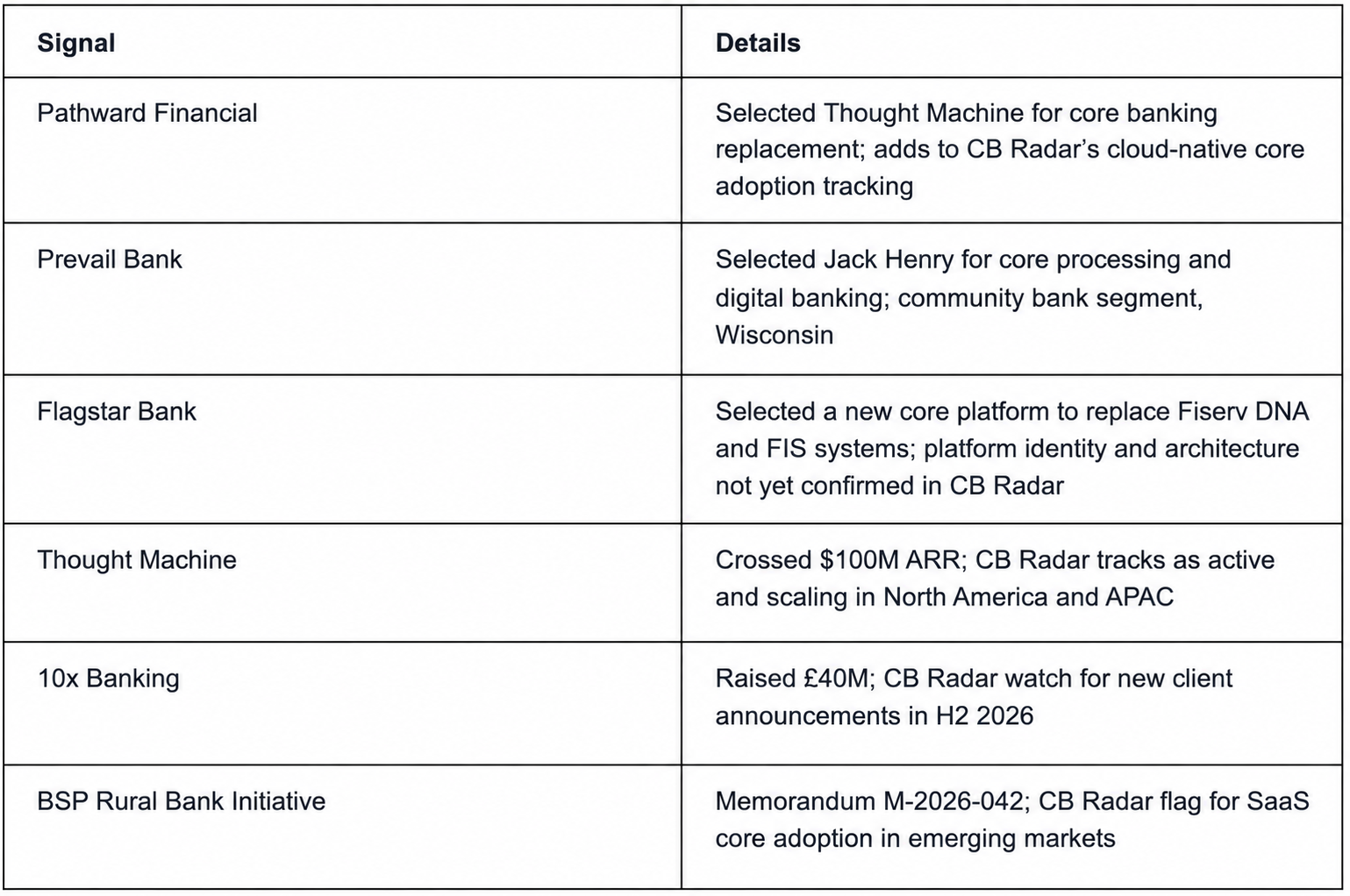
The pattern in our proprietary CB Radar database this week is worth noting directly. Three separate core selections were announced in a single week, spanning a federally chartered payments bank, a regional bank replacing a dual-core legacy environment, and a community bank in the Midwest. That breadth, across institution type, size, and geography, suggests the core modernization cycle is not concentrated in a single segment. It is moving across the market simultaneously. For vendors, that means demand is broad but so is competition. For bank buyers, it means the reference pool for evaluating new platforms is growing quickly, and peer benchmarking is more accessible than it was two years ago.
RICK’S STRATEGIC TAKE
➜ The tokenization conversation needs an honest internal assessment before it needs a product announcement. Wells Fargo joining JPMorgan and Citi in tokenized deposits is a legitimate competitive signal, and I understand why boards are asking about it. But the question I would want answered first is whether the back-office infrastructure, the compliance framework, and the treasury operations team are actually ready to support it. Announcing a tokenized deposit product and operating one reliably at scale for corporate clients are two very different things. If your institution is considering this, start with the operational readiness question, not the press release.
➜ BNY Mellon’s workforce numbers deserve a serious internal conversation, not a benchmarking exercise. The temptation is to compare headcount ratios and task-automation percentages and ask whether your institution is keeping pace. That misses the point. What BNY Mellon built is an enterprise-wide operating model redesign with AI as the organizing principle. The technology was probably not the hardest part. The governance, the role redesign, the change management, and the leadership decisions about what humans do and what machines do: that is where the real work happened. If your AI strategy does not include a serious operating model workstream, you are likely underestimating what this actually requires.
➜ On the regulatory front, I will say this plainly: we have been flagging the EU AI Act deadline and the revised U.S. model-risk guidance in this brief for months. The institutions that acted on those signals early are in a fundamentally different position today than the ones that treated them as future concerns. The gap between those two groups is now visible and measurable. If your AI governance infrastructure is not built to the standard these frameworks require, the cost of retrofitting it is going up, not down, with every passing quarter. The window to get ahead of this is not closed, but it is narrowing.
For a deeper framework on what AI-ready core architecture actually requires, see CSP’s CB Architecture Series at coresystempartners.com.
Want the Full Picture?
Subscribe to BIS, the Banking Intelligence Service from Core System Partners, for the full breakdown including Rick’s Strategic Take on the governance gap, the CB Radar vendor tracking signals, and the regulatory pulse analysis covering what SR 11-7 does and does not cover for agentic deployments, delivered weekly. Banking Intelligence Service
For CSP’s full analysis of what the Fed and Treasury are actually concerned about—and a framework for what AI-ready architecture requires—visit Core System Partners.
Continue With Core System Partners
- Contact Us: https://coresystempartners.com/#contact
- The Strategic Flywheel (book): https://coresystempartners.com/resources/strategicflywheel/
- Core Insider (weekly newsletter): https://coresystempartners.com/resources/newsletter/