Issue #39
Weekly Banking Intelligence: October 23 to October 29, 2026
THIS WEEK’S SIGNAL
AI is moving into core operations at regional banks, and the institutions doing it are not necessarily the ones with the biggest technology budgets. Customers Bank is closing commercial loans in seven days using AI. First Internet Bank cut SBA compliance review time by 87%. JPMorgan’s Private Bank is using AI to make advisers more efficient. The pattern this week is not experimentation; it is deployment, and it is showing up in the income statement. The question worth asking in your next leadership meeting is not whether your institution is exploring AI, but whether it is producing results you can actually measure.
DEEP DIVE
AI in commercial lending: when the proof of concept becomes the competitive gap
Customers Bank, a Pennsylvania-based commercial lender, is now closing commercial loans in seven days using AI agents embedded in its underwriting and documentation workflow. As reported this week by PYMNTS, the bank’s leadership acknowledged that larger builds still take quarters, not weeks, and that the underlying technology is roughly six months old. That context matters. This is not a mature, battle-tested system. It is an early deployment that is already producing a measurable outcome in a product line where speed is a genuine competitive differentiator.
First Internet Bank, an Indiana-based digital bank, offers a sharper data point. The bank cut SBA loan compliance review times by 87%, reducing eight to ten hours of manual work to under one hour. Their stated position is that AI means more loans, not fewer people. That framing is deliberate and worth noting. They are positioning AI as a growth enabler rather than a cost-cutting tool, which changes how you design the workflow, how you staff around it, and how you communicate the change internally.

Why it matters: Regional and mid-size banks have historically competed with larger institutions by being faster and more relationship-driven on commercial credit. AI is now compressing that timeline further, and the banks that have already deployed are pulling ahead. The gap between institutions that have working AI in their lending operations and those still in pilot is beginning to show up in commercial loan volume. As reported this week by PYMNTS, commercial lending increased at PNC, U.S. Bancorp, Regions, and
KeyCorp, while Fifth Third added new commercial relationships. Whether AI is the primary driver or a contributing factor, the correlation is worth watching.
Why it matters for your operating model: Here is what I think people are missing. Deploying AI in a lending workflow is not primarily a technology decision. It requires someone to own the process redesign, someone to own the model governance, and someone to own the change management with the credit team. The banks that are seeing results appear to have figured out the operating model around the technology, not just the technology itself. A seven-day loan close does not happen because you bought a tool. It happens because you rebuilt the workflow around the tool and held the organization accountable to the new timeline.
The Bank of England published its annual AI in financial services report this week, and one finding is worth flagging for any institution operating with a cross-border footprint: UK intellectual property rights and international regulation (specifically the EU AI Act’s indirect effects) were the two areas most frequently cited as sources of unclear compliance best practice. That is not an abstract concern. If your institution has any UK or EU presence, the compliance ambiguity around AI-generated outputs and training data is a real operational risk that your legal and compliance teams need to be actively working through, not waiting on.
MARKET MOVES
Axos Bank’s acquisition-led AI strategy
Axos Bank has been quietly building one of the more deliberate AI strategies among mid-size U.S. banks, and it is worth understanding how they are doing it. The bank has executed a series of targeted acquisitions: Verdant Commercial Capital (closed September 2025), approximately $2.3 billion in Jenius Bank consumer deposits (closed May 2026), a Capital One IRA portfolio that closed at approximately $1.9 billion in September 2026, and Arc Technologies (closed July 2026). Each deal adds either an asset class, a deposit base, or a technology capability. Axos is also building AI into its consumer-bank developer environment using OutSystems Agent Workbench for error-log analysis and document data entry.
Why it matters: Axos is using M&A not just to grow the balance sheet but to acquire the raw material, deposits, assets, and technology, that feeds its AI build-out. That is a different acquisition thesis than most regional banks are running. The question worth asking is whether your institution’s M&A criteria include any assessment of the target’s data architecture and AI readiness, or whether you are still evaluating deals primarily on the traditional metrics. A deposit portfolio or loan book that comes with clean, structured data and modern infrastructure is worth more to an AI-enabled acquirer than one that does not.
Core banking moves: Temenos, Oracle FLEXCUBE, and the week’s go-lives
Three core banking go-lives closed this week. Kingdom Bank, a UK specialist bank serving Christian churches and charities, went live on Temenos SaaS running on Microsoft Azure. NMB Bank, a Tanzania-based institution, went live on Oracle FLEXCUBE, replacing a 15-year-old legacy core, with the implementation carried out by Oracle partner Profinch. ESAF Small Finance Bank in India completed its migration to Oracle FLEXCUBE as well, including a data centre upgrade and implementation of additional business applications. Separately, Vancity, one of Canada’s largest credit unions, selected Temenos SaaS to modernize its core banking platform.
Why it matters: Four core banking decisions in a single week is not noise. Temenos is landing SaaS wins on both ends of the size spectrum, from a specialist UK niche bank to a major Canadian credit union. Oracle FLEXCUBE is executing in emerging markets where legacy replacement cycles are accelerating. What is consistent across all four is the direction: institutions are moving off aging cores, and they are choosing cloud-native or SaaS delivery models when they do. The institutions still deferring that decision are not avoiding the work; they are accumulating it.
VENDOR SIGNALS
Backbase launches agentic AI delivery factory
Backbase, the Amsterdam-based digital banking platform provider, announced this week that it is helping banks deploy agentic AI through what it is calling a Delivery Factory model. As reported by PYMNTS, the announcement included reference to examples of companies merging legacy banking cores with agentic AI, citing Kastle as one such case. The Delivery Factory framing suggests Backbase is positioning itself not just as a platform vendor but as an implementation partner for agentic deployments.
The practical question for any bank evaluating this is what “delivery” actually means in practice. Agentic AI in a banking context requires clean data feeds, defined decision boundaries, audit trails, and governance structures that most legacy environments were not built to support. A vendor that bundles deployment services with the platform can accelerate time-to-production, but it also creates a dependency worth understanding before you sign. Know what you own and what you are renting.
10x Banking crosses 10 million live accounts
10x Banking, the UK-based cloud-native core banking provider, announced this week that it has surpassed 10 million live accounts on its SuperCore platform, with annual recurring revenue (ARR) growth of 30% over the past 12 months. The company’s H2 2026 roadmap includes product launches, migrations, and additional customer go-lives. The milestone, reported in the context of the evolving PSD3 and FiDA regulatory environment, signals that 10x is past the proof-of-concept stage and into genuine scale.
Thirty percent ARR growth on a cloud-native core is a meaningful signal in a market where most established vendors are defending existing install bases rather than growing them. The institutions worth watching are the ones selecting 10x for net-new builds or greenfield digital bank launches, because those decisions tell you something about where the next generation of core architecture is heading.
TEN Credit Union: Coordinating Core and Digital Banking Decisions
TEN Credit Union recently chose Bankjoy as its digital banking provider while transitioning to Corelation KeyStone for its core banking system. Bankjoy specializes in digital banking solutions for credit unions. Earlier this month, Corelation announced that six credit unions, representing more than $5.4 billion in combined assets, had selected KeyStone during the third quarter.
TEN Credit Union’s approach highlights a growing trend among financial institutions: evaluating and selecting core banking systems and digital banking platforms together instead of treating them as separate decisions.
This coordinated approach is important because it allows institutions to consider how their technology platforms will work together from the beginning. By selecting both systems at the same time, credit unions can establish a clearer integration strategy and better align their technology investments with operational needs.
In contrast, institutions that adopted core and digital banking solutions at different times often face integration challenges. These challenges can create additional technical complexity and restrict the capabilities of both platforms.
REGULATORY PULSE
BIS survey: central bank AI is operational, but compliance monitoring is not
A 2026 Bank for International Settlements (BIS) survey published this week found that over two-thirds of central bank AI projects are now operational. The more pointed finding is that only 4% of banks rate their AI compliance monitoring capabilities highly. That gap between operational deployment and compliance confidence is not a central-bank-only problem. It is the same gap showing up in commercial banking, and regulators are paying attention to it.
Following up on the FSB framework covered in Issue #38, and the joint Fed, OCC, and FDIC supervisory questions from Issue #37, the BIS data adds a quantitative dimension to what has been a qualitative concern. Regulators across multiple jurisdictions are asking the same question: banks are deploying AI, but are they monitoring it? A 4% confidence rating on compliance monitoring suggests the honest answer, for most institutions, is no.
AI compliance in AML and SOX: from theory to requirement
Reporting this week from BankingNewsAI covered the growing use of AI in anti-money laundering (AML) compliance, including transaction monitoring, alert triage, and Suspicious Activity Report (SAR) narrative generation, as well as AI-assisted SOX controls and Bank Secrecy Act (BSA) monitoring. The consistent theme is that AI is helping compliance teams process volume that manual processes can no longer handle at the pace regulators expect.
The tension here is real. Regulators want faster, more accurate compliance monitoring. AI can deliver it. But the same regulators are also asking hard questions about model risk, explainability, and what happens when an AI-generated SAR narrative is wrong. As reported by BankingNewsAI, regulators have identified ten specific AI risks in banking: model risk, bias and fair lending, data privacy, third-party and vendor risk, cyber and adversarial attack, hallucination, concentration and systemic risk, operational resilience, explainability, and consumer harm or deception. If your compliance team is deploying AI tools in any of these areas and your model risk management framework has not been updated to cover them, that is a gap worth closing before an examiner finds it.
TALENT SIGNALS
AI roles rising as deployment moves into operations
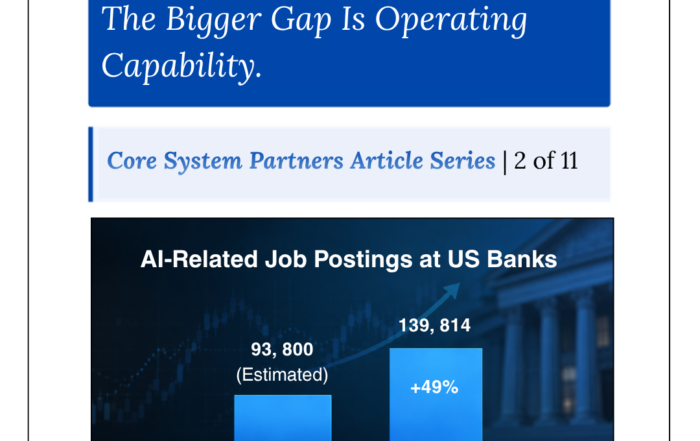
As reported this week by BankingNewsAI, Axos Bank is actively hiring across a range of AI-specific roles including AI platform engineer, lead AI engineer, cloud and AI security engineer, and AI enablement specialist. These are not exploratory hires. They are operational roles tied to a bank that is already running AI agents in production environments. The hiring profile reflects what happens when an institution moves from pilot to deployment: the talent requirement shifts from data scientists and proof-of-concept builders to engineers who can run, secure, and scale what has already been built.
The broader pattern, consistent with what we flagged in Issue #36, is that AI-related roles are rising because of adoption. Banks that have committed to AI in production need people who can operate it. The institutions still in pilot mode are not yet feeling this pressure, but they will. The time to start building that capability is before you need it, not after.
JPMorgan Private Bank: AI as an adviser productivity tool
As reported this week by Bloomberg, JPMorgan’s Private Bank is using AI to simplify complex processes, give advisers faster access to research and investment views, and help clients find relevant information through its website and app. The framing is adviser augmentation, not adviser replacement. JPMorgan is not reducing headcount in its wealth arm; it is trying to make each adviser more productive and better informed.
This is worth noting because the talent implication runs in both directions. AI is not creating a simple substitution story in wealth management. It is changing what advisers are expected to do with their time and what skills they need to do it well. Institutions building out wealth and private banking capabilities should be thinking about how AI changes the adviser role, not just whether it reduces the number of advisers needed.
CB RADAR UPDATE
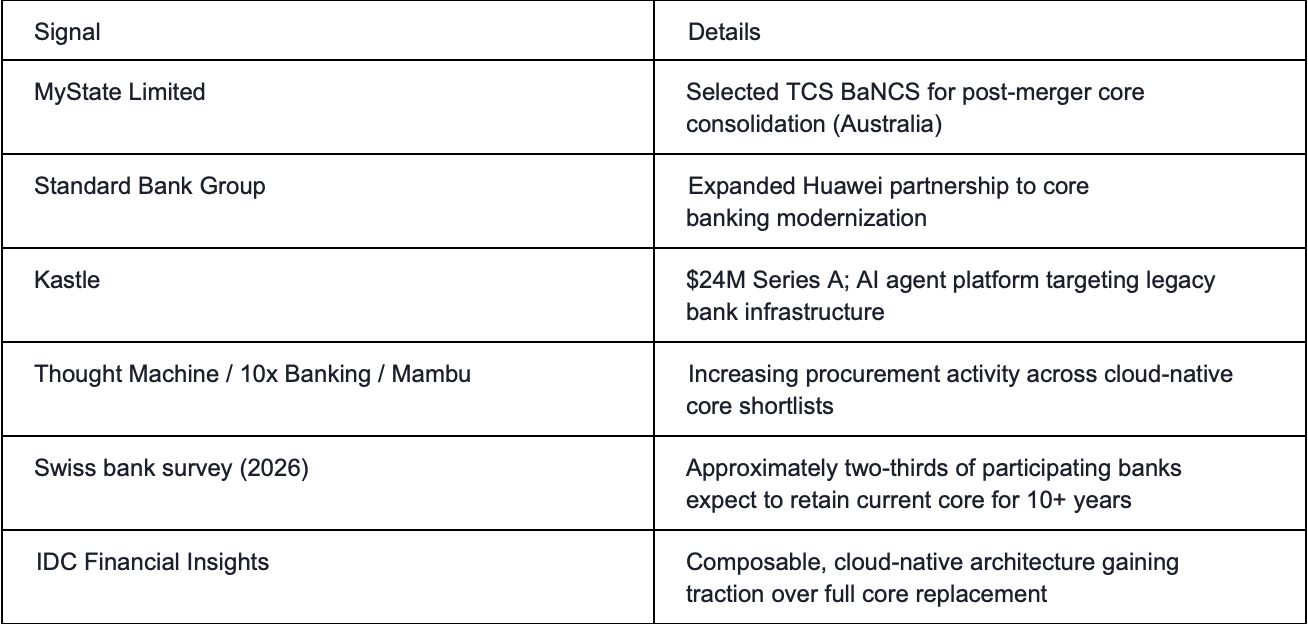
The CB Radar picture this week reflects a market that is splitting into two distinct camps. One group is actively modernizing: selecting new platforms, expanding vendor partnerships, and building composable architecture. The other group is deferring, with the Swiss survey data suggesting that deference is not always reluctance; sometimes it is a deliberate choice to extract more life from existing systems while deploying AI on top. What is worth watching is whether the Kastle model, AI agents on legacy infrastructure, gives the deferring camp enough runway to delay core decisions indefinitely, or whether the governance and operational complexity of that approach eventually forces the conversation anyway.
RICK’S STRATEGIC TAKE
➜ The commercial lending results at Customers Bank and First Internet Bank are the most important signals in this week’s brief, and not because the numbers are large. They matter because they are real, they are measured, and they are showing up at institutions that are not the biggest names in the industry. If I were sitting with a regional bank CEO right now, I would ask one question: what is our equivalent of a seven-day loan close, and what would it take to get there? If the answer is “we don’t know yet,” that is the conversation to have before your competitors have it for you.
➜ The BIS finding that only 4% of banks rate their AI compliance monitoring capabilities highly should be uncomfortable reading for any institution that has deployed AI in a regulated workflow. We have spent three issues watching regulators sharpen their questions around AI governance, from the Fed’s shutdown question in Issue #37 to the FSB’s 12 sound practices in Issue #38. The BIS data this week quantifies the gap. Deploying AI without the compliance monitoring to match it is not a technology problem. It is a governance and operating model problem, and it is the kind of problem that tends to surface at the worst possible time.
➜ Four core banking go-lives in one week is not a coincidence. It reflects a decision cycle that has been building for two to three years finally reaching execution. The institutions completing these migrations are not just replacing technology; they are removing the constraints that have been limiting what they can do with data, with AI, and with new product development. The ones still deferring are not saving money. They are deferring capability while their peers accumulate it.
For a deeper framework on what AI-ready core architecture actually requires, see CSP’s CB Architecture Series at coresystempartners.com.
Want the Full Picture?
Subscribe to BIS, the Banking Intelligence Service from Core System Partners, for the full breakdown including Rick’s Strategic Take on the governance gap, the CB Radar vendor tracking signals, and the regulatory pulse analysis covering what SR 11-7 does and does not cover for agentic deployments, delivered weekly. Banking Intelligence Service
For CSP’s full analysis of what the Fed and Treasury are actually concerned about—and a framework for what AI-ready architecture requires—visit Core System Partners.
Continue With Core System Partners
- Contact Us: https://coresystempartners.com/#contact
- The Strategic Flywheel (book): https://coresystempartners.com/resources/strategicflywheel/
- Core Insider (weekly newsletter): https://coresystempartners.com/resources/newsletter/