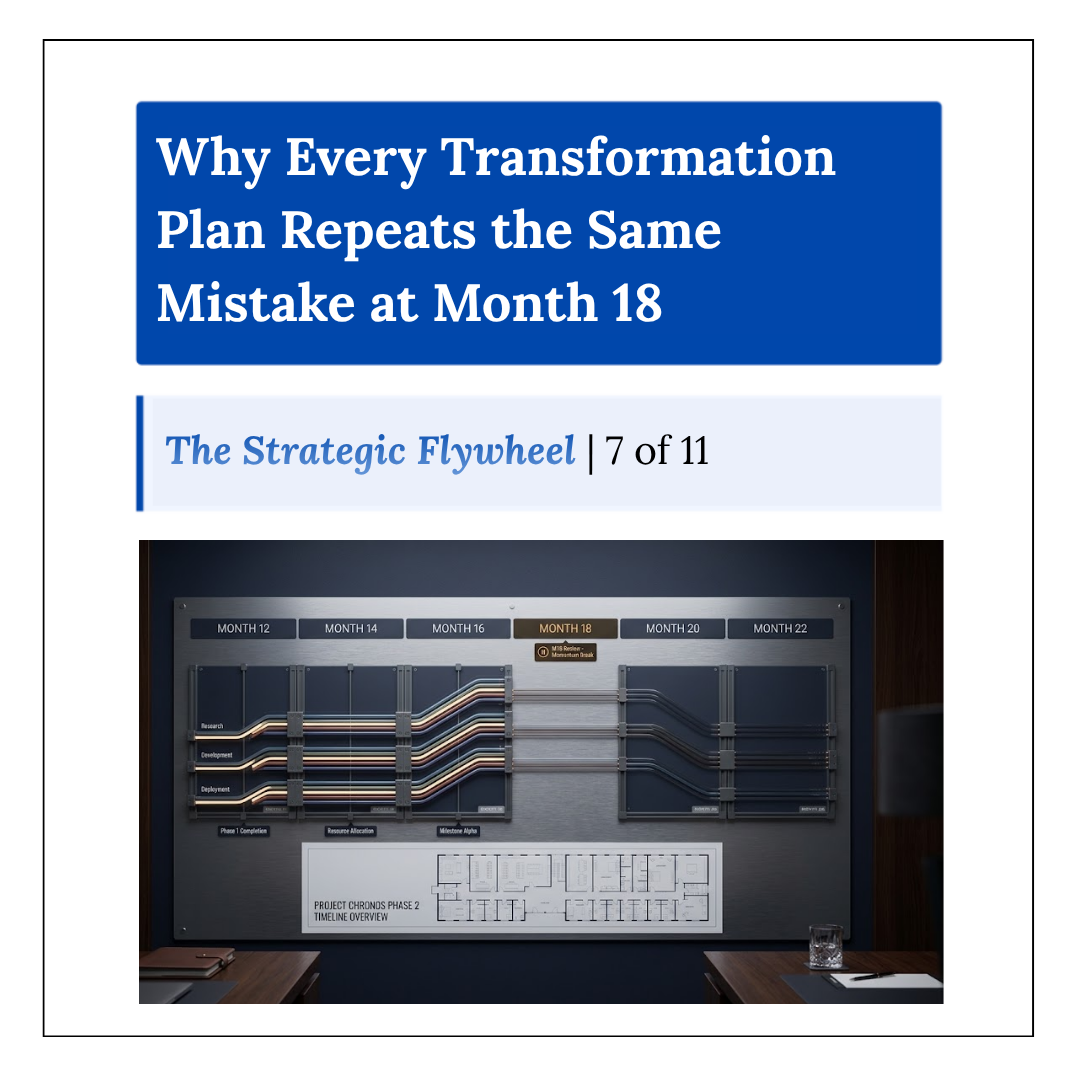
Transformation rarely fails all at once. Around Month 18, shifting priorities, resource pressure, and execution drift can quietly derail even the strongest banking transformation plans.
Give almost any transformation program about a year and a half and you can predict the meeting. The kickoff deck is still technically accurate. The org chart hasn’t changed. And yet momentum is gone, not from one failure, but from a slow accumulation of “temporary” workarounds that quietly became permanent. Nobody scheduled the stall. It just arrived, the way it always does.
I spent a lot of time on this question with Harvey Koeppel while working on this book. Harvey is a former CIO who ran the technology integration for the Citibank and Smith Barney merger, which is about as good a laboratory for this problem as banking offers. His diagnosis wasn’t process, and it wasn’t talent. It was incentives that never moved.
Here’s the pattern he described. Everyone is technically pulling toward the same transformation goal, but the incentives don’t match the strategy:
- The branch manager is still measured on uptime and complaint volume.
- The IT lead is still measured on hitting a delivery date, not on whether anyone actually adopted what got delivered.
- The ops team is still measured purely on cost containment, so anything that looks like short-term friction, even friction in service of a better system, gets quietly deprioritized.
Everyone is doing their job well. The transformation stalls anyway, because nobody’s job actually changed when the strategy did.
Koeppel’s fix on the Citibank integration wasn’t a new governance layer. It was blunter than that:
- Name the top 20 corporate projects out loud, and align people across every division to those first.
- Managers whose people were fully committed elsewhere had to surface the resource conflict instead of quietly absorbing it.
- Executives got visibility to move money and people on purpose instead of by accretion.
- A few projects paused. Others finally got resourced properly. The result wasn’t more activity, it was less friction.
The other half of it is ownership, and this is where I’d add Ben Gurdus’s line from his interview:
“If you don’t know who owns the data, there’s no belly button to push when something goes wrong.”
— Ben Gurdus
Vague ownership is how “hot potato” projects happen: initiatives that stall and generate finger-pointing the moment they hit a rough patch, because no single person was ever actually on the hook. The fix is unglamorous. Name an outcome owner for every initiative, and measure that owner on adoption and benefit, not on whether the project shipped on the date in the original slide.
That’s the real tell, month eighteen or otherwise. If the people closest to a change are still being scored entirely on the metrics that predate it, the transformation is running on borrowed goodwill. It will look fine for a while. Koeppel’s own rule for spotting it early: adoption is the metric that matters. If a pilot doesn’t show value, shut it down. Not because failure is shameful, but because a pilot with no adoption is telling you the incentive problem before the delivery problem shows up.
Strategy doesn’t fail at month eighteen because the plan was wrong in month one. It fails because nobody went back and asked whether the people executing it were still being rewarded for the old way of doing things.
— Rick Mavrovich