Issue #19
Weekly Banking Intelligence: June 06 to June 12, 2026
THIS WEEK’S SIGNAL
The workforce reckoning is no longer theoretical.
Bloomberg and Fortune both reported this week that major banks are actively laying the groundwork for mass headcount reductions, with entry-level analysts and junior processing roles squarely in the crosshairs. Simultaneously, 72% of those same banks cannot tell you how to shut down a failing AI model or report an AI failure to regulators. Banks are accelerating into AI deployment while the governance infrastructure to manage that deployment does not yet exist. That gap is the defining risk of 2026.
DEEP DIVE
The Kill-Switch Problem: Banks Are Deploying AI Faster Than They Can Control It
A new survey from Wolters Kluwer (a global compliance and risk management software firm) published this week found that 72% of bankers identified model kill-switch protocols (34%) or regulatory reporting of AI failures (38%) as the areas where their institutions are least prepared. Read that again: nearly three quarters of banks have no reliable mechanism to stop a failing AI model or tell regulators about it. This is not a technology gap. It is a governance gap, and it is compounding daily as AI deployment accelerates.
The timing is particularly sharp. Bloomberg reported on June 7 that banks are actively preparing workforce reduction plans tied directly to AI automation across customer service, transaction monitoring, and trade surveillance functions. Banks are simultaneously removing the human checkpoints that historically caught model errors and failing to build the automated governance controls that would replace them. The result is a control vacuum sitting at the center of operational risk.
The European context makes this worse. The European Supervisory Authorities released a joint report this week showing that 29% of the 3,383 major operational incidents recorded under the Digital Operational Resilience Act’s (DORA’s) first year originated from third-party provider failures. That is not a small number. For U.S. banks operating under advisory-only third-party AI oversight (rather than enforceable rules), the practical implication is that no regulator is forcing them to quantify this exposure. They have to do it themselves, and most are not.
The Reserve Bank of India (RBI) moved more decisively than most Western regulators this week, directing banks and other regulated entities to complete a board-approved AI risk gap assessment and formulate a time-bound action plan by June 30. That is a hard deadline, not a suggestion. The contrast with the U.S. posture is instructive: the RBI is treating AI governance as a safety-and-soundness issue right now, while U.S. federal regulators are still debating the legislative grammar. Banks operating across both jurisdictions need two parallel compliance tracks, and they needed them yesterday.
MARKET MOVES
CORA Group Acquires Finastra’s U.S. Mid-Market Banking Business
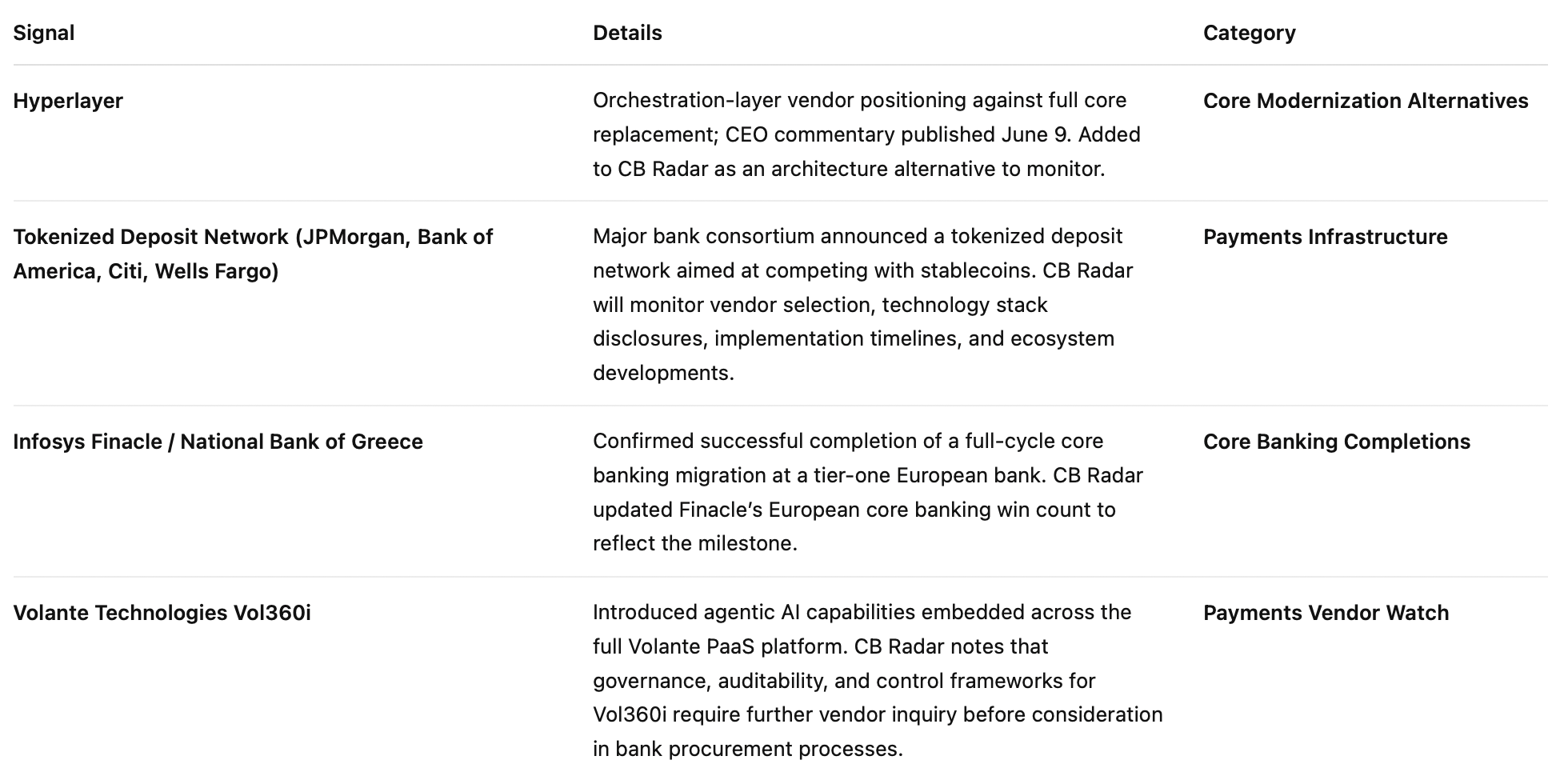
CORA Group, a banking technology platform provider, acquired Finastra’s U.S. mid-market banking business this week, including the Phoenix Core Banking System and Malauzai Digital Banking. This is a meaningful consolidation signal: Finastra is shedding a mid-market segment it could not profitably scale, and CORA is betting it can. For the community and mid-tier banks running Phoenix, the ownership change raises immediate questions about roadmap continuity, support commitments, and whether CORA has the engineering depth to modernize a legacy core while competing against cloud-native alternatives.
Capital One / Brex: Deal Context Worth Noting
A market summary circulating this week referenced Capital One’s January 2026 agreement to acquire corporate spend management fintech Brex at approximately $5.15 billion. No new developments were reported this week; the deal is included here because the CB Radar implications for embedded finance and corporate card infrastructure are still being processed by mid-market competitors who have not yet adjusted their product roadmaps in response.
Ramp Raises $750M at $44B Valuation
Ramp, a corporate spend management and financial operations platform, closed a $750 million funding round at a $44 billion valuation, nearly tripling its valuation in one year. Investors are explicitly pricing the AI story: Ramp’s pitch centers on AI-driven expense automation and real-time financial intelligence. For banks still building corporate card and spend analytics capabilities internally, this valuation is a competitive benchmark they will not be able to match on organic timelines.
Big Banks Launch Tokenized Deposit Network
JPMorgan Chase, Bank of America, Citigroup, Wells Fargo, and other major commercial banks announced plans this week to launch a tokenized deposit network, framed explicitly as a defensive response to stablecoin competition under the current crypto-friendly regulatory environment. The strategic logic is sound: if stablecoins are going to operate as payment rails, banks want a bank-controlled alternative that preserves deposit relationships. The execution risk is significant, as tokenized deposit infrastructure requires coordination across competing institutions that have historically struggled to maintain shared technology standards.
VENDOR SIGNALS
Volante Technologies Embeds Agentic AI Across Payments Platform
Volante Technologies, which positions itself as a global leader in Payments as a Service (PaaS), announced that its payments platform and PaaS operations are now fully powered by its “Vol360i” agentic AI layer. This is not a bolt-on feature announcement. Embedding agentic AI at the payments processing layer means Volante is positioning for autonomous payment routing, exception handling, and compliance decisioning without human intervention in the loop. Banks evaluating PaaS vendors need to ask hard questions about how Vol360i decisions are logged, audited, and overridden. Given the kill-switch findings from Wolters Kluwer above, this is not a theoretical concern.
National Bank of Greece Completes Infosys Finacle Transformation
National Bank of Greece (NBG) announced completion of its core banking transformation using Infosys Finacle this week. NBG is one of Greece’s largest banks, and this completion marks a full-cycle migration rather than a phased pilot. Infosys Finacle (the core banking product line of Infosys, the Indian IT services giant) continues to accumulate European completions. For CB Radar tracking purposes, this is a confirmed Finacle win at tier-one scale in Southern Europe.
Hyperlayer Argues the Core Debate Is the Wrong Debate
Hyperlayer, a banking technology firm betting on orchestration-layer architecture rather than core replacement, published a CEO commentary this week arguing that the industry is asking the wrong question. The framing: the speed of AI adaptation is determined not by which core you run but by whether you have an orchestration layer capable of connecting AI models to live banking data and processes. This is a direct competitive argument against full core replacement projects and worth tracking. Hyperlayer is in CB Radar as a vendor to watch.
Anthropic’s Claude Mythos: Vulnerability Discovery at Scale
A global banking AI vulnerability assessment published this week noted that in early April 2026, Anthropic (the AI safety company behind the Claude model family) released Claude Mythos in limited capacity, describing it as a model capable of identifying thousands of previously unknown software defects across major operating systems and web browsers. The banking implication is not the model itself but what it signals: AI is now capable of systematic vulnerability discovery at a scale no human red team can match. Banks that have not run AI-assisted penetration testing against their own infrastructure are operating with an asymmetric information disadvantage against adversaries who have.
REGULATORY PULSE
Federal AI Regulation Bill Introduced: Fraud Penalties Double When AI Is Involved
Representative Jay Obernolte (R-CA) and Representative Lori Chavez-DeRemer introduced a federal AI regulation bill this week that includes a provision doubling fines for federal mail fraud, wire fraud, bank fraud, and money laundering when AI is used in the commission of those offenses. This is a direct signal to banks: regulators and legislators are treating AI-assisted fraud as a categorically more serious offense, which means AI-enabled fraud controls are no longer a best practice but a legal liability management tool. Banks that cannot demonstrate AI-specific fraud detection in their model inventories are exposed.
Colorado AI Act Takes Effect June 30
Colorado’s comprehensive AI Act, which applies to any business deploying “high-risk” AI systems, takes effect on June 30, 2026. California has enacted 24 separate AI laws across two legislative sessions. The state-level patchwork is accelerating faster than any federal framework, and banks operating across multiple states are now managing a compliance matrix that changes quarterly. The practical implication: AI governance programs built around a single federal standard do not exist yet, and waiting for one is not a compliance strategy.
RBI Sets June 30 Deadline for AI Risk Gap Plans
As noted in the Deep Dive, the Reserve Bank of India directed banks and regulated entities this week to complete board-approved AI risk gap assessments and submit time-bound remediation plans by June 30. For international banks with Indian operations, this is an immediate action item, not a watch item.
TALENT SIGNALS
Banks Are Cutting Headcount and Hiring AI Engineers Simultaneously
The Bloomberg and Fortune workforce reporting this week confirms a pattern CSP has been tracking for months: banks are reducing entry-level analyst headcount, junior processing roles, and routine middle-office functions as a direct consequence of AI automation. These are not efficiency trims. They are structural eliminations of roles that AI now performs faster and cheaper. At the same time, demand for agentic AI engineers, AI governance and compliance managers, and MLOps (Machine Learning Operations) specialists is rising because AI adoption requires those roles to exist. The directionality is not ambiguous: automation is removing one category of worker and requiring a different one.
Goldman Sachs CEO Flags Engineering Headcount Plateau
Goldman Sachs CEO David Solomon stated this week that AI’s growing ability to assist with software development may slow or halt the steep rise in bank engineering headcount that has characterized the past several years. The implication is not that Goldman stops hiring engineers. It is that AI-assisted coding is compressing the number of engineers needed to produce a given output. For banks that justified large technology hiring programs on the basis of build-versus-buy strategies, this changes the internal ROI math on those programs.
BMO Harris Bank Is Hiring AI Governance Leads
BMO Harris Bank is actively hiring AI governance and compliance roles as the regulatory pressure from state-level AI laws and anticipated federal frameworks creates immediate staffing needs. This is consistent with the broader pattern: AI governance leads are rising in demand because of AI adoption, not despite it. Banks that do not have this function staffed before Colorado and California deadlines land are building compliance exposure in real time.
CB RADAR UPDATE
RICK’S STRATEGIC TAKE
The kill-switch finding is the story of the week, and most banks are treating it as a survey result rather than an action item.
Seventy-two percent of banks cannot shut down a failing AI model or report an AI failure to regulators. Meanwhile, those same banks are actively removing the human roles that historically caught model errors. If you are a CRO or a Chief Compliance Officer at a bank in that 72%, you do not have an AI strategy problem. You have a safety-and-soundness problem. The Wolters Kluwer data and the RBI’s June 30 deadline are pointing at the same gap from two different directions. The gap is real, it is measurable, and it is yours to close.
The CORA/Finastra deal and the Hyperlayer orchestration argument are not unrelated.
Banks running Phoenix Core are now asking whether to stay with CORA, migrate to a new core, or insert an orchestration layer that buys them time. That is exactly the question Hyperlayer is designed to answer, and it is the same question CSP fields from mid-tier clients every week. The honest answer is that orchestration can extend a legacy core’s useful life by three to five years if the integration architecture is clean, but it does not resolve the underlying data model limitations that will constrain AI performance at scale. Know which problem you are actually solving before you select the solution.
State-level AI regulation is not waiting for Washington.
Colorado goes live June 30. California has 24 laws on the books and is still legislating. The RBI has a hard deadline this month. Banks that are managing AI compliance as a single future federal event are already behind in three jurisdictions. The compliance architecture for AI governance needs to be modular and jurisdiction-aware right now, not after the next federal bill passes. Banks that build that architecture once and configure it by jurisdiction will spend a fraction of what banks spend that rebuild it for every new state law.
For a deeper framework on what AI-ready core architecture actually requires, see CSP’s CB Architecture Series at coresystempartners.com.
Want the Full Picture?
Subscribe to BIS, the Banking Intelligence Service from Core System Partners, for the full breakdown including Rick’s Strategic Take on the governance gap, the CB Radar vendor tracking signals, and the regulatory pulse analysis covering what SR 11-7 does and does not cover for agentic deployments, delivered weekly. Banking Intelligence Service
For CSP’s full analysis of what the Fed and Treasury are actually concerned about—and a framework for what AI-ready architecture requires—visit Core System Partners.
Continue With Core System Partners
- Contact Us: https://coresystempartners.com/#contact
- The Strategic Flywheel (book): https://coresystempartners.com/resources/strategicflywheel/
- Core Insider (weekly newsletter): https://coresystempartners.com/resources/newsletter/