Issue #20
Weekly Banking Intelligence: June 12 to June 18, 2026
THIS WEEK’S SIGNAL
The regulatory window on agentic AI is closing faster than most banks are moving.** The OCC, Fed, and FDIC signaled this week that a formal Request for Information on AI model risk is coming, the Financial Stability Board published 12 sound practices for responsible AI adoption, and examiners are already asking questions in the field. Banks that have been treating AI governance as a future project are about to find out it is a current examination priority.
DEEP DIVE
The Regulatory Net Is Tightening Around AI, and the Gaps Are Getting Harder to Ignore
Here is what caught my attention this week. The April 2026 SR 26-2 guidance updated model risk management standards for traditional quantitative models but explicitly carved out generative and agentic AI. That sounds like breathing room. It is not. Examiners are already incorporating AI oversight into every bank examination, and the OCC confirmed this week that the agencies plan to issue a formal Request for Information covering model risk management broadly, with specific attention to generative AI and agentic AI. The carve-out was never a safe harbor. It was a placeholder.
Layered on top of that, the Financial Stability Board (FSB) published a consultation report on June 10 outlining 12 sound practices for responsible AI adoption. The FSB’s most notable acknowledgment: continuous human oversight of agentic AI systems is reaching its practical limits, and banks should begin exploring AI monitoring AI as a compensating control. That is a significant statement from a body that has historically been cautious about endorsing automation in governance roles. When the FSB says human oversight is hitting a ceiling, that is worth a conversation in your next board risk committee meeting.
The operational picture is equally telling. Banks are accelerating agentic AI deployment across fraud detection, payments, document processing, and customer service. FIS launched a financial crimes AI agent this week that keeps a human in the loop for final disposition, which is the pattern most institutions are following right now: point the agents inward, keep humans on the signature line. That is a reasonable starting position. But the pressure to let agents act autonomously on customer-facing transactions is building, and the first institution that crosses that line will set the precedent for everyone else. The regulatory, liability, and reputational stakes of being first are enormous.
What I would be asking at the leadership level: Do you have a current inventory of every AI model and agent in production, including the ones your vendors are running on your behalf? Does your AI governance framework explicitly address agentic systems, or does it still assume a human reviewed every model output before action was taken? And when the RFI lands, will your responses reflect a program that was designed, or one that was assembled?
MARKET MOVES
Nuvei Acquires Payoneer for $2.75 Billion
Nuvei, a Canadian payments technology company, announced it will acquire Payoneer, a cross-border payments and working capital platform, for approximately $2.75 billion in cash. The deal combines Nuvei’s payment acceptance infrastructure with Payoneer’s cross-border payout capabilities and embedded financial services. The strategic read here is consolidation at the infrastructure layer of global payments. Banks that rely on third-party rails for cross-border settlement should watch this one closely. Fewer, larger payments infrastructure players means less negotiating leverage and more dependency concentration over time.
Temenos Acquisition Expected to Close Early Q3 2026
As previously reported, Temenos is acquiring a fintech target through equal parts cash and equity, with closing expected in early Q3 2026, subject to customary conditions. No new material details emerged this week beyond the timeline confirmation. We will follow up when the transaction closes.
VENDOR SIGNALS
Jack Henry Continues Its Community Bank Run
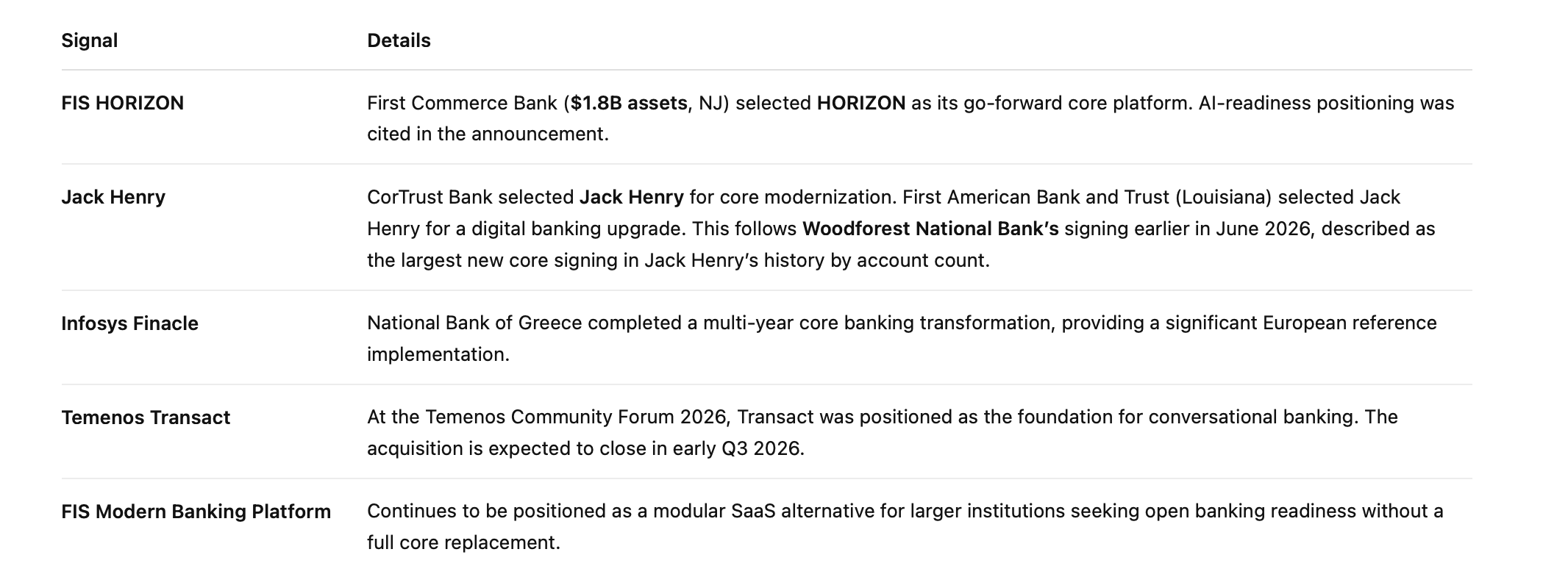
Jack Henry (Nasdaq: JKHY) signed two more institutions this week. CorTrust Bank selected Jack Henry for core banking modernization, and First American Bank and Trust, a Louisiana community bank, selected Jack Henry’s technology solutions for digital banking and operational improvement. Both signings build on the momentum from Jack Henry’s earlier announcement that Woodforest National Bank, described by the company as the largest new core signing in Jack Henry’s history by number of accounts, had also selected the platform. Three signings in a compressed window is not a coincidence. Jack Henry is executing a deliberate push into the larger end of the community bank segment, and it appears to be working.
FIS Lands First Commerce Bank on HORIZON
First Commerce Bank, a $1.8 billion-asset community bank based in New Jersey, selected FIS HORIZON as its go-forward core banking platform. The agreement gives First Commerce access to the full HORIZON API-enabled ecosystem. FIS has been positioning HORIZON explicitly around AI readiness and open banking capability, and this signing reflects that messaging landing with community banks that are thinking beyond near-term cost reduction toward longer-term competitive positioning.
FIS Modern Banking Platform Gaining Attention for Larger Institutions
Separately, FIS is actively pitching its cloud-native Modern Banking Platform as a modular SaaS alternative for larger institutions that want faster product deployment and open banking readiness without a full core replacement. The distinction between HORIZON (community) and Modern Banking Platform (larger institutions) reflects a deliberate two-track strategy. Worth watching in CB Radar as FIS attempts to hold share across both segments simultaneously.
National Bank of Greece Completes Infosys Finacle Transformation
National Bank of Greece (NBG) announced the completion of a multi-year core banking transformation program built on Infosys Finacle. This is a notable milestone. Multi-year core transformations that actually finish are still not common enough to be unremarkable. The NBG completion adds a meaningful reference point for European institutions evaluating Finacle, particularly those facing both modernization pressure and regulatory complexity.
Temenos Transact Positioning
At the Temenos Community Forum 2026, Temenos leadership outlined a path from foundational trust through modernization to what they are calling “transcendence,” framing the Transact core engine as the foundation for conversational banking. The messaging is consistent with where the broader market is heading. Whether the execution matches the positioning is the question CB Radar will track as client signings and go-live announcements emerge.
REGULATORY PULSE
AI Is Now an Examination Topic, Not a Future Consideration
The clearest signal this week came from Reuters, which reported that U.S. banking regulators are actively pressing firms in examinations on data access, governance controls, and AI risk. This is not a proposed rulemaking. This is happening now, in live examinations. The OCC, Fed, and FDIC have confirmed they plan to issue a formal Request for Information on model risk management, with explicit focus on generative and agentic AI. Banks should treat that RFI as an open-book exam for which the preparation window is already open.
The ABA noted this week that the April 2026 SR 26-2 guidance applies to traditional AI models but explicitly excludes generative and agentic AI, while also stating that a bank’s risk management and governance practices should guide controls even for excluded systems. Read that carefully. The regulators are saying: the formal rule does not cover your GenAI and agentic systems yet, but your governance framework still has to. The absence of a specific rule is not the absence of an expectation.
The FSB’s consultation report, published June 10, adds an international dimension. Twelve sound practices for responsible AI adoption, including the acknowledgment that AI monitoring AI may be necessary as human oversight reaches its limits. For banks operating across jurisdictions, the FSB signal matters as much as the domestic guidance.
The kill-switch gap is real. Banks are deploying agentic systems faster than they are building the controls to halt, audit, or roll back those systems when something goes wrong. That gap is what examiners are looking for.
TALENT SIGNALS
Chief AI Officers Are Now a Compensation Category
Bloomberg reported this week that HSBC, Commonwealth Bank of Australia, and Lloyds Banking Group have all filled top AI leadership roles in the past three months, with compensation approaching $3.5 million per year for the right candidates. The talent pool is thin, firms are recruiting across industries, and the roles are genuinely hard to fill because the skill set requires both technical depth and the ability to operate at the executive level. AI leadership roles are rising because of AI adoption, and the institutions that built those functions early have a structural advantage in retaining the people who already understand their environment.
Banks Are Hiring for LLM Development, AI Architecture, and MLOps
China Daily reported a broad hiring drive across banks focused on large language model (LLM) development, AI application deployment, and technology architecture planning. This is consistent with what we are seeing in CB Radar hiring signals globally. The roles being created are net new, not rebranded. Banks are building capability that did not exist in their organizations three years ago.
BMO Harris Bank Is Hiring in AI Governance
BMO Harris Bank is actively building out its AI governance and risk function, reflecting the regulatory pressure described above. This is the right response. Governance headcount is rising because of AI adoption, and the institutions that staff governance proactively will be in a materially better position when the RFI lands and when examiners ask to see the program.
Morgan Stanley Estimates 400,000 European Banking Roles at Risk
Morgan Stanley doubled its estimate for AI-driven job losses in European banking to as much as 20 percent of roles, or approximately 400,000 positions. Zopa Bank research suggests one in ten UK bankers, roughly 27,000 roles, could be at risk by 2030. These are not teller roles alone. Middle-office processing, routine credit analysis, and non-AI compliance headcount are all in scope. The displacement is a consequence of automation, and it is accelerating. The institutions managing this well are the ones that are redeploying affected talent into change management, data stewardship, and AI oversight roles rather than simply reducing headcount and hoping the transition manages itself.
CB RADAR UPDATE
RICK’S STRATEGIC TAKE
The regulatory posture on AI shifted from “guidance is coming” to “examiners are already asking” this week. The OCC, Fed, and FDIC are in your building. The FSB is setting international expectations. The RFI is on its way. If your AI governance program exists primarily in a PowerPoint deck, that is a material risk. The institutions that will navigate this well are the ones that can show examiners a documented program, an AI inventory, and a governance structure with real ownership. Not a framework. A program.
The $170 billion profit erosion estimate from the DIFC report, and McKinsey’s $200 to $340 billion annual value potential from GenAI, are two sides of the same coin. The banks that capture the upside are the ones with the architecture and operating model to deploy AI at scale. The ones that absorb the downside are the ones still debating whether to modernize. I have seen this dynamic before in prior technology cycles. The gap between the institutions that moved and the ones that waited is always larger than anyone predicted, and it compounds faster than anyone expected.
The community bank core market is moving. Jack Henry signed three institutions in a matter of weeks, including what it called the largest signing in its history by account count. FIS landed First Commerce Bank on HORIZON with an explicit AI-readiness message. National Bank of Greece crossed the finish line on a multi-year Finacle transformation. These are not isolated announcements. Community and mid-tier banks are making decisions now, and the vendors that are winning are the ones that can connect core modernization directly to AI capability. The institutions still in evaluation mode should note that the competitive window is not sitting still while they deliberate.
For a deeper framework on what AI-ready core architecture actually requires, see CSP’s CB Architecture Series at coresystempartners.com.
Want the Full Picture?
Subscribe to BIS, the Banking Intelligence Service from Core System Partners, for the full breakdown including Rick’s Strategic Take on the governance gap, the CB Radar vendor tracking signals, and the regulatory pulse analysis covering what SR 11-7 does and does not cover for agentic deployments, delivered weekly. Banking Intelligence Service
For CSP’s full analysis of what the Fed and Treasury are actually concerned about—and a framework for what AI-ready architecture requires—visit Core System Partners.
Continue With Core System Partners
- Contact Us: https://coresystempartners.com/#contact
- The Strategic Flywheel (book): https://coresystempartners.com/resources/strategicflywheel/
- Core Insider (weekly newsletter): https://coresystempartners.com/resources/newsletter/