Issue #21
Weekly Banking Intelligence: June 19 to June 25, 2026
THIS WEEK’S SIGNAL
HSBC put a hard number on AI this week, and the industry has no good excuse to ignore it. The bank’s new partnership with Google Cloud is expected to generate more than 200 use cases over two years, with HSBC estimating the benefit value on its highest-priority initiatives will exceed $100 million. That is not a pilot. That is a P&L commitment. At the same time, NatWest’s CEO publicly stated that AI will take over some existing banking roles, and Lloyds launched a drive to hire 300 AI and technology specialists. The pattern this week is not adoption. It is acceleration, with real numbers attached. Why it matters: banks that are still in the “exploring AI” phase are not just behind on technology; they are behind on the organizational and architectural work required to capture returns at this scale.
DEEP DIVE
HSBC and Google Cloud: The First Hard Number
HSBC’s announcement of its expanded partnership with Google Cloud, unveiled at the Google Cloud Summit London on June 17, is worth slowing down on. Most bank-vendor AI announcements are long on aspiration and short on accountability. This one is different. HSBC has publicly committed to a financial benefit threshold exceeding $100 million across its highest-value AI initiatives, making it one of the first major institutions to attach a P&L expectation to an enterprise AI program rather than a headcount or use-case count.
The partnership is expected to enable more than 200 new AI use cases over two years. That number alone is less interesting than the sequencing question it raises. Two hundred use cases across a bank the size of HSBC requires a data infrastructure, a governance layer, and an operating model that most institutions have not yet built. The use cases do not run themselves. Someone has to own them, govern them, and connect them to the core systems that hold the actual data.
Why it matters: HSBC is not just announcing a vendor relationship. It is signaling that the return on AI investment is now measurable and expected. Every board that reads this announcement will ask their CEO the same question: where is our number? If your institution cannot answer that question with specificity, you have an architecture problem before you have an AI problem.
There is a second implication that deserves attention. Bloomberg reported in March that HSBC is considering using AI to reduce headcount in the middle and back office, with potential impact on roughly 20,000 roles, or approximately 10 percent of its total workforce. That context sits directly behind this partnership announcement. The Google Cloud deal is not just about building new capabilities. It is also about replacing manual processes at scale. The math is straightforward: if AI generates $100 million in value while also reducing operating costs through headcount rationalization, the return case becomes significantly more compelling.
Why it matters from an architecture standpoint: none of this works on a legacy core. The data access, the API connectivity, the real-time processing requirements for 200 AI use cases across a global bank require a modern infrastructure. HSBC has been investing in modernization for years. That prior investment is what makes this announcement credible. Banks that have deferred that work are not just behind on AI deployment; they are behind on the foundational plumbing that makes deployment possible.
The KPMG Banking Technology Survey released this week reinforces this point directly. Across the survey respondents, the top challenges cited for deploying AI at enterprise scale were data foundations, modern infrastructure, and practical implementation at scale. Not model selection. Not vendor access. Infrastructure and data. That is the same message we have been delivering in this brief for months, and now it is showing up in survey data from bank executives themselves.
MARKET MOVES
Finastra Exits Core Banking
Finastra, one of the largest banking software providers in the world, has agreed to sell its global core banking software business, Universal Banking, to Pollen Street, a London-based private capital asset manager. Universal Banking will be carved out and established as a standalone company under Pollen Street’s ownership. Finastra retains its payments and lending businesses.
This is a significant strategic signal. Finastra built Universal Banking through years of acquisitions and is now effectively saying that core banking is not where it wants to compete. Payments and lending, with their higher growth profiles and cleaner integration with AI-driven workflows, are the priority. Pollen Street, which specializes in financial services private equity, presumably sees value in a standalone core banking business that can operate with more focus than it had inside a large software conglomerate.
Why it matters: every bank currently running on Finastra’s Universal Banking platform needs to pay attention. A carve-out introduces transition risk: new ownership, new leadership priorities, new investment decisions, and new support structures. That does not mean the platform deteriorates overnight, but it does mean the roadmap is uncertain for a period. If you are on Universal Banking, this is the week to schedule a conversation with your account team and get clear answers about continuity, investment, and the go-forward product strategy.
Deluxe Acquires Celero Commerce for $625 Million
Deluxe Corporation, the Minnesota-based company best known for check printing, has agreed to acquire Celero Commerce, a Canadian payments technology company, for $625 million. Deluxe CEO Barry McCarthy has been explicit that the goal is to complete the company’s transition away from its legacy check-printing business toward a fintech-oriented model.
Why it matters: Deluxe is not a story about payments innovation. It is a story about what happens to legacy financial services businesses when their core revenue stream disappears. Check volume has been declining for years. Deluxe is buying its way into relevance. The question worth asking is whether a $625 million acquisition can actually complete that transformation or whether it just delays the harder operating model and cultural work that legacy-to-modern transitions require.
Meta and CRED: A $4 Billion Signal from India
Meta is reportedly in discussions to invest in CRED, a Bengaluru-based fintech serving India’s premium credit card market, at a valuation of approximately $4 billion. CRED has built a high-engagement consumer finance platform with a focus on affluent urban users.
Why it matters: this is less about India specifically and more about what it signals for global payments and fintech consolidation. Meta has been looking for a credible financial services entry point for years. A $4 billion bet on a high-engagement consumer fintech in the world’s largest digital payments market is a serious move. U.S. and European banks with international ambitions should be watching how this plays out.
VENDOR SIGNALS
FIS Wins First Commerce Bank
First Commerce Bank, a $1.8 billion community bank based in New Jersey, has selected FIS as its core banking platform. The move is framed as a modernization play to help the bank compete more effectively against larger institutions.
Why it matters: FIS continues to win community bank core replacements. For banks in the $1 to $3 billion asset range, this is a meaningful data point. The competitive dynamic at that tier is intensifying as larger banks deploy AI-assisted products that smaller institutions cannot replicate on legacy infrastructure.
Jack Henry Adds CorTrust Bank
CorTrust Bank has selected Jack Henry for core banking modernization. This follows Jack Henry’s signing of Woodforest National Bank earlier in June 2026, which Jack Henry described as the largest new core signing in its history by number of accounts. Two significant community and regional bank wins in a single month is not a coincidence.
Why it matters: Jack Henry is building momentum with larger community banks at a pace that deserves attention in CB Radar. The Woodforest signing in particular shifts the perception of Jack Henry from a smaller community bank vendor to a credible option for mid-tier regional institutions. That changes the competitive landscape for FIS and Fiserv at that tier.
SJCCU Selects Profile Software
Saint John’s Cooperative Credit Union, a Caribbean-based institution, has selected Profile Software’s Finuevo Core platform for its core banking upgrade. Profile Software (a Greece-headquartered banking technology provider with a significant presence in emerging and developing markets) continues to expand its footprint in smaller international markets.
Why it matters: this is a niche signal but a directionally interesting one. As global core banking vendors consolidate and reposition, smaller regional vendors like Profile Software are finding space in markets that the large platforms do not prioritize. Watch for more of this pattern in Caribbean, African, and Southeast Asian markets.
Microsoft Publishes Agentic AI Playbook for Commercial Banking
Microsoft published a detailed piece this week on how agentic AI is reshaping corporate and commercial banking, focusing on decision-making workflows, credit processes, and relationship manager productivity. The piece positions Microsoft’s cloud and Copilot infrastructure as the enabling layer.
Why it matters: Microsoft is not just selling software. It is actively shaping how bank executives think about the operating model for AI deployment. When a vendor publishes the playbook, it is also defining the problem in terms that favor its own solution. Bank executives should read Microsoft’s framing as useful but not neutral.
Deutsche Bank: Years to Months
A senior Deutsche Bank executive stated publicly this week that AI has compressed technology project timelines from years to months. That is a significant operational claim from a major global institution, not a vendor pitch.
Why it matters: if this is real at scale, it has direct implications for how banks think about transformation roadmaps, vendor contracts, and resourcing. Projects that were scoped as multi-year initiatives may need to be rescoped. More importantly, it raises the question of whether your institution has the governance infrastructure to manage a faster pace of change without accumulating new technical debt.
REGULATORY PULSE
Agentic AI and the “Bank Run in Seconds” Warning
Testimony before the House Financial Services Committee this week included a stark warning from a lawmaker: “We are not ready.” The specific concern raised was agentic AI systems triggering bank runs in seconds, with AI-driven financial agents capable of moving deposits faster than any human-operated system could respond. The discussion also touched on Claude Mythos Preview (Anthropic’s frontier reasoning model, currently available in limited preview under Project Glasswing) as an example of the capability class regulators are trying to understand.
Separately, Anthropic suspended access to Claude Mythos 5 and Claude Fable 5 following a U.S. government export-control and national-security directive. These are distinct from the Claude Mythos Preview model referenced in the congressional testimony. The distinction matters: one is a commercially available preview model; the other two are frontier-tier models that the government has determined require access controls.
Why it matters: regulators are now explicitly naming specific AI model families in congressional testimony and supervisory discussions. That is a new level of specificity. If your institution is deploying or evaluating frontier AI models, your legal, compliance, and risk teams need to be in that conversation now, not after the guidance lands.
Fed, OCC, and FDIC Model Risk Update
As noted in American Banker this week, the Federal Reserve, Office of the Comptroller of the Currency, and Federal Deposit Insurance Corporation updated the model risk framework on April 17, covering quantitative models used in credit underwriting, stress testing, capital calculations, and fraud detection. The update is now in effect. The American Banker piece makes a point worth repeating directly: regulatory silence on generative AI is not permission to proceed without governance.
Why it matters: banks that have been waiting for explicit generative AI guidance before building governance frameworks are already behind. The updated model risk framework applies now. If your AI models touch credit, capital, or fraud, they are in scope.
EBA Flags Frontier LLMs as Cyber Risk Amplifiers
The European Banking Authority released a report in June 2026 explicitly identifying frontier large language models as amplifiers of cyber risk for banks. The report elevates regulatory scrutiny across EU institutions and signals that AI cyber risk is moving from theoretical concern to active supervisory priority.
Why it matters: for any bank with EU operations or EU regulatory obligations, this report is not background reading. It is a supervisory signal. Cyber risk frameworks that do not account for AI-specific attack surfaces are now visibly out of step with where the EBA is heading.
U.S. Regulators Ramp Up AI Scrutiny
Reuters reported this week that U.S. banking regulators are actively pressing financial institutions on data access, governance controls, and AI-specific operational risks. This is consistent with the EBA direction and the congressional testimony above.
Why it matters: the regulatory environment around AI is tightening simultaneously in the U.S. and EU. Banks operating across both jurisdictions face a converging set of expectations with different timelines and different enforcement mechanisms. Getting ahead of this now is significantly easier than responding to it after an exam finding.
TALENT SIGNALS
Lloyds Banking Group: 300 AI and Technology Hires
Lloyds Banking Group is hiring 300 technology specialists focused on AI, ahead of what CEO Charlie Nunn is expected to announce as a major strategic plan for the 261-year-old institution. The recruitment drive is being framed as a foundational capability investment, not a project-specific headcount addition.
Why it matters: Lloyds is building the internal capability to own its AI strategy rather than outsource it entirely to vendors. Three hundred technology hires at a major UK bank is a signal that the talent competition for AI engineers, ML engineers, and AI governance professionals is intensifying across the Atlantic, not just in the U.S. If you are a U.S. bank competing for the same talent pool, the competition just got more expensive.
NatWest CEO on Role Displacement
NatWest CEO Paul Thwaite stated publicly this week that AI will take over some existing banking roles. He did not quantify the number, but the statement is notable for its directness from a sitting bank CEO.
Why it matters: AI-related roles are rising because banks are deploying AI at scale. Other roles, particularly in middle-office processing, routine operations, and non-specialized compliance functions, are declining as a direct consequence of that deployment. NatWest’s CEO saying this publicly is not a prediction. It is a description of what is already happening. Banks that have not had an honest internal conversation about workforce implications are behind that conversation now.
Chief AI Officer Hiring Accelerates
Reporting from The Straits Times this week confirmed that major banks are accelerating hiring for Chief AI Officers and senior AI governance roles, with talent frequently moving between institutions. The governance question of where AI training and oversight sits organizationally, whether in HR, a digital division, or under the CTO, remains unresolved at many banks.
Why it matters: the Chief AI Officer role is not yet standardized in banking. Banks that are serious about AI governance need to resolve the organizational question before the regulatory question resolves it for them. Waiting for a regulator to define the role is not a strategy.
BMO Harris Bank: AI Infrastructure Hiring
BMO Harris Bank is hiring for AI infrastructure and machine learning engineering roles as it scales its enterprise AI program. The hiring pattern reflects a broader shift at Tier 1 North American banks toward building internal AI engineering capacity rather than relying exclusively on vendor-managed deployments.
Why it matters: as AI infrastructure roles rise across Tier 1 banks, community and regional banks face a genuine talent disadvantage. The answer is not to compete for the same engineers. It is to make architectural and vendor decisions that reduce the internal engineering burden while preserving governance and control.
CB RADAR UPDATE
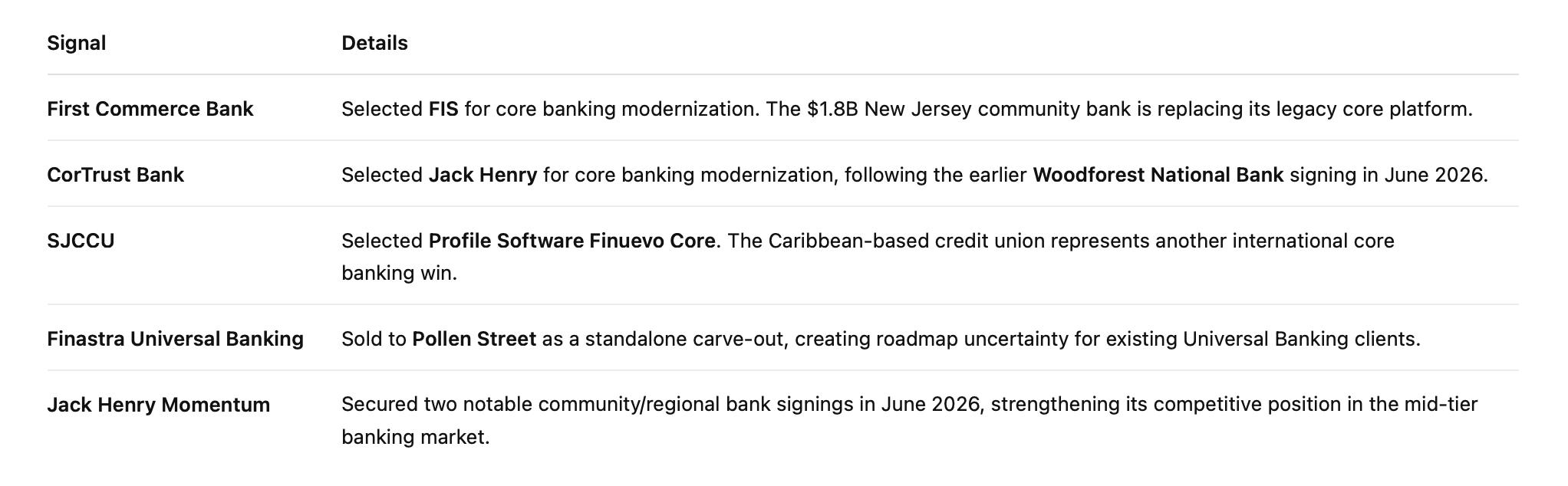
Why it matters: the core banking replacement cycle is not slowing down. In our proprietary CB Radar database, the pattern this week reinforces a clear split: FIS and Jack Henry are winning community and regional bank deals through modernization narratives, while Finastra’s exit from core banking creates an active displacement opportunity for every other vendor in the market. Banks currently on Finastra Universal Banking should treat this carve-out as a natural trigger to reassess their vendor relationship and roadmap. The Forbes piece published this week by Visa makes the architectural case directly: the most successful core migrations are running parallel environments before cutting over, not executing a hard cutover. That sequencing discipline is what separates successful transformations from failed ones.
RICK’S STRATEGIC TAKE
HSBC putting a $100 million return threshold on its AI program is the most important signal of the week, and not because of the number itself. It is because it changes the board-level conversation at every institution that reads it. Boards will now ask for a number. If your leadership team cannot produce one, the question becomes: what would it take to get there? That question leads directly to architecture, data infrastructure, and operating model, which is exactly where the conversation needs to be.
The Finastra Universal Banking sale is an underreported story. When one of the largest core banking software providers in the world decides to exit the core banking business, that is a structural signal about where margin and growth are heading in this industry. Payments and lending, with their AI-native workflow potential, are where the vendors want to be. Banks still treating their core as a stable, long-term platform need to ask whether their vendor shares that view.
The regulatory and congressional signals this week are converging on a single message: AI governance is not optional, and the absence of explicit guidance is not a safe harbor. The Fed, OCC, and FDIC updated the model risk framework in April. The EBA is flagging frontier models as cyber risk amplifiers. Congress is asking whether we are ready for AI-triggered bank runs. The institutions that will navigate this well are the ones that built governance infrastructure before the exam, not in response to it.
The Fable 5 and Mythos 5 episode is the regulatory environment in miniature. A frontier model did not wait for a notice-and-comment cycle: access changed after a U.S. government export-control and national-security directive, and Anthropic disabled the models globally to comply. That is not conventional bank regulation, but it is exactly the kind of intervention banks should expect as AI capabilities outrun supervisory playbooks. Why it matters: bank AI governance cannot assume regulators will move slowly. It has to handle emergency directives, national-security judgments, vendor access changes, and board-level questions that can arrive faster than procurement, vendor-risk, or model-risk committees are used to moving.
For a deeper framework on what AI-ready core architecture actually requires, see CSP’s CB Architecture Series at coresystempartners.com.
Want the Full Picture?
Subscribe to BIS, the Banking Intelligence Service from Core System Partners, for the full breakdown including Rick’s Strategic Take on the governance gap, the CB Radar vendor tracking signals, and the regulatory pulse analysis covering what SR 11-7 does and does not cover for agentic deployments, delivered weekly. Banking Intelligence Service
For CSP’s full analysis of what the Fed and Treasury are actually concerned about—and a framework for what AI-ready architecture requires—visit Core System Partners.
Continue With Core System Partners
- Contact Us: https://coresystempartners.com/#contact
- The Strategic Flywheel (book): https://coresystempartners.com/resources/strategicflywheel/
- Core Insider (weekly newsletter): https://coresystempartners.com/resources/newsletter/