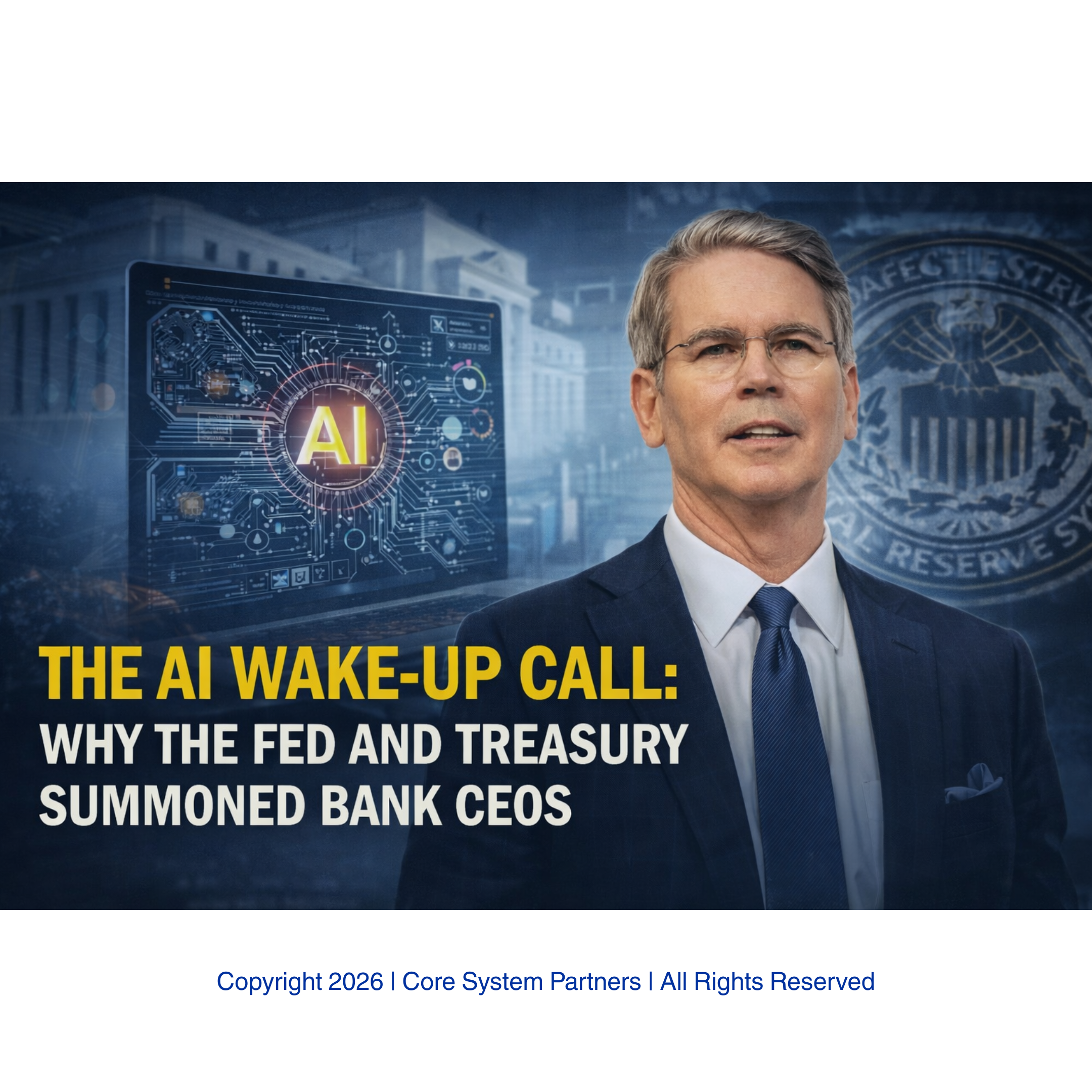
AI wake-up call in banking showing Federal Reserve context, bank executive and AI system highlighting regulatory and architectural risks
What an emergency AI briefing reveals about the architectural risks hiding inside today’s banking platforms
Last week, the Treasury and the Federal Reserve called an unscheduled, closed-door meeting with the CEOs of the largest banks in the country.
The topic wasn’t rates.
It wasn’t liquidity.
It wasn’t capital.
It was AI.
Let that sink in for a second.
The two institutions responsible for the stability of the financial system pulled bank CEOs into a room to talk about AI.
That’s not a trend. That’s a signal.
Our readers already know that we are halfway through our Architecture and AI series.
That series didn’t start last week. It’s the culmination of two years of conversations, client work, and a simple message we’ve been repeating over and over:
If your architecture isn’t ready, AI isn’t going to work the way you think it will.
Last week just reinforced that point in a way the entire industry can’t ignore.
This Is Not About Innovation. It’s About Exposure.
The trigger for the meeting was a new class of AI capabilities that can identify and exploit vulnerabilities across complex systems at a scale we haven’t seen before.
Not incremental improvement. Not better tools.
A step change.
Systems that can:
- uncover unknown vulnerabilities
- map dependencies across environments
- chain together exploit paths
- operate continuously
That matters for one reason.
Banks run on complexity.
Decades of systems layered on top of each other.
Legacy cores.
Integration after integration.
Data copied, transformed, and reused across domains.
Business logic scattered across platforms.
That complexity has always been there.
What’s changed is that it can now be understood at scale.
Most People Are Calling This a Cyber Story
It’s not.
Cybersecurity has traditionally been about defense.
Perimeters.
Access controls.
Monitoring.
Response.
What these new AI capabilities expose is something deeper.
They expose structure.
They show:
- where systems are tightly coupled
- where dependencies are hidden
- where data flows break down
- where controls are inconsistent
That’s architecture.
AI doesn’t create these issues. It reveals them.
And it does it faster than most organizations can react.
Take a Hard Look at the Typical Bank Stack
If you look at most banks today, the pattern is familiar.
A core system that has been in place for years.
An API layer added over time.
Multiple data stores supporting different functions.
Integrations built to solve specific problems at specific points in time.
Business rules embedded across systems instead of defined centrally.
None of this is unusual.
It’s how the industry evolved.
And for a long time, it worked.
Because complexity was hard to see.
That Assumption Is Gone
The operating model most banks rely on assumes:
- system behavior is partially opaque
- dependencies are not fully mapped
- vulnerabilities take time to uncover
Those assumptions don’t hold anymore.
AI collapses that gap.
What used to take months can now happen continuously.
What used to be hidden can now be mapped.
What used to be manageable becomes visible.
Two Forces Are Now Colliding
On one side, you have the upside of AI:
- automation
- efficiency
- improved decisioning
- new revenue opportunities
On the other side, you have the downside:
- increased visibility into system weaknesses
- faster discovery of vulnerabilities
- expanded attack surface
- rising regulatory scrutiny
Both forces are pointing to the same place.
Your architecture.
This Is the Conversation We’ve Been Having
This is exactly why we launched this series.
Not to talk about AI in isolation.
Not to speculate about use cases.
To focus on what sits underneath.
Because AI doesn’t sit on top of your bank.
It runs through it.
And when it does, it tests everything:
- your data
- your integrations
- your definitions
- your controls
- your operating model
That’s the part most conversations miss.
Structure Is Only Half the Problem
Most banks have spent years working on data structure.
Data models. Warehouses. Pipelines.
That’s necessary.
It’s not sufficient.
Because AI doesn’t just need data.
It needs context.
It needs to understand what that data means across the enterprise.
What is a customer across different lines of business.
What is an exposure across lending and treasury.
What defines a relationship versus a household versus a legal entity.
Most institutions don’t have a consistent answer to those questions.
They have multiple versions of the truth.
That’s where things start to break down.
We’ll go deeper on this in an upcoming article, because it’s one of the least understood and most important gaps we’re seeing.
Regulators Just Elevated the Conversation
An unscheduled meeting at this level is not about long-term strategy.
It’s about current risk.
No mandates were issued.
None were needed.
The message is implicit:
Understand your exposure.
Understand your systems.
Understand how AI changes the equation.
That’s not a technology exercise.
That’s a business and risk conversation.
The Questions That Matter Now
This is where leadership teams need to focus.
- Do we actually understand our system dependencies
- Can we trace data across domains
- Are our interfaces consistent and governed
- Can we isolate failures quickly
- Do we have shared definitions across the enterprise
If those answers are unclear, that’s not unusual.
But it is now a problem.
The Bottom Line
This is not a future scenario.
It’s not a pilot.
It’s not something you get to later.
AI is already changing how systems are analyzed, understood, and potentially exploited.
That shifts the conversation.
From:
What can we build
To:
What does our architecture look like under pressure
Because that’s where we are now.
Where to Go From Here
We’ll continue breaking this down in the remaining articles in the series.
If you want a clear view of where your institution stands today, explore the CSP Transformation Readiness Scorecard or reach out for a working session.
The gap between AI ambition and architectural reality is measurable.
And now, it matters more than ever.